

I’ve been training in Kyokushin for over 46 years now. In that time, I’ve belonged to just two organizations: the original IKO under Sosai Masutatsu Oyama, and later the IFK, which I joined two years after Sosai passed away.
That works out to 14 years in IKO and nearly 32 years in IFK.
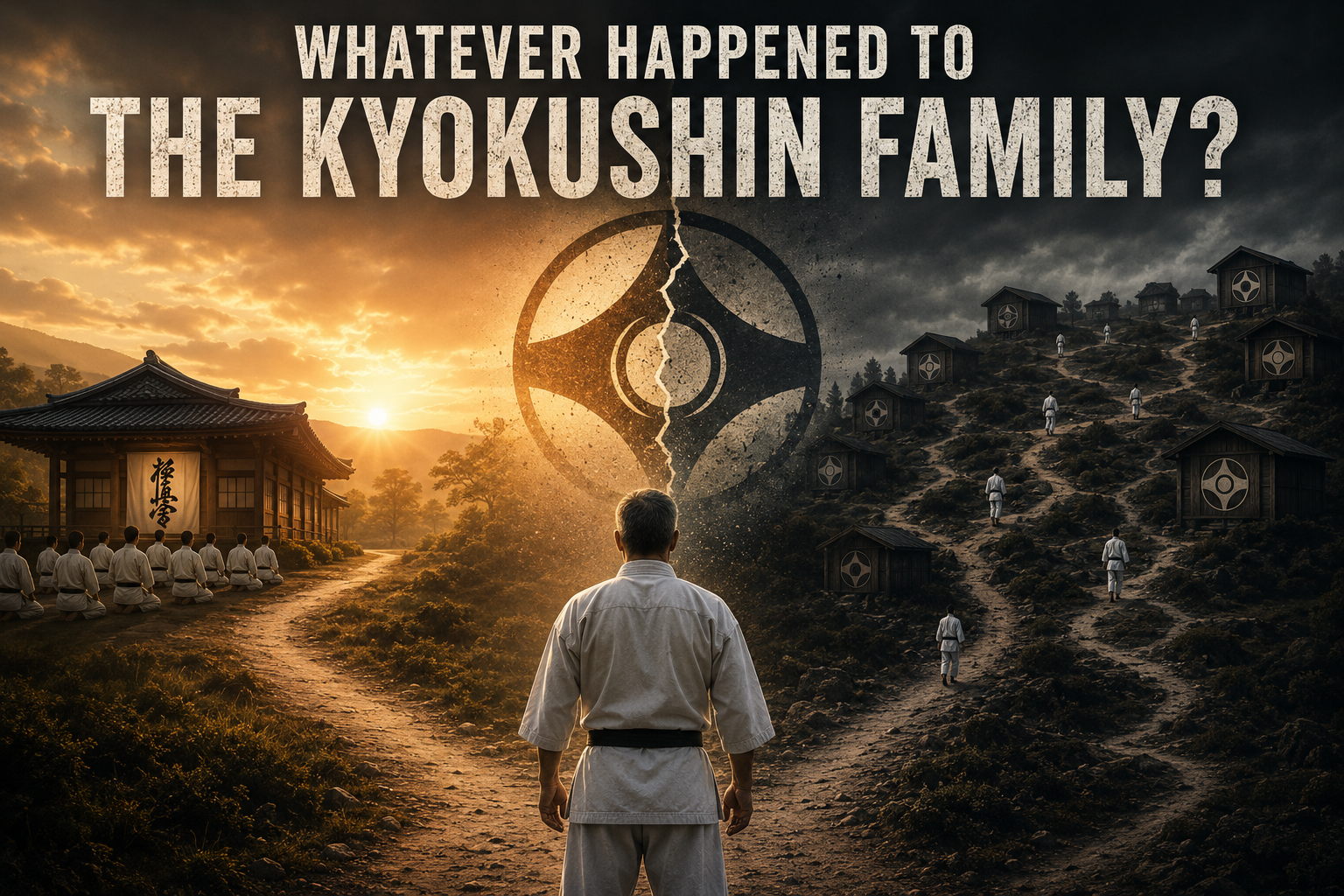
Over those decades, I’ve watched the Kyokushin world gradually fracture into countless organizations, groups, and factions. As I’ve gotten older, I sometimes find myself looking back to an earlier time, when regardless of nationality, branch, or dojo, we all largely considered ourselves part of one Kyokushin family.
Honestly, I miss that.
I suspect many older practitioners look back on those days with similar feelings.
There were disagreements, politics, strong personalities, and organizational struggles back then too.
But there was also a stronger sense that we were all part of something larger than ourselves.
Today, it often feels as though fragmentation itself has become normalized. Over time, the larger Kyokushin community has gradually divided into smaller organizations and separate circles, each increasingly isolated from one another.
To be fair, the fragmentation of Kyokushin did not happen entirely without reason. Over the years, different organizations have emphasized different things, and some of that evolution has undoubtedly helped Kyokushin grow and reach new people.
There are also many people in other organizations whom I respect greatly. After nearly half a century in Kyokushin, I’ve learned that good people, dedicated karateka, and capable instructors can be found in many different places.
At the same time, I think we also need to honestly acknowledge that continual division comes with consequences. Whether intentionally or not, fragmentation has made the Kyokushin community increasingly separated and isolated from itself.
One place this becomes especially visible is in tournaments. Many promoters today struggle to build the kind of large knockdown divisions that were once far more common. Fighters, dojo, and organizations are now spread across countless groups, each operating largely within their own circles.
The result is that even though there may still be many karateka training worldwide, the larger Kyokushin community often feels smaller, more divided, and less connected than it once did.
After nearly half a century in Kyokushin, I’ve learned something important:
No organization is perfect.
Every organization will eventually have frustrations, disagreements, personalities, and things we may not like. That is simply part of people trying to work together over long periods of time.
The question is not whether an organization is perfect.
The question is whether we still believe in the larger purpose behind it.
Before moving back to the United States from Guam in 2021, I spent quite a bit of time looking at the various Kyokushin organizations that existed in the U.S. I had been largely absent from the American Kyokushin scene for nearly 20 years after returning to active military service following 9/11 in 2001.
During those years, life and military service took me to Bahrain, Japan, Afghanistan, the Philippines, Guam, and several other places along the way. Like many people whose lives take unexpected turns, my connection to organized Kyokushin became more distant over time, even though Kyokushin itself never completely left me.
When I eventually returned to the United States, I was naturally curious about what had changed over the years and where I might best fit moving forward.
In the end, nothing really pulled me strongly in another direction.
That summer, I attended USA-IFK Summer Camp and reconnected with many people I had known for years. After spending time with everyone again, I came to a fairly simple realization:
I didn’t really have any compelling reason to leave.
Technically, my IFK membership had always remained a lifetime membership anyway. More importantly, after reconnecting with everyone, I realized the things that mattered most to me in Kyokushin were already there:
the relationships,
the shared history,
the training,
the standards,
and the sense of continuity.
Over enough years, you begin to realize how much those things matter. Most major organizations have capable instructors, dedicated karateka, and people sincerely trying to preserve and pass on what they believe in. But after enough time, the relationships we build and the people we share the journey with often become the things that matter most.
The grass is always greener somewhere else.
Until you get there.
Strong organizations are not built simply through talent or ambition. They are built through people who continue contributing even when things are imperfect. People who believe in something larger than themselves. People willing to work together to create opportunities not only for themselves, but for future generations of students.
As instructors, we also have a responsibility to think beyond ourselves. Before changing organizations, we should carefully consider not only what may benefit us personally in the moment, but what will best serve our students — both current and future. The opportunities available to students are shaped by the stability, relationships, events, standards, and long-term strength of the organizations surrounding them.
The camps.
The tournaments.
The seminars.
The friendships.
The international relationships.
The sense of community.
These things do not happen automatically.
They exist because people choose to support and strengthen the organizations around them instead of constantly pulling apart from one another.
That does not mean organizations should never improve or that people should blindly follow leadership without question. Honest discussion and constructive criticism are necessary for growth. But I do believe people should think carefully before contributing further to the endless cycle of fragmentation that has affected Kyokushin for decades.
Every time another organization splinters away, something is lost.
Not only numbers, but unity.
And while we can never fully return to the days when Kyokushin was one organization under Sosai, I still believe we should resist the temptation to divide unnecessarily whenever possible.
Kyokushin was supposed to bring people together through hard training, shared struggle, and mutual respect.
It was supposed to be about becoming better people through training together, pushing ourselves, and supporting something larger than ourselves.
Perhaps that is something worth remembering.
Osu.
Connect with me:
Follow Kyokushin Karate Blog on Facebook, Instagram, and X.
Be sure to visit Kyokushinkai Karate, our Facebook group — one of the largest and most dedicated Kyokushin communities online.
Learn more about Bill Stewart and Texas Kyokushin Karate, where we continue the Kyokushin tradition in Texas. Follow Kyokushin Karate Blog on Facebook, Instagram, and X.
Learn more about Bill Stewart and Texas Kyokushin Karate, where we continue the Kyokushin tradition in Texas.
