
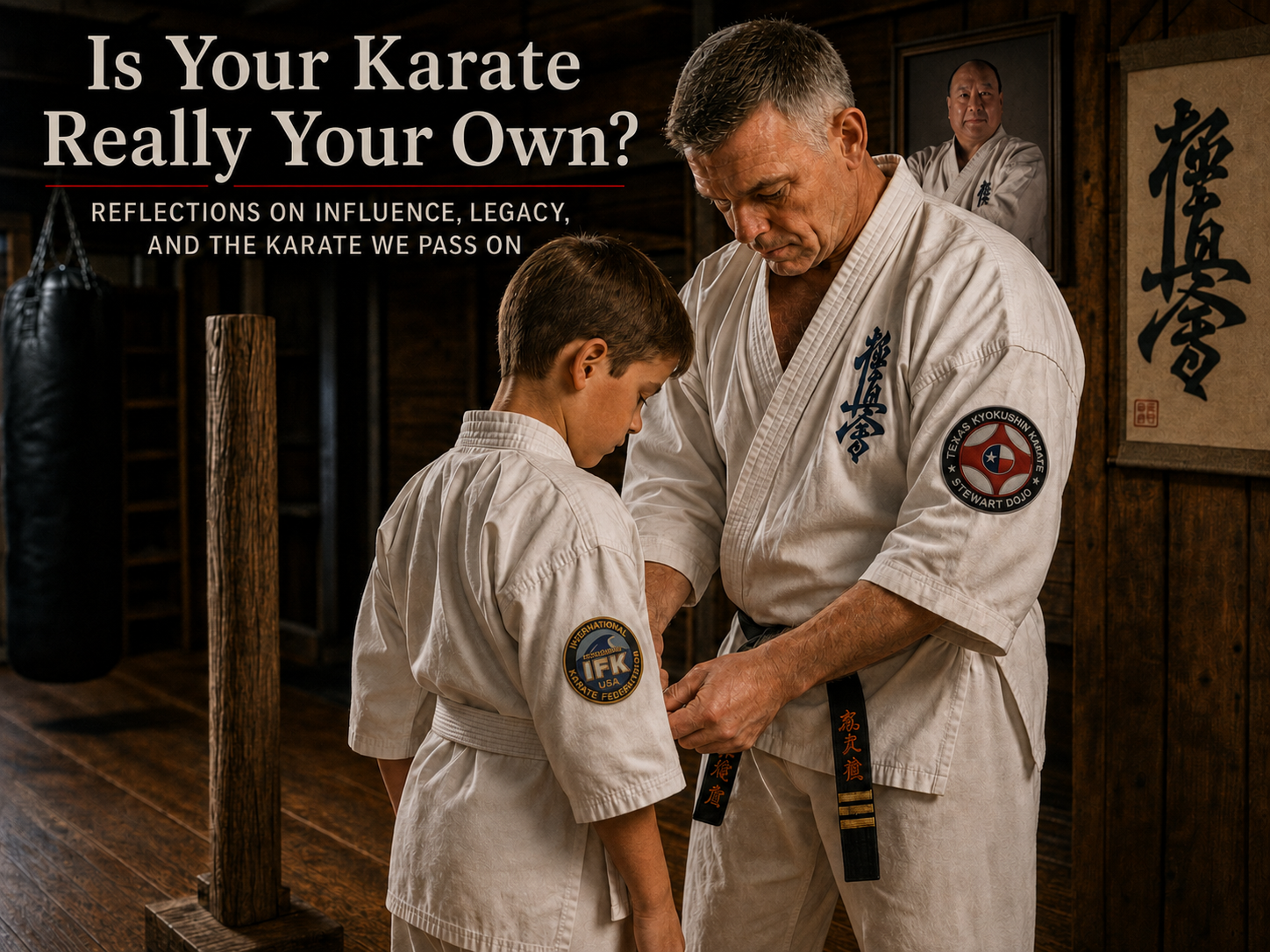

One of the things I’ve come to appreciate after more than four decades in Kyokushin is how much of our karate belongs to the people who taught us. Every experienced instructor eventually develops a teaching style that reflects their own personality, experiences, and understanding of the art. No two instructors teach exactly alike. Yet none of us begins with a blank slate.
Long before we ever stand at the front of a dojo, our own teachers have already shaped the way we think about karate. Their influence can still be seen in what we notice, what we emphasize, what we choose to correct, and even what we believe is most important for our students to learn. Those influences don’t disappear as we gain experience. If anything, they become so deeply ingrained that we can sometimes forget where they came from.
The longer I’ve taught, the more I’ve realized that none of us simply inherits techniques. We inherit habits of thought, priorities, and ways of solving problems, explaining concepts, and evaluating good karate. Over time, those lessons become so much a part of who we are that they no longer feel borrowed. They simply become our karate. That doesn’t mean we remain exactly like our first instructor.
I sometimes tell the story of bursting out laughing while sparring with Shihan Swanson. We attacked with identical techniques and, without thinking, flowed into exactly the same counter at the same moment. He looked at me with obvious annoyance while I struggled to regain my composure. It was one of those rare moments when I realized just how much of his karate had become my own.
Throughout our lives we continue learning from seminars, camps, competitions, training partners, and other teachers we meet along the way. We refine our understanding, adopt new ideas, and sometimes abandon approaches that no longer make sense to us. Our karate evolves. As it should. But those early influences rarely disappear. More often, they become the foundation upon which everything else is built.
Looking back, I can see those layers quite clearly in my own teaching. The standardized methodology I’ve adopted through the IFK has influenced how I organize classes and present the curriculum. Decades of experience have deepened my understanding of many techniques and concepts. Yet beneath all of that, I can still see my own teacher. His emphasis on movement, timing, distancing, and learning to think while fighting didn’t disappear because I adopted a different syllabus. Those lessons became part of how I understand karate itself.
Perhaps that’s inevitable. Every generation of instructors becomes a bridge between the teachers who came before them and the students who will follow. We pass on the techniques we were taught, but we also pass on the values, priorities, and philosophy that shaped us, often without realizing we’re doing it.
Recently I wrote about watching one of my students working with a beginner and how much he reminded me of myself as a much younger instructor. Looking a little closer, however, I realized I could also see a small piece of my own teacher in him.
That may be one of the greatest gifts a teacher ever receives. Years later, you watch one of your own students teach and recognize something familiar. It may be a correction, the way they explain a concept, or simply the way they move around the dojo. You realize they aren’t consciously copying you any more than you consciously copied your own teacher. Those lessons have simply become part of who they are.
Shihan Swanson passed away over a decade ago, yet rarely does a day go by that I don’t find myself thinking about him. Such was the influence he had on my life. I suspect many of us eventually reach that point with our own teachers. We begin by trying to learn from them. Years later, we realize just how much of them we’ve been carrying with us all along.
In that sense, perhaps good teachers never really disappear from the dojo.
Osu!
If this article resonated with you, I’d be interested in hearing your thoughts. Leave a comment below and share how your own teachers have influenced the way you train or teach. And if you enjoy articles like this, subscribe to Kyokushin Karate Blog so you don’t miss future posts.
Follow Kyokushin Karate Blog on Facebook, Instagram, and X.
Be sure to visit Kyokushinkai Karate, our Facebook group — one of the largest Kyokushin communities online today.
Learn more about Bill Stewart and Texas Kyokushin Karate, where we continue the Kyokushin tradition in Texas.
