

Over my years in Kyokushin, I’ve had many conversations about Zen and its place in martial arts. Some people see Zen primarily as a religion, or assume that practicing meditation means adopting a religious belief system. I’ve never approached it that way. For me, Zen has always been more discipline than doctrine—a way of paying attention rather than something to believe in.
Zen as Practice
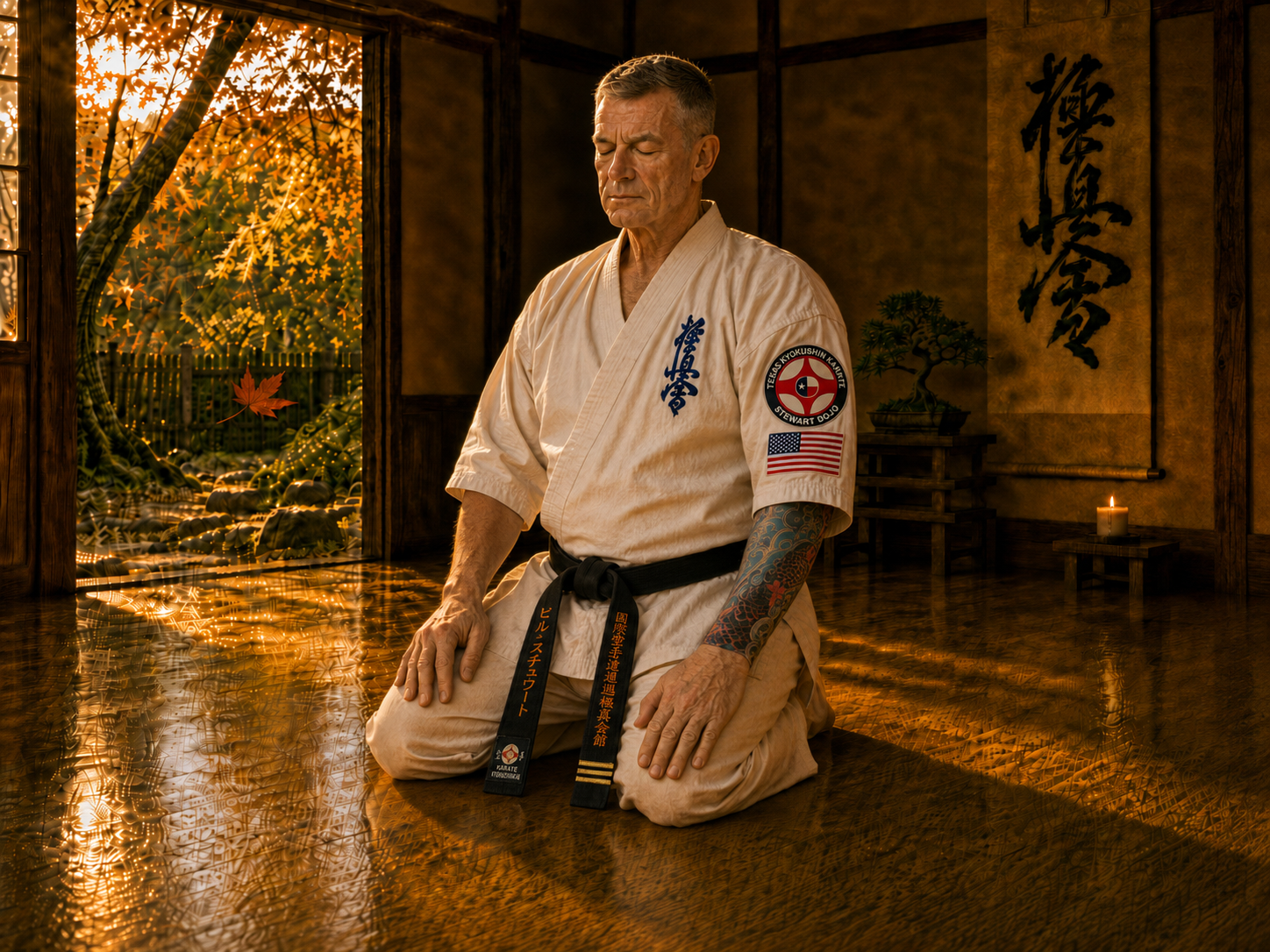
My introduction to Zen meditation came through my first karate teacher. The way he taught it was simple: sit in seiza with a straight spine, remain completely still, and focus your attention on the physical sensation of the breath. Thoughts will arise—they always do. When they do, let them go and return your attention to the breath.
The practice is simple. That doesn’t mean it’s easy. Sit quietly for very long and you quickly discover just how unwilling the mind is to stay where you put it. Something that happened yesterday appears. Then something you need to do tomorrow. An old conversation comes back. You start solving a problem that didn’t seem important five minutes earlier. Eventually you notice what happened and return to the breath. Then you do it again.
That repeated act of noticing and returning has probably been one of the most useful things meditation has taught me. There are different approaches to zazen. I don’t pretend to have studied formally under a Zen teacher. My own practice has generally involved attention to the breath. What has mattered to me is learning to notice where my mind has gone and bringing it back to what is actually happening.
Over time, that begins to carry beyond meditation. Most of us spend a great deal of time replaying the past or projecting ourselves into the future—rehashing conversations, worrying about outcomes, becoming angry again about something that already happened, or anticipating things that may never happen at all. Meditation has helped me recognize when I’m doing that. It has also helped me recognize when I’m annoyed, angry, or simply reacting emotionally. I don’t always succeed in doing something useful with that awareness. Anyone who knows me well could probably confirm that. But when I’m training and meditating regularly, I’m generally calmer and more aware of what is going on inside my own head.
I’ve sometimes thought of kata as a moving form of meditation. The circumstances are obviously different from sitting zazen, but there is something similar in the kind of concentration involved. When I’m truly absorbed in a kata, I’m not consciously thinking about which movement comes next. I’m simply moving from one moment into the next, and the kata seems to flow out on its own. For those few minutes, whatever else may have been occupying my mind tends to fall away.
Mushin: The Mind Isn’t Empty
That practical side of Zen has always interested me far more than anything mystical. One Zen concept that has always made particular sense to me in martial arts is mushin, usually translated as “no mind.” That translation can make it sound considerably more mysterious than it needs to be. I don’t take mushin to mean that the mind somehow shuts off or that you literally have no thoughts. In martial arts, I understand it more as a state where conscious thought, hesitation, anxiety, or anticipation no longer interfere with what you need to do.
Years ago, someone asked me what I would do if he threw a punch at me. I smiled and said, “Throw the punch and find out.” There really wasn’t any other honest answer. Is the punch coming at my face or my body? Is it his lead hand or rear hand? Is it straight or hooking? What is the distance? How fast is he moving? Is he stepping toward me as he throws it? Until he actually throws the punch, how can I know what I’m going to do?
Training gives us techniques and teaches us responses, but fighting isn’t a script. Beginners have to learn in terms of, “If he does this, I do that.” There’s nothing wrong with that. We all have to start somewhere. Eventually, though, there are simply too many variables. You can’t consciously sort through a catalog of techniques every time someone moves, and you can’t decide beforehand what the correct response will be and then expect reality to cooperate.
Takuan Sōhō was a seventeenth-century Zen monk who wrote about the relationship between Zen and swordsmanship. In a letter to the swordsman Yagyū Munenori, later published as The Mysterious Record of Immovable Wisdom and included in the collection The Unfettered Mind, he used the image of looking at a tree. If your attention becomes completely fixed on one red leaf, he wrote, you lose sight of the rest of the tree. His point wasn’t that you shouldn’t see the leaf, but that the mind shouldn’t become stuck there. In martial arts, that leaf might be the opponent’s fist, the technique you intend to use, your concern about getting hit, or even something that happened a moment earlier. The problem isn’t that you noticed it. The problem is that you stopped seeing everything else. That is a useful way of thinking about mushin. The mind isn’t empty. It simply isn’t stuck.
Years later, when I was training for knockdown competition, I experienced something that gave me a much more practical understanding of the same idea. We trained on wrestling mats at the time, and Sensei Swanson had me work inside a small circle on the mat. For a month or so, I sparred the members of his regular class, who were primarily beginners and intermediate students. I wasn’t allowed to leave that small circle, and I wasn’t allowed to attack or counter. All I could do was move.
Someone attacked and I had to deal with whatever came without fighting back and without stepping outside that little circle. Round after round, class after class, that was the exercise. Eventually Sensei brought in the advanced students—the brown and black belts who primarily trained in another class at another location.
My first match was with a brown belt. He moved, I moved, and then we both stopped. He started looking around, trying to figure out where I had gone, until one of the black belts watching pointed behind him. That was where I was standing. I hadn’t consciously decided to move behind him. I hadn’t thought through a sequence of movements or selected a technique. After weeks of doing little more than watching people move toward me and learning to move in response, I simply did what the situation called for. To me, that is about as practical an example of mushin as I can give. My mind wasn’t blank. I was aware of what he was doing. But there was no internal discussion about what I should do next. He moved, and I moved.
I didn’t stop in the middle of that exchange and think about mushin. The understanding came later, when I thought about what had happened and why. That may be another part of the process that sometimes gets overlooked. Mas Oyama’s seventh motto says, “In the Martial Arts, introspection begets wisdom. Always see contemplation on your actions as an opportunity to improve.” That idea has always made sense to me. Training gives us experiences, but experience by itself doesn’t guarantee that we learn everything it has to teach us. We still have to look back honestly at what happened—what worked, what didn’t, how we reacted, and why. Sometimes the lesson is technical. Sometimes it has more to do with anxiety, frustration, impatience, or ego.
In that sense, introspection and mushin are not really opposites. During the moment, there may be no time for conscious analysis. Afterward, there is every reason to think carefully about what happened. One is about not allowing thought to interfere with action when action is required. The other is about using thought afterward to understand the experience and improve.
That is also one of the places where meditation and martial arts seem to overlap. In meditation, I notice that my mind has wandered and bring it back to what is happening now. In kata, when everything is working well, I’m not consciously reaching for the next movement; the form simply unfolds from one moment into the next. In kumite, I have to deal with whatever is actually happening in front of me. Later, I can reflect on what happened and perhaps understand something I didn’t see clearly in the moment.
I don’t claim any formal standing in Zen. I’ve never trained in a Zen temple or belonged to a formal Zen school. My understanding began with my first karate teacher introducing me to meditation, followed by many conversations with him and decades of reading and self-study. We both tended to dig beneath technique and ask why something mattered rather than simply accepting it because someone said it did.
What I do know is that sitting quietly, paying attention to the breath, training, and trying to become more aware of my own reactions have had an effect on me. When I’m doing those things regularly, I’m generally calmer. Sometimes that awareness comes while sitting quietly, sometimes during kata, and sometimes during kumite, when someone moves and there simply isn’t time to think.
Mas Oyama expressed the connection between karate and Zen this way:
“Karate is the most Zen-like of all the Martial Arts. It has abandoned the sword. This means that it transcends the idea of winning and losing to become a way of thinking and living…”
For me, that connection doesn’t require anything mystical. It is found in learning to pay attention, in noticing when the mind has wandered and bringing it back, in responding to what is actually happening rather than what we expected to happen, and afterward being willing to look honestly at our own actions and learn from them. Maybe that is what I have taken most from Zen. Whether that awareness comes through sitting meditation, kata, kumite, or reflection afterward, the lesson has been much the same: pay attention to what is actually happening, and learn from it.
Osu!
Follow Kyokushin Karate Blog on Facebook, Instagram, and X.
Be sure to visit Kyokushinkai Karate, our Facebook group — one of the largest Kyokushin communities online today.
Learn more about Bill Stewart and Texas Kyokushin Karate, where we continue the Kyokushin tradition in Texas.
