

I wasn’t diagnosed with ADHD until I was in my 60s. I had gone back to college and was struggling more than I expected. After watching a documentary about ADHD, I recognized many of the symptoms in myself and made an appointment to be evaluated. When my doctor and I talked about it, he said I had almost certainly had it since childhood. That raised an obvious question. If I’d had ADHD all those years, how had I managed to get through school, a military career, and everything else without anyone recognizing it?
His answer was that I had probably learned ways to compensate for it. One thing he specifically mentioned was the amount of structure in my life. The military certainly provided that, but so did martial arts. I’ve been training in Kyokushin since 1980, and when I started thinking about it from that perspective, it made sense. In his evaluation, he also noted that I may have been “self-medicating with copious amounts of caffeine.” Caffeine isn’t normally thought of as a treatment for ADHD, but stimulants commonly are, so in that respect it makes a bit of sense.
Looking back, there were probably signs that nobody thought much about at the time. When I was a white belt, Sensei Jim Swanson used to threaten to bring a brick to class and make me hold it in my right hand so I could remember my left from my right. 😄 Of course, with practice I eventually got past that, but at the time it became something of a running joke. Nobody was thinking about ADHD or working memory. I was simply the student who occasionally needed a little extra help remembering which direction I was supposed to turn.
Recently I came across a 2025 paper that made me think about that conversation with my doctor again. Martial Arts and ADHD: A Narrative Review of Cognitive, Behavioral, and Epigenetic Effects reviewed eleven peer-reviewed studies involving taekwondo, judo, karate, kung fu, tai chi, and qigong. The authors found evidence indicating that martial arts training can offer benefits for some people with ADHD, including improvements in attention, working memory, inhibitory control, and self-regulation.
That doesn’t mean martial arts should replace medication, cognitive behavioral therapy, or other treatment recommended by a doctor. At the same time, the fact that research indicates martial arts can be helpful shouldn’t be ignored either. For parents looking for activities for a child with ADHD, there are legitimate reasons to consider martial arts that go beyond simply providing exercise. What interested me most about the paper was how closely many of the things the researchers identified line up with what we have always done in a traditional dojo.
The Structure of Traditional Karate
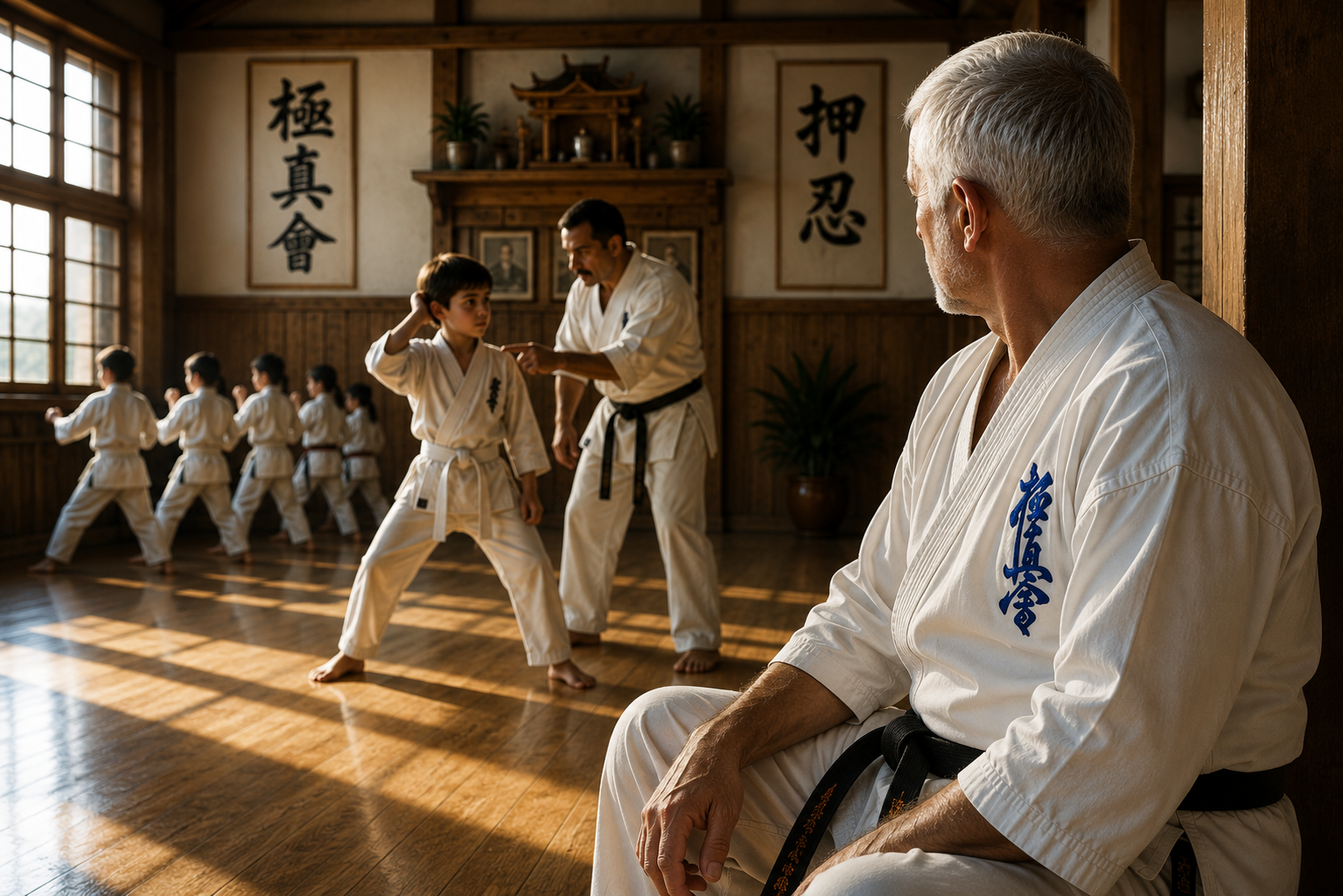
Traditional karate is structured almost from the moment you walk through the door. There is a way we line up, commands we follow, techniques learned in a progression, and expectations about how students behave. Students are expected to pay attention, wait their turn, respond when called on, and control what they are doing. That probably seems completely normal to anyone who has spent years training, and much of it is simply part of learning anything new. Every student needs repetition. Students forget things, and beginners get confused at times. A student with ADHD may struggle more with some aspects of attention, remembering a sequence, or controlling an immediate response, but I wouldn’t look at a student having trouble with a kata and conclude that ADHD has anything to do with it.
Teaching has probably made me more conscious of how differently people learn. Some students pick something up quickly, and others take longer. Sometimes a different explanation works, sometimes breaking something into smaller pieces helps, and sometimes they simply need more repetitions. That’s teaching. What I hadn’t really considered until reading this research was that the structure already built into traditional karate may also provide repeated practice in some of the areas that can be difficult for a person with ADHD.
During kihon, for example, you don’t simply do what you feel like doing. You listen for the command, perform the technique, stop, listen to the correction, and repeat it. I’ve always considered repetition one of the strengths of traditional karate. We aren’t repeating techniques because we couldn’t think of anything new to do. We’re trying to take something that initially requires a great deal of thought and gradually make it natural.
Think about a beginner performing gedan barai. They may be trying to remember the stance, the chamber, the position of the blocking arm, the hikite, the hips, the direction of the technique, and whatever correction the instructor just gave them. Then we ask them to do it again. Eventually, it becomes easier, so we add movement, combinations, and changes in direction or speed. The demands change as the student develops.
For someone with ADHD, there may be another layer to that process. The student is repeatedly asked to focus on a specific task, listen to instructions, remember a correction, and apply it in the next repetition.
Kata and Working Memory
Kata adds another kind of mental demand. Anyone who has taught beginners knows how difficult even a relatively simple kata can be when someone first learns it. The student has to remember which direction to turn, which technique comes next, which stance to use, and what each hand is doing. About the time they finally remember the sequence, we start correcting how they are performing the techniques.
As students progress, the demands increase. They aren’t simply trying to remember where to turn anymore. They are working on timing, rhythm, breathing, balance, focus, and technical execution while still keeping track of where they are in the kata.
In that sense, kata is memory in motion. It combines sequencing, spatial awareness, concentration, and physical coordination. We normally think about those demands in terms of learning karate, but reading the ADHD research made me look at them a little differently. It also made Sensei Swanson’s threatened brick seem a little more relevant forty-some years later. 😄
Kumite and Learning to Respond
Kumite adds another person to the equation, and that person isn’t necessarily going to do what you expect. Now you have to watch, judge distance, recognize openings, make decisions, and control your response.
That distinction between responding and simply reacting is important. A fighter who reacts to every feint is easy to control. Someone who becomes frustrated or angry generally starts making poor decisions. With experience, we learn to recognize what is happening without allowing every movement or emotion to dictate what we do next.
I’ve written before about the value of pressure in training. Kumite gives us a controlled environment where we have to make decisions while physically tired and under stress. It isn’t the same as real violence, but it does force us to function when everything isn’t comfortable or predictable. Attention, impulse control, decision-making, and emotional regulation are all involved, even though we normally think of them simply as part of becoming better at kumite.
What the Research Found
The review describes martial arts as combining physical movement with cognitive engagement, emotional regulation, motor coordination, strategic thinking and social interaction. Unlike activities such as running or cycling, martial arts frequently require sequenced movement, sustained attention, and decisions made in real time. The authors describe martial arts as a form of “ecologically valid cognitive training,” which is an academic way of describing mental skills being exercised while dealing with an actual changing task.
One of the stronger studies reviewed followed 40 adolescents with ADHD through an 18-month taekwondo program. The researchers reported improvements in selective attention, sustained attention, and inhibitory control. Another study involving 57 children found improvements in visuospatial working memory after twelve weeks of judo training, along with changes in an EEG measure associated with working-memory capacity. The review also cites a network meta-analysis of 31 randomized controlled trials in which martial arts ranked among the more effective forms of physical exercise for improving executive functions in children and adolescents with ADHD.
Not every study showed the same level of improvement, and the authors are careful about that. They point out that many of the studies involved relatively small groups, different martial arts, different training programs, and limited long-term follow-up. The evidence is encouraging, but there is still a great deal we don’t know about which types of training work best, which students are most likely to benefit, and what happens after years rather than weeks or months of training.
I don’t see those limitations as a reason to dismiss the findings. They simply tell us that the research is still developing. For parents of a child with ADHD, I think that distinction matters. Research indicates that martial arts training can offer benefits for some people with ADHD. That doesn’t mean every child will respond the same way, and it doesn’t make karate a replacement for appropriate medical care. Coupled with approaches such as cognitive behavioral therapy or medication supervised by a doctor, there are indications that structured martial arts training can be another useful part of the picture.
Looking Back
When I started Kyokushin in 1980, ADHD wasn’t something anyone in the dojo talked about. I wasn’t training because someone thought karate would help me concentrate. I was training because I wanted to learn karate.
Looking back, though, I can see how much of my life involved external structure. The Navy gave me structure, and Kyokushin gave me structure. In the dojo, there was always something specific I was supposed to be doing. There was a technique to work on, a kata to learn, a correction to make, or someone standing in front of me who demanded my attention.
Teaching has given me another perspective on that. I don’t look at students and try to decide who does or doesn’t have ADHD, nor would I be qualified to do that. What I do see is students learning within the same kind of structure that I did. They listen, repeat, make mistakes, receive corrections, and try again. For students who happen to struggle with attention or impulse control, the research suggests that process can offer benefits beyond simply getting better at karate.
Maybe it helped me. I can’t prove that it did, and neither can this research. But after reading the paper, the idea my doctor raised doesn’t seem quite as speculative as it did when we first talked about it. We spend a lot of time talking about what karate teaches us physically, and naturally that’s where most of our attention goes. After more than four decades of training, though, I increasingly find myself thinking about some of the things karate may have taught me without my realizing I was learning them. For someone who had difficulty maintaining attention, the dojo demanded attention. For someone who could be impulsive, it demanded control. It provided structure, repetition, and constant feedback, and it required me to keep working at things that didn’t necessarily come easily. I didn’t know I had ADHD when I walked into a Kyokushin dojo in 1980. I’m beginning to wonder how much the dojo may have been helping me all along.
Osu!
Follow Kyokushin Karate Blog on Facebook, Instagram, and X.
Be sure to visit Kyokushinkai Karate, our Facebook group — one of the largest Kyokushin communities online today.
Learn more about Bill Stewart and Texas Kyokushin Karate, where we continue the Kyokushin tradition in Texas.
Reference:
Costanza, C., Colecchia, F. P., Polito, R., Monda, M., Carotenuto, M., Messina, G., Monda, A., Mancini, N., Moscatelli, F., Bargiacchi, G., & Ruberto, M. (2025). Martial Arts and ADHD: A Narrative Review of Cognitive, Behavioral, and Epigenetic Effects. Physical Education Theory and Methodology, 25(3), 684–690. https://doi.org/10.17309/tmfv.2025.3.26
Costanza, C., Colecchia, F. P., Polito, R., Monda, M., Carotenuto, M., Messina, G., Monda, A., Mancini, N., Moscatelli, F., Bargiacchi, G., & Ruberto, M. (2025). Martial Arts and ADHD: A Narrative Review of Cognitive, Behavioral, and Epigenetic Effects. Physical Education Theory and Methodology, 25(3), 684–690. https://doi.org/10.17309/tmfv.2025.3.26
