

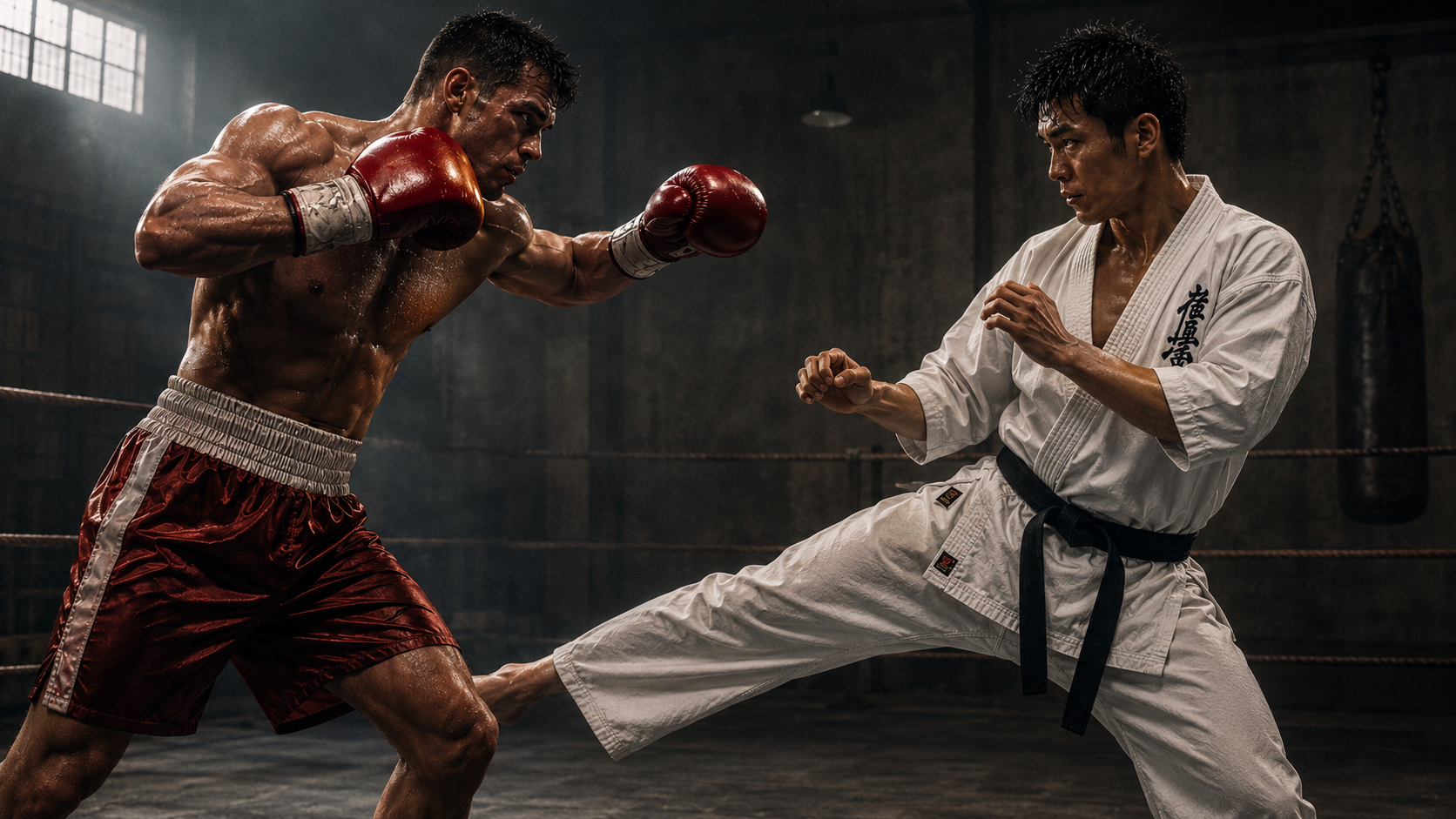

A boxer will always win against a Kyokushin Fighter. What? You didn’t know this? We hear it on the internet all the time, so it must be true, right?
This isn’t the first time I’ve written on this subject, probably because every time I turn around, some keyboard warrior is talking about how unrealistic Kyokushin is because “we don’t punch to the face.” They often go on to state that an average boxer would quickly knock out a Kyokushin fighter. I’ve nothing against boxers. Boxing is an effective fighting style, and good boxers develop excellent timing, footwork, distance, head movement, and, obviously, punching ability.
Put someone who has never had to deal with punches to the head in front of a competent boxer, and that can become a very serious problem very quickly. But an average boxer will automatically win against a Kyokushin fighter simply because Kyokushin competition doesn’t allow punches to the face?
Really?
What Exactly Do We Mean by “Realistic”?
“Realistic” is one of those words people like to throw around when discussing martial arts, usually without stopping to define what they mean. If we’re talking about sport competition, neither boxing nor Kyokushin is a street fight. Both operate under rules designed to allow people to train and compete repeatedly without causing unnecessary injury. Kyokushin tournament rules do not allow punches to the face. That is a limitation, and pretending otherwise doesn’t help anyone. Training and competing under any ruleset will create habits based upon what is and isn’t allowed. If we’re going to use realism as the standard, however, we should probably apply that standard equally. A boxer enters the ring with his hands wrapped and padded gloves covering them. Those gloves don’t just protect the person being punched. They also protect the boxer’s hands and allow him to repeatedly strike the skull with considerably less concern about breaking them.
We’ve all heard stories of professional boxers getting into fights outside the ring and breaking a hand after landing a punch. There is a reason for that. The human hand contains a lot of small bones, while the human skull is considerably harder. So if someone wants to argue that Kyokushin is unrealistic because we don’t punch to the face in competition, it seems fair to ask how realistic it is to assume you’ll have time to wrap your hands and put on boxing gloves before a fight.
The Kyokushin Knockdown Ruleset Is Really What Is Being Criticized
The more legitimate criticism is not really that Kyokushin fighters somehow don’t know how to punch to the head. It is that the knockdown ruleset can encourage habits that become dangerous if those rules are suddenly removed. Knockdown fights are often contested at very close range, with both fighters standing in the pocket and concentrating on body punches, low kicks, knees and other permitted attacks. At that range a fighter may very well drop his hands while exchanging punches to the body because, under knockdown rules, he doesn’t have to worry about a fist suddenly coming straight into his face or the side of his head.
That criticism is valid. We often say that we fight the way we train, and there is truth in that. If someone repeatedly trains to stand at close range with his hands low because punches to the head are prohibited, there is always a danger that the same habit will appear when the rules are no longer there to protect him. That is why I can be an advocate of knockdown competition and still believe that realistic training has to include more than knockdown fighting. From time to time, we should put on gloves and practice striking to the head and face under controlled conditions. We should practice defending those attacks as well, maintaining a guard and moving in ways that make sense when the head is once again a target. Knockdown competition has enormous value, but it is a ruleset. It should not necessarily be the totality of a Kyokushin student’s fighting education.
What Kyokushin Knockdown Gets Right
At the same time, one of the things I value about knockdown fighting is the fact that we fight bare-knuckle. If we’re going to talk about realism, I think that matters. Learning to strike a resisting opponent with an unprotected fist teaches lessons that punching with wrapped and gloved hands cannot. You learn what it feels like to make contact with your bare knuckles. Proper fist formation and wrist alignment matter. Target selection matters. A poorly delivered punch can injure the person throwing it just as easily as the person receiving it.
That is a very real consideration outside the ring. Boxing gloves allow a fighter to strike with a degree of hand protection that will not exist in an unexpected physical confrontation. They make it possible to repeatedly punch the head with force while greatly reducing the risk to the hands. That is useful for boxing competition, but it is also an artificial protection created by the ruleset. So if we’re going to say that Kyokushin is unrealistic because it removes punches to the face, it seems only fair to acknowledge that boxing introduces its own form of unreality by wrapping and heavily padding the hands. Neither approach is perfectly realistic. Each preserves some elements of fighting and removes others.
Every Ruleset Creates Habits
Competition rules shape the way people fight. Kyokushin fighters can develop habits around the fact that punches to the head are prohibited. Boxers develop habits around the fact that kicks, knees and many other attacks do not exist within their rules. A boxer doesn’t have to worry about someone kicking his thigh, throwing a roundhouse kick to the ribs or head, or driving a knee into his body. He doesn’t have to deal with attacks coming from a completely different range using weapons that don’t exist within boxing competition. That doesn’t make boxing ineffective. It simply means boxing develops a fighter extremely well for the problems boxing is designed to solve, just as Kyokushin develops fighters for the problems created by its own ruleset.
Put a Kyokushin fighter into a boxing match and the boxer should have an enormous advantage. That’s hardly surprising. He’s fighting under his rules, at the distances he trains every day, and he is free to attack the very target that critics say Kyokushin fighters are least prepared to defend. Put that same boxer into a Kyokushin knockdown match and the advantage swings the other way. Not only does he suddenly have to deal with low kicks, body kicks, head kicks and knees, but punches to the face — the weapon supposedly giving him such an overwhelming advantage — have been taken away from him. His stance may expose his lead leg in ways he has never had to consider, and his familiar combinations have to be adapted to a ruleset in which one of boxing’s most important targets is no longer available.
Of course, the obvious response is that punches to the face are not prohibited in a real fight. That’s true, and it is exactly why I believe Kyokushin practitioners should train to deal with them. But once we leave sport competition and start talking about a “real fight,” neither fighter gets to carry his preferred ruleset with him. In a real confrontation, nobody is going to stop the action because someone punched to the face. Nobody is going to stop it because someone grabbed the other person, attacked the groin or tried to gouge an eye either.
Neither boxing nor Kyokushin competition allows everything that might occur in an actual fight. Once we start using “anything can happen” as our standard for realism, both sports immediately become incomplete representations of fighting. A real confrontation does not suddenly become a boxing match simply because punches to the face are allowed.
What Happens When the Rules Disappear?
This is where the comparison becomes much more interesting. If we’re no longer talking about a boxing match or a Kyokushin tournament, then both fighters suddenly have to deal with things that their competition rules normally remove. The boxer gets to punch the Kyokushin fighter in the face, and that is unquestionably a serious weapon. The Kyokushin fighter, however, is still able to kick the legs, body and head, use knees and attack from ranges that don’t exist in boxing. Neither fighter has a referee enforcing the familiar limitations of his sport.
But, the boxer no longer has wrapped and padded hands protecting him. If realism is the standard, that matters too. The same punch to the skull that is routine with a wrapped and gloved hand may have very different consequences when thrown bare-knuckle. None of that guarantees that the Kyokushin fighter wins. It simply means the prediction becomes considerably more complicated than “boxer punches him in the face, fight over.”
The Boxer Has Problems Too
Imagine that average boxer facing a competent Kyokushin fighter outside the boxing ring. The boxer certainly has dangerous hands, and nobody sensible should dismiss that. If the Kyokushin fighter stands in front of him at punching range with his hands down as though he were still fighting under knockdown rules, he may learn a very painful lesson. But the boxer also has problems to solve. The Kyokushin fighter has tools the boxer may never have encountered or trained seriously to defend against, and some of them can change the nature of the encounter very quickly.
A hard low kick can change a fight without anyone being knocked unconscious. A boxer whose lead leg has been repeatedly attacked may discover that punching, moving and even maintaining his stance become considerably more difficult. A body kick can arrive from outside normal punching range, while knees introduce another weapon at distances where a boxer may otherwise feel comfortable. Kicks also change distance. A boxer generally wants to establish a range where his hands are effective, while a karate fighter can begin attacking before the boxer reaches that range. That doesn’t guarantee the karate fighter wins any more than the availability of head punches guarantees the boxer wins. It simply means both fighters are confronting threats that may lie outside the environment in which they normally compete.
People Fight, Styles Don’t
This may be the biggest problem with these discussions. We talk about “the boxer” and “the Kyokushin fighter” as though we’re comparing two computer programs, when in reality we’re talking about two individual people with different levels of experience, athletic ability, toughness and training. How experienced are they? Is one significantly larger than the other? Do they spar often? Have they trained outside their normal competition rules? Have they actually been hit hard, and can they remain composed when the fight stops looking like what they’re accustomed to?
A professional boxer facing a recreational Kyokushin student is one thing. An experienced Kyokushin fighter facing someone who has boxed recreationally for six months is something entirely different. Styles give people tools, but fighters determine how well those tools are used. That’s why absolute statements about one style “always” beating another are usually meaningless.
Realistic Training Means Training Beyond the Rules
I’m not interested in pretending Kyokushin is perfect. It isn’t. The lack of face punches in knockdown competition is a legitimate weakness if tournament-style kumite becomes the only form of fighting a student ever practices. That is why I believe students should occasionally train outside those restrictions. Put on gloves. Allow controlled punches to the face and head. Practice defending them. Learn what changes when your head becomes a legal target and how quickly a low guard becomes a liability. At the same time, there is value in taking those gloves off and learning what it means to strike with a bare fist. If all of your punching experience comes with wrapped and padded hands, that also creates assumptions about what you can safely hit and how hard you can hit it.
To me, realistic training means recognizing both problems. Knockdown competition develops toughness, pressure, body conditioning and the ability to continue fighting while being hit hard. Bare-knuckle striking teaches lessons about hand formation, alignment and target selection that gloves can hide. Training with head punches teaches guard, movement and defensive habits that knockdown rules can neglect. There is no reason we have to choose only one of those lessons.
So Who Wins?
The boxer, obviously. Didn’t you read the title? He wins every time because people on the internet told us so. Or perhaps the more accurate answer is that nobody knows. A boxer has skills that could give a Kyokushin fighter serious problems, and a Kyokushin fighter has skills that could give a boxer serious problems. Take away the rules that each fighter is accustomed to and both suddenly have to adapt.
That, perhaps, is the part the keyboard warriors tend to leave out. A fighting style isn’t unrealistic because its competition rules don’t include everything that can happen in a fight. If that were the standard, none of them would be realistic.
The mistake isn’t recognizing that Kyokushin’s rules create limitations. They do. The mistake is pretending that boxing’s rules somehow don’t. Every combat sport makes compromises so that people can train and compete, and competition rules should never be confused with the totality of fighting or self-defense. The important question is whether we understand those compromises well enough to train beyond them when necessary. Kyokushin knockdown fighting is not a street fight. Neither is boxing. And neither one comes with a guarantee.
Osu!
Follow Kyokushin Karate Blog on Facebook, Instagram, and X.
Be sure to visit Kyokushinkai Karate, our Facebook group — one of the largest Kyokushin communities online today.
Learn more about Bill Stewart and Texas Kyokushin Karate, where we continue the Kyokushin tradition in Texas.
