

When people first encounter Kyokushin Karate, they often come away with misconceptions about what they are seeing.
Beyond the Misconceptions
One of the most common misconceptions is the belief that Kyokushin does not include punches to the face. The source of that misunderstanding is easy to identify. Many people’s first exposure to Kyokushin comes through knockdown competition, where punches to the head are prohibited by the competition rules. Because of that, many assume that what they see in competition represents the entirety of the style.
That conclusion becomes difficult to reconcile with Mas Oyama’s own philosophy. Oyama famously stated that, “The heart of our karate is real fighting. There can be no proof without real fighting.” While competition rules may prohibit certain techniques, it is a mistake to assume those rules define the entirety of the system.
In reality, knockdown karate is a ruleset, not the whole of Kyokushin. Training methods vary from dojo to dojo and organization to organization. Some schools focus heavily on knockdown competition, while others incorporate drills and sparring methods that include attacks to the head. The absence of face punches in competition does not necessarily mean they are absent from training.
A second misconception often follows close behind the first. Many people conclude that Kyokushin is little more than a style built around toughness, conditioning, and the ability to absorb punishment. Certainly, those things have value. Conditioning matters. The ability to continue functioning under pressure matters. The ability to keep functioning after being hit has value. However, reducing Kyokushin to those qualities alone misses much of what the training is intended to develop.
It also overlooks important aspects of the art itself. Kyokushin has always included tai sabaki, the use of body movement and positioning to avoid attacks and create opportunities. Footwork, timing, distancing, angles, and defensive movement have always been important parts of karate training. These skills remain necessary in knockdown competition, although they are not always as obvious to casual observers as the techniques themselves.
More Than Techniques
The reality is that what has always made Kyokushin distinctive is not the techniques themselves, but the way those techniques are trained.
Kyokushin did not emerge in a vacuum. Many of the techniques and kata practiced today were inherited from earlier traditions, particularly Shotokan and Goju-ryu. What made Kyokushin distinctive was not the creation of an entirely new technical curriculum, but the way those techniques were trained and applied.
Mas Oyama did not build Kyokushin around secret techniques. In fact, one of his most famous observations was, “The only secret is sweat.” That statement tells us far more about Kyokushin than any particular punch, kick, or kata.
Oyama became famous not because he possessed hidden knowledge, but because he demanded an uncommon level of commitment from his students. He did not ask his students to do what nobody else could do. He asked them to do more than most people were willing to do.
Training was expected to be difficult. Sparring was not reserved for a select group of advanced students. Students performed countless repetitions of basic techniques. Physical conditioning was not viewed as optional. Hard work was simply part of the culture. The training was about more than techniques. It was intended to develop the person as well.
Hard Training as a Cultural Expectation
Over the years, I have met outstanding martial artists from other systems. Some were good fighters. Some had excellent technique. The common denominator was rarely the style itself. The common denominator was the mindset they brought to their training.
Kyokushin is not the only martial art that values hard training. There are outstanding practitioners and instructors in many systems who understand the importance of basics, repetition, conditioning, and disciplined practice.
What made Kyokushin distinctive was not that it invented these ideas. What made it distinctive was the degree to which they became part of the culture. Hard training was not reserved for a select few. It was simply what was expected.
White belts and black belts alike were expected to challenge themselves. Students were encouraged to push beyond their comfort zones and continue moving forward when the training became difficult and quitting would have been easier.
The emphasis on hard training is not accidental. It reflects Mas Oyama’s belief that karate must be rooted in reality. Real fighting is not limited by tournament rules. Strikes to the face and head, grabbing, grappling, and countless other possibilities exist outside the controlled environment of competition. In the real world, conditioning matters. Strength, speed, endurance, and the ability to continue functioning under pressure all provide advantages. No one blocks every attack or executes every technique perfectly. The ability to keep functioning after being hit has value.
The mistake is not recognizing the importance of these things. The mistake is assuming they are all that matters. Conditioning alone is not enough. Timing, distancing, footwork, strategy, and self-control matter as well.
At least, that has always been my understanding of Kyokushin.
Certainly, Kyokushin does produce capable fighters. That is one of its intended outcomes. Timing, distance, positioning, strategy, self-control, and perseverance all matter.
Most students will never enter a world championship. Most will never complete a 100-man kumite. Many will never compete at all. Yet they still benefit from the lessons that serious training provides.
What the Training Produces
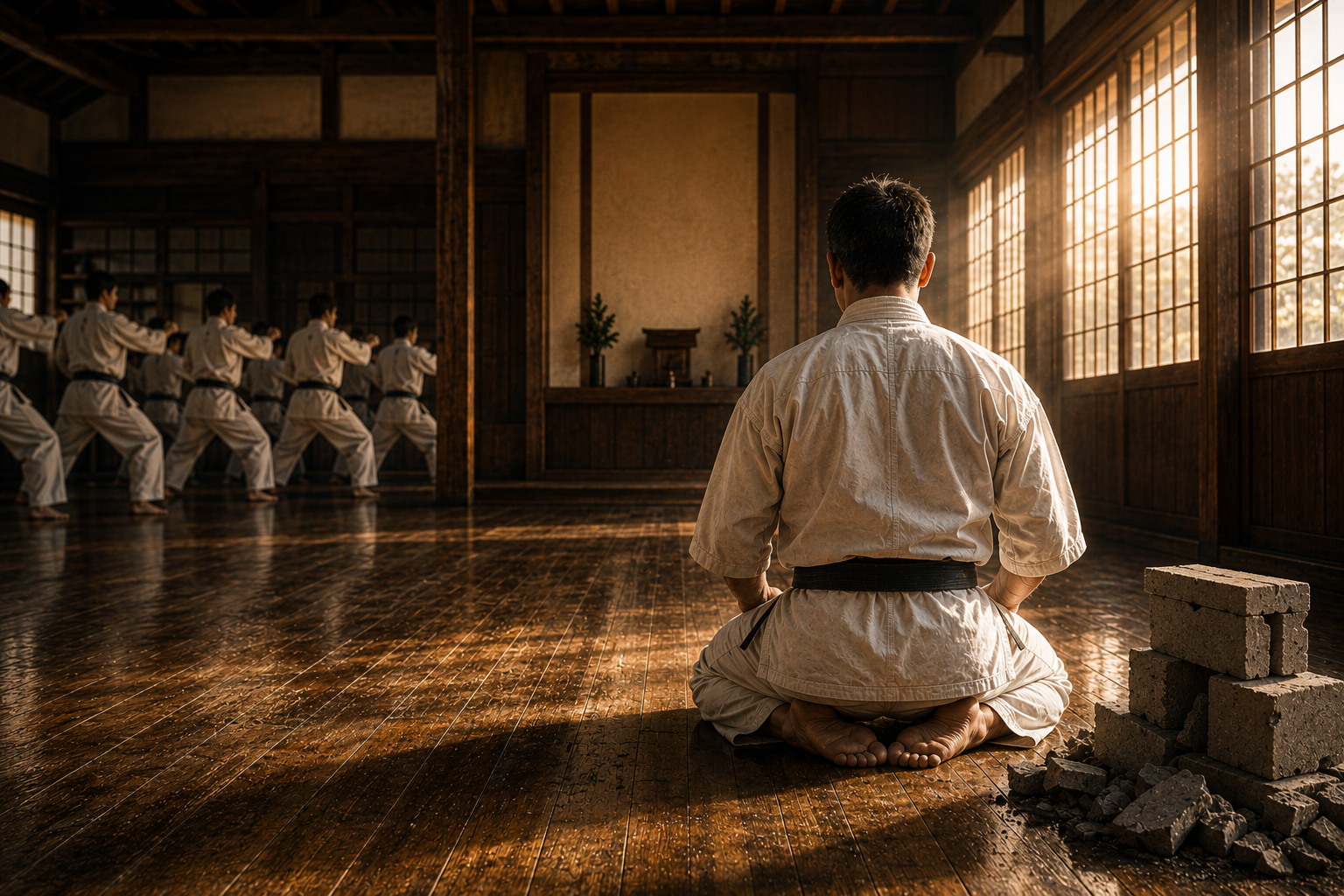
I remember working with Claudio on tameshiwari one day after he successfully broke an 8 x 16 x 2 inch concrete block. I asked him if, “when he first started training, had he ever imagined he would one day be able to break two inches of concrete?”
He laughed and answered, “No.”
My teacher used to say that breaking is 97 percent mental and 3 percent technique. The technique matters because poor technique can result in injury, but the mental aspect takes precedence. In many ways, the concrete is not the obstacle. The student’s own doubts are.
That is one of the lessons Kyokushin has always tried to teach. The training often takes students places they could not have imagined when they first began. Sometimes the achievement is a tournament victory. Other times it is a black belt. Sometimes it is simply realizing that they are capable of far more than they once believed.
This idea is reflected in one of the concepts most closely associated with Kyokushin: Osu no Shinobu. While Osu is often translated as perseverance or endurance, Shinobu carries a deeper meaning. It speaks to patience, self-control, and the ability to continue despite difficulty.
The student who remains committed to the process often finds themselves accomplishing things they never imagined when they first walked into the dojo.
The true legacy of Kyokushin is more than just a collection of techniques. The true legacy of Kyokushin is a philosophy of training.
The punches, kicks, kata, and conditioning drills are important. They are tools.
What ultimately matters is the person who emerges from the training.
The difference was never the technique. It was the training, and what that training was intended to produce.
Osu!
Connect with me:
Follow Kyokushin Karate Blog on Facebook, Instagram, and X.
Be sure to visit Kyokushinkai Karate, our Facebook group — one of the largest and most dedicated Kyokushin communities online. Learn more about Bill Stewart and Texas Kyokushin Karate, where we continue the Kyokushin tradition in Texas. Follow Kyokushin Karate Blog on Facebook, Instagram, and X.
