
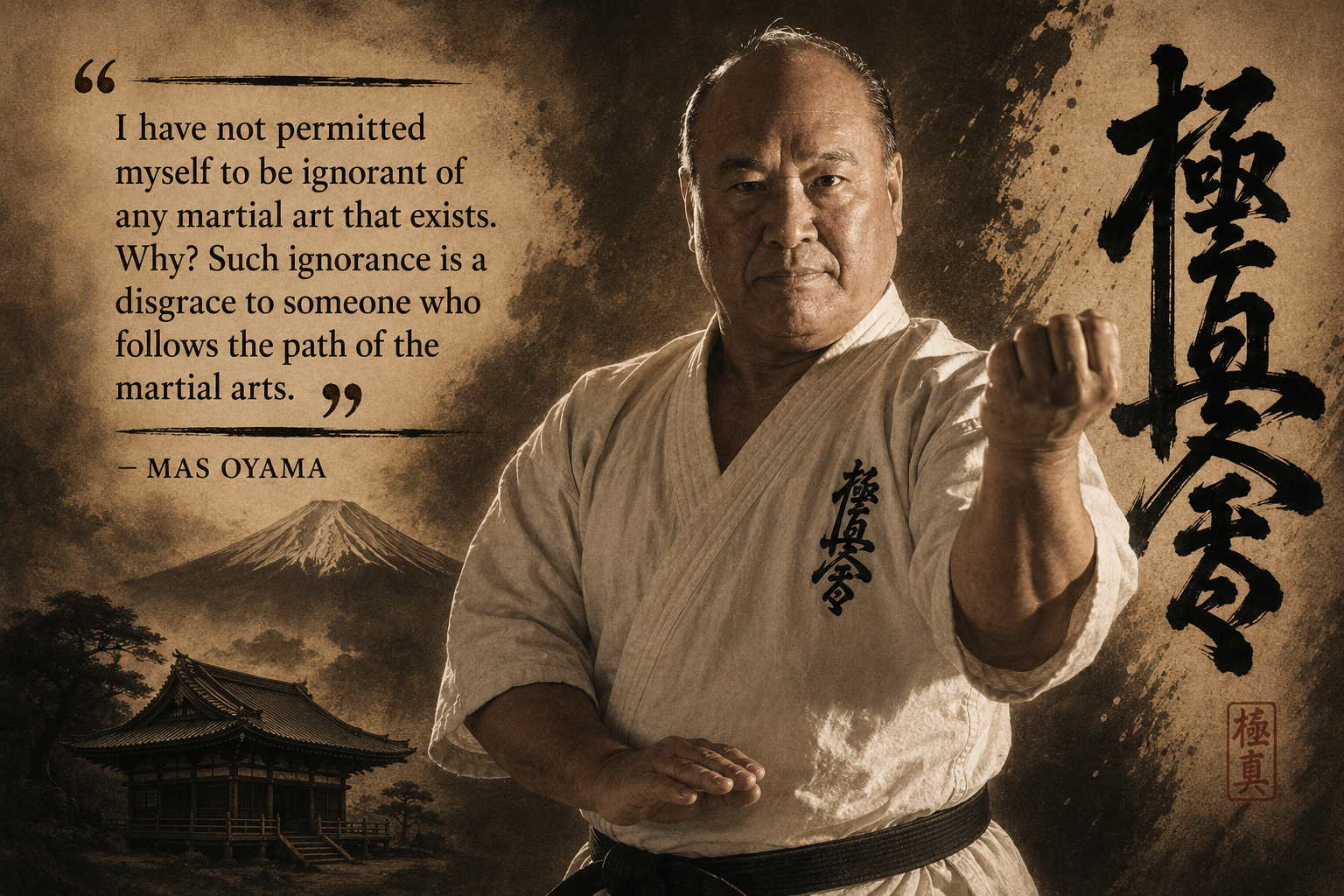

This is one quotation by Sosai Mas Oyama that is frequently shared among karateka. It appears on social media, posters, and in discussions about Kyokushin around the world. Yet I sometimes wonder whether we have become so familiar with it that we no longer stop to consider what it really means.
For all our talk about “The Strongest Karate,” are we following Oyama’s example, or have we become more interested in defending Kyokushin than understanding the martial arts as a whole? That may sound like an uncomfortable question, but I believe it is one worth asking.
Mas Oyama earned his reputation by constantly testing himself and his karate. After being sent to live on his sister’s farm in Manchuria as a child, he was introduced to a Chinese system called Eighteen Hands by a farm worker he knew as Mr. Yi. When he returned to Korea, he continued training in Korean Kenpo.
Later in Japan, he studied under Funakoshi in Shotokan, then went on to train extensively in Goju-ryu under Gogen Yamaguchi, and separately earned a 4th dan in Kosen Judo before setting it aside. He wasn’t content simply to repeat what he already knew. Whenever he found something worthwhile, he was willing to learn from it. His pursuit was never about proving that any single system already possessed every answer. It was about discovering what actually worked in real combat. That distinction is important.
Today, we occasionally hear Kyokushin practitioners dismiss other martial arts. A vocal minority insist that Kyokushin is all anyone will ever need, that cross-training somehow reflects a lack of faith in our style, or that studying another discipline weakens one’s commitment to Kyokushin. Ironically, that attitude seems far removed from the example Mas Oyama himself set.
This isn’t an argument against Kyokushin. Far from it. I have devoted more than four decades of my life to this style and remain convinced that it offers one of the finest foundations a martial artist can have. But having confidence in Kyokushin should never require us to deny reality.
Every martial art has developed areas of exceptional expertise. Judoka understand throwing in ways few karateka ever will. Wrestlers have spent generations refining takedowns. Brazilian Jiu-Jitsu practitioners have elevated ground fighting to an extraordinary level. Boxers continue to demonstrate some of the finest hands in combat sports. Muay Thai practitioners have built an exceptional system of knees, elbows, and clinch fighting.
Recognizing these strengths does not diminish Kyokushin. It simply acknowledges reality. Every ruleset shapes the athletes who compete under it. Boxing produces exceptional boxers because they spend thousands of hours boxing. Wrestlers become exceptional wrestlers because they spend thousands of hours wrestling. The same is true of Kyokushin.
Over the decades, our own emphasis on knockdown competition has naturally influenced what we spend the most time practicing. That isn’t a criticism. It is simply the inevitable result of specialization. Every competitive format rewards certain skills while placing less emphasis on others. The important thing is not to confuse specialization with completeness.
Recently, one of my students earned his Shodan after four and a half years of dedicated training. My advice to him might surprise some people. I didn’t tell him to stop training in Kyokushin. I encouraged him to find a good grappling school—whether that meant Judo, wrestling, or Brazilian Jiu-Jitsu. Not because Kyokushin had failed him.
Because his Kyokushin foundation was finally strong enough to benefit from learning something new. I told him something I have believed for many years. My responsibility was to help build that foundation. Someday, I had always told him, he would learn from instructors who could teach him things that I could not. That isn’t a failure of Kyokushin, nor is it a failure of his instructor. It is simply the reality that no single teacher, and no single style, possesses every answer. Perhaps that is exactly what Sosai Oyama meant.
The founder of Kyokushin never permitted himself to be ignorant of other martial arts. Neither should we. If we truly wish to honor his legacy, perhaps the greatest tribute is not to proclaim that Kyokushin has every answer, but to continue asking questions, testing our assumptions, and remaining students for the rest of our lives.
After all, confidence does not require us to believe we know everything. Only insecurity does.
Osu!
Follow Kyokushin Karate Blog on Facebook, Instagram, and X.
Be sure to visit Kyokushinkai Karate, our Facebook group — one of the largest Kyokushin communities online today.
Learn more about Bill Stewart and Texas Kyokushin Karate, where we continue the Kyokushin tradition in Texas.
