

“The Martial Arts Begins With a Point and Ends in a Circle” – Mas Oyama
One of Sosai’s eleven mottos states: “The Martial Arts begins with a point and ends in a circle. Straight lines stem from this principle.” It’s almost as if many people focus entirely on the phrase “straight lines stem from this principle,” while overlooking the part that says the martial arts “ends in a circle.” Even Kyokushin people.
A point is direct. Simple. Linear. Beginners often think fighting works this way. Move straight forward. Attack directly. Meet force with force.
And sometimes that works… particularly against inexperienced opponents. Straight lines exist. But the art itself does not end there.
Real fighting rarely stays in one place long enough for a straight line to be the whole story. A skilled fighter is constantly adjusting — shifting weight, changing angles, closing or opening distance, reading what the opponent gives away and reacting before the next exchange begins. None of this erases the straight line. Techniques still travel directly at their target, and power still moves along that same path, exactly as Sosai described. What changes is what happens around the technique.
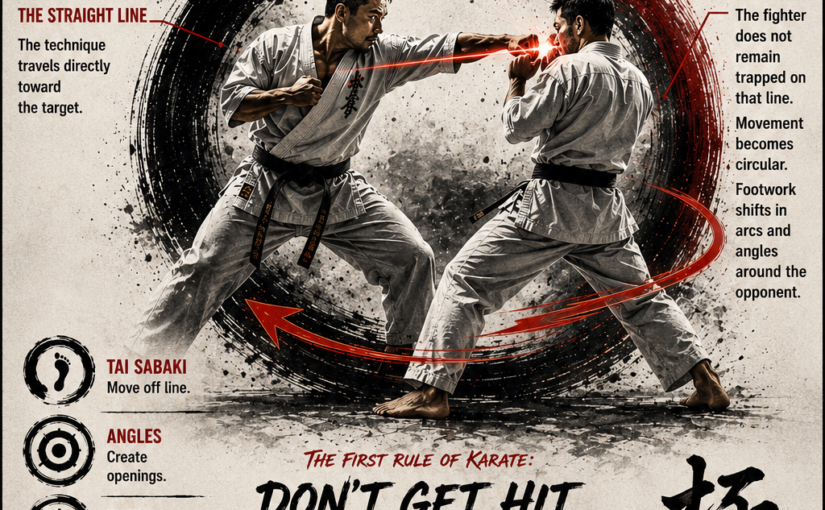
That surrounding movement is where tai sabaki lives. It’s the pivot before the strike, the step that takes you off the centerline, the small adjustment that turns a fighter from a stationary target into a moving problem. The line is still there. It’s just no longer the only thing happening.
Circular movement, tai sabaki, angles, positioning, timing, and strategy were never foreign concepts in Kyokushin. They were already there from the beginning. Even many kata movements flow through circular transitions, body rotation, and shifting angles.
These ideas were already deeply embedded in the Kyokushin I learned decades ago. Through drills, sparring, and experience, movement, angles, tai sabaki, and circular positioning developed naturally. The goal was never simply to stand directly in front of someone absorbing punishment unnecessarily.
In fact, I was taught very early on that standing directly in front of your opponent trying to prove how tough you are was foolish. My teacher used to tell us the idea is to damage your opponent, while not allowing your opponent to damage you. Seems obvious doesn’t it?
Another saying I heard repeatedly over the years was that the first rule of karate is “don’t get hit.” Obviously none of us will ever become so skilled that we never get hit. Fighting simply does not work that way. But we can certainly become much harder to hit through movement, timing, distancing, positioning, and experience. And if we do get hit? Well… that’s what conditioning is for.
But one of the mistakes people make is reducing Kyokushin to toughness alone. Conditioning and fighting spirit mattered, but they were never the entire picture. What surprises me is how many people on the internet fail to recognize these principles within Kyokushin.
The straight line still exists. The technique still travels directly toward the target. But the fighter does not remain trapped on those lines. The movement surrounding the technique becomes circular. Footwork shifts in arcs and angles around an opponent rather than remaining fixed directly in front of them.
“The Martial Arts begins with a point and ends in a circle. Straight lines stem from this principle.”
— Mas Oyama
OSU!
Connect with me:
Follow Kyokushin Karate Blog on Facebook, Instagram, and X.
Be sure to visit Kyokushinkai Karate, our Facebook group — one of the largest and most dedicated Kyokushin communities online.
Learn more about Bill Stewart and Texas Kyokushin Karate, where we continue the Kyokushin tradition in Texas.
