
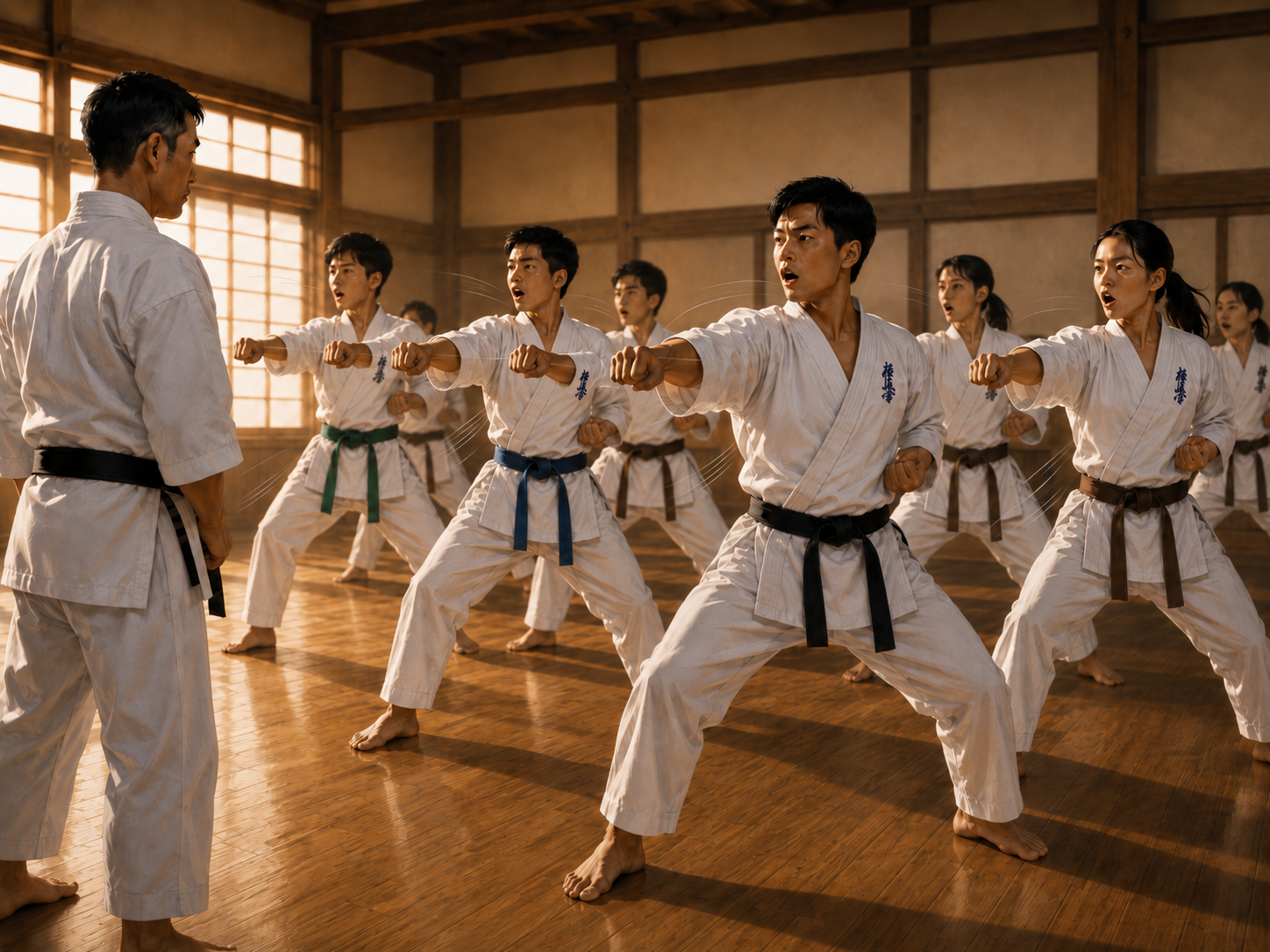

In IFK classes, students vocalize “osu” with each technique as it’s performed during certain drills, particularly when practicing the syllabus in its various forms. To someone unfamiliar with the method, it may sound repetitive or unnecessary. It may even be mistaken for an attempt to use “osu” as a kiai.
Within the IFK, however, that is not what is happening. Saying “osu” with each technique is part of a teaching method designed to connect breathing, movement, cadence, and group timing. It serves a different purpose from kiai and understanding that purpose makes the practice much easier to appreciate.
Building the Exhale into the Drill
One of the first problems instructors encounter with beginners is that they hold their breath. A new student concentrating on the chamber, rotation, target, stance, and all the other details of a technique will often lock up their breathing without realizing it. Under fatigue, the problem becomes worse. The result is a student who gasses early, carries unnecessary tension through techniques that should flow, and begins developing a habit that can become difficult to correct.
The usual response is for the instructor to call out “breathe!” during the drill or correct students individually when they notice it happening. Given enough time and attention, that can work. Within the IFK, however, the correction is built directly into the way certain drills are conducted.
Students vocalize “osu” with the execution of each technique. Producing the sound requires the student to exhale on every repetition. The student does not have to remember to breathe, and the instructor does not have to catch each person holding their breath. The breathing cue is part of the drill itself.
That is the difference between making an occasional correction and building the solution into the methodology. The exhale occurs for every student, on every repetition, from the beginning. Breathing, however, is only one part of what the method is intended to teach.
Rhythmic Training
Shihan Michael Monaco (8th Dan) regularly explains that Hanshi Steve Arneil referred to this teaching approach as “rhythmics,” or sometimes “rhythmatics.” The terminology may sound unusual to modern ears, but rhythmic training is probably a clearer description for those unfamiliar with the method.
Hanshi developed the approach as a way of connecting breath, movement, sound, and cadence during repeated practice. The importance of rhythm itself was already well established in Kyokushin. Oyama himself devoted a section of Mas Oyama’s Essential Karate to “Rhythm in Karate,” describing rhythm as “the regular recurrence of strong and weak elements” [pg 94] and arguing that students with a developed sense of rhythm would improve more quickly.
Oyama’s own suggestion was that studying music or dance could help karate students develop that quality. Hanshi’s contribution was different: he created a karate-specific method for cultivating rhythm within the training itself.
By having students vocalize “osu” as they execute each technique, Hanshi gave the rhythm an audible form. The sound connects exhalation to movement, establishes a consistent cadence, and allows everyone in the room to hear whether that cadence is being maintained.
Mugorei and Collective Timing
The value of the method becomes especially clear during mugorei—drilling or kata performed without a count from the instructor. When there is no count coming from the front of the class, students are no longer simply reacting to someone else’s command. They must establish and sustain the rhythm themselves.
The repeated “osu” allows them to hear that rhythm and recognize when the class begins to rush, drag, hesitate, or break apart. The group can begin correcting itself in a way that twenty people moving silently could not. Everyone can hear whether the class is together, but keeping the group synchronized is only part of the purpose.
Rhythm is deeper than everyone arriving at the end of the technique at the same moment. Students are learning to connect preparation and execution, breath and movement, tension and relaxation, and one technique to the next. The vocalization gives that relationship an audible structure.
Why It Is Not a Kiai
A kiai is something different. It is an expression of focused intent, committed spirit, and the concentrated release of breath and power. It may be used at designated moments in kata or combinations, but it can also be used repeatedly to increase the intensity of a drill and demand committed execution under fatigue.
Saying “osu” with each technique serves another purpose. It connects breath to movement, establishes rhythm, and makes the class’s cadence audible. One does not replace the other, and the fact that both involve vocalization does not make them the same thing.
Because both practices involve sound, the repeated “osu” is sometimes mistaken for a weak or misplaced kiai. That interpretation misses the purpose of the drill. No one using the method is claiming that “osu” replaces kiai. When the training calls for kiai, students kiai. Saying “osu” during rhythmic drilling belongs to a different part of the teaching method.
People are free to question whether vocalizing “osu” is the best way to teach breathing and rhythm. Another instructor may prefer a different method, and another organization may develop those qualities through different drills. That is a legitimate discussion, but the method should first be understood for what it is rather than judged as an attempted kiai.
A Small Example of IFK Pedagogy
The repeated “osu” is a small but useful example of the way IFK pedagogy is structured. Rather than relying entirely on occasional reminders, the correction is built into the drill. At the same time, the same practice develops breathing, timing, cadence, and rhythm.
The next time you hear an IFK class vocalizing “osu” with every technique, listen for what is actually happening. Students are exhaling with their techniques, establishing cadence, hearing whether the class is moving together, and learning to sustain their own rhythm without depending entirely upon the instructor’s count.
When it is time to kiai, they will kiai. Saying “osu” during these drills is something else: it is rhythmic training.
Osu!
Follow Kyokushin Karate Blog on Facebook, Instagram, and X.
Be sure to visit Kyokushinkai Karate, our Facebook group — one of the largest Kyokushin communities online today.
Learn more about Bill Stewart and Texas Kyokushin Karate, where we continue the Kyokushin tradition in Texas.
