

I’ve written previously about Osu. In that article I looked at the roots of the word, where it came from, and how it is used. Here, I’d like to explore the word’s relationship to other aspects of training. If you spend any time in a Kyokushin dojo, you’ll hear the word Osu constantly. We say it when we bow, when we greet each other, when we acknowledge instruction, and sometimes when training gets hard and we’re reminding ourselves to just keep going. It becomes part of the rhythm of dojo life.
Within Kyokushin, Osu is traditionally understood through the expression Oshi Shinobu 押し忍ぶ — to push and endure. From that comes Osu no Seishin 押忍の精神, the Spirit of Osu, often understood as “the spirit of perseverance.” But the meaning goes deeper than simply refusing to quit.
Osu-More Than a Word
Practitioners in Kyokushin use Osu in many ways. It can mean, “Yes, I understand.” It can be a greeting, an acknowledgment of a command or correction, or even a way of recognizing a strong technique from a training partner. Over time, though, the word begins to represent something larger. We connect the attitude we bring to training with patience, perseverance, humility, and the determination to endure.
Kyokushin training has a way of testing all of those things. At first, your body wants to stop, but your mind keeps pushing. Later, your mind also wants to stop, and your spirit must carry you. You push through the fatigue, endure the repetition, and continue through the frustration. That is Osu.
Renma: Always Polishing
There is another concept that fits naturally alongside the Spirit of Osu: Renma 錬磨, often translated as “always polishing.” We practice the same punches, blocks, kicks, stances, movements, and kata again and again, sometimes thousands of times. To someone looking from the outside, that repetition can seem unnecessary. Once you know how to perform a technique, why keep doing it?
Because knowing a technique and understanding it are not the same thing. And understanding it today does not mean there is nothing left to understand tomorrow. A student can master a technique to a very high degree. With enough practice, a student may be able to perform it reliably and with very little variation. But that does not mean the practice has nothing more to teach.
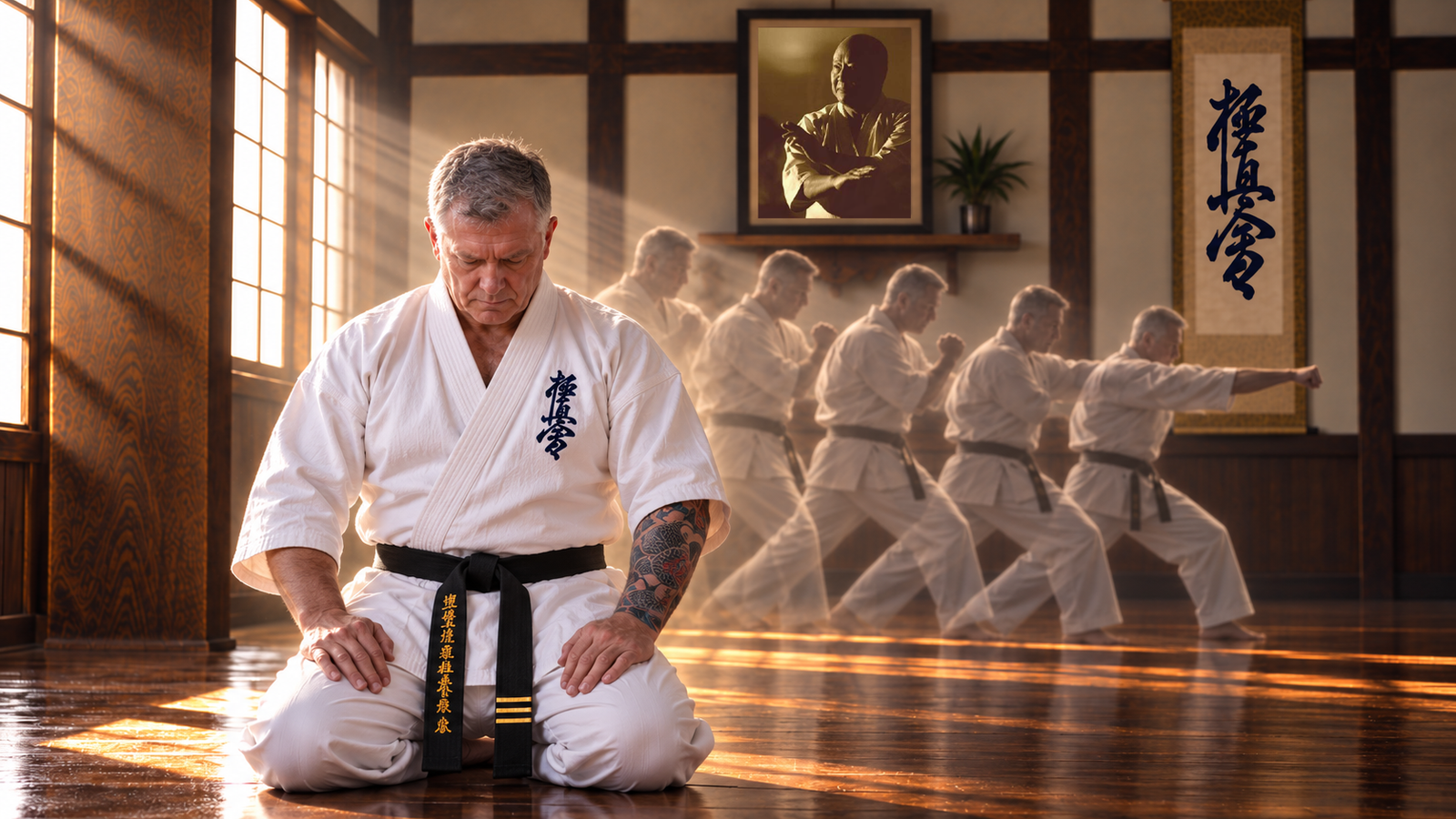
A technique may eventually require very little technical correction, but the practitioner can still continue to grow through the practice. What continues to develop may be patience, judgment, discipline, humility, or simply a deeper understanding of ourselves and what we are doing. The movement may be familiar, but what we take from practicing it can continue to evolve. Training demonstrates how Osu no Seishin is expressed. Perseverance goes beyond simply enduring a hard class or not quitting when we are tired. It is also having the patience to return to the same material year after year and continuing to work even when progress is difficult to see. Osu teaches us to endure. Renma teaches us what to do while we endure: keep polishing.
The Patience to Continue
One of the easiest things to lose in long-term training is patience. There are periods when progress feels obvious and other periods when it seems like nothing is changing at all. The techniques are the same, the kata are the same, and sometimes even the corrections sound the same. That is often where people begin to lose interest.
Traditional martial arts did not build themselves on constant novelty. They were built upon constant refinement. Shihan Swanson often told me that in karate we were on a lifelong journey toward a perfection we would never achieve. Perfection was not the point, he said. The journey was the point. Renma was the point — the constant polishing. Shoshin 初心 was the point as well: keeping the beginner’s mind and remembering that there is always more to learn and more to understand.
The more experienced we become, the easier it can be to assume that we already know what something means. Shoshin asks us to return to familiar material without assuming that our current understanding is complete. We can practice the same technique for years and then one day realize something we had never seen before, or even come to understand it in a completely different way.
Renma is not just the continual polishing of technique, it is also the continual polishing of the person performing it. When we return to something familiar and try to perform it a little better, we are practicing patience. Every time we continue through frustration, we are practicing perseverance. Whenever we accept correction and begin again, we are practicing humility. Those are the acts that build Osu no Seishin.
From Repetition to Instinct
With enough repetition, something else begins to happen. The technique that once required conscious thought begins to occur naturally, and the body no longer has to be instructed through every part of the movement. This points to a broader idea found throughout traditional martial arts: the use of a physical method to bring about a psychological outcome. We repeat techniques, kata, and drills not only to improve the mechanics of movement, but to change the way the mind responds under pressure. Through repetition, fatigue, correction, and refinement, we gradually develop patience, composure, and the ability to act without hesitation.
This is where the concept of Mushin 無心, often translated as “no mind,” becomes relevant. Mushin does not mean that the mind is empty or that we stop thinking altogether. It describes a state in which action is no longer slowed by conscious deliberation. You do not have to think through every part of the movement before you act.
Modern sport psychologists often describe a similar experience as a flow state, but the two are not quite the same. In flow, the athlete becomes deeply absorbed in the task. Attention is concentrated, self-consciousness fades, and performance begins to feel fluid and almost effortless. Mushin approaches the problem from a different direction. Rather than becoming absorbed in one thing, the mind avoids becoming fixed on anything. Fear, ego, hesitation, and attachment to a particular response fall away so that awareness remains open and responsive.
One way of looking at it is that flow reaches effortless action through complete engagement, while mushin reaches it through freedom from mental fixation. The paths are different, but the practical outcome can look similar: less conscious interference, faster reactions, and movement that emerges naturally from training rather than deliberate thought. Neither state appears by accident. Both depend upon a body that has been trained well enough that the mind no longer needs to control every action.
Three Years on a Rock
Shihan Cameron Quinn explains in The Budo Karate of Mas Oyama, that there is a Japanese saying: Ishi no ue ni mo sannen 石の上にも三年 — “Three years on a rock.” The idea is simple: stay long enough, endure long enough, and eventually even the cold stone becomes warm. It is a philosophy of perseverance, and it fits Kyokushin well.
Karate does not reveal everything quickly. Some lessons can be explained in a few minutes but may take years to truly understand. Often, we do not understand something simply because we have not practiced it long enough. Someone may think they understand a stance until they try to use it under pressure. We may think we understand a kata until years later, when a movement suddenly makes sense in a way it never did before. We may think we understand perseverance until training gives us a reason to quit. Then we discover whether we really do.
A Spirit for the Dojo and for Life
The Spirit of Osu is not limited to karate. The habits we build in the dojo have a way of following us outside it. We learn that frustration is not necessarily a reason to stop, that being uncomfortable does not always mean something is wrong, and that improvement may be happening even when we cannot immediately see it. Perhaps most importantly, we learn to continue. Not blindly and not recklessly, but with patience and purpose.
Kyokushin is more than punches, kicks, kata, and fighting. Those are the tools. What we do with them over years of training is something deeper. We polish technique, we polish character, we endure difficulty, and then we return the next day and begin polishing again. That is Renma. That is Shoshin. That is Oshi Shinobu. That is the Spirit of Osu.
Osu.
Connect with me:
Follow Kyokushin Karate Blog on Facebook, Instagram, and X.
Be sure to visit Kyokushinkai Karate, our Facebook group — one of the largest and most dedicated Kyokushin communities online.
Learn more about Bill Stewart and Texas Kyokushin Karate, where we continue the Kyokushin tradition in Texas.
