


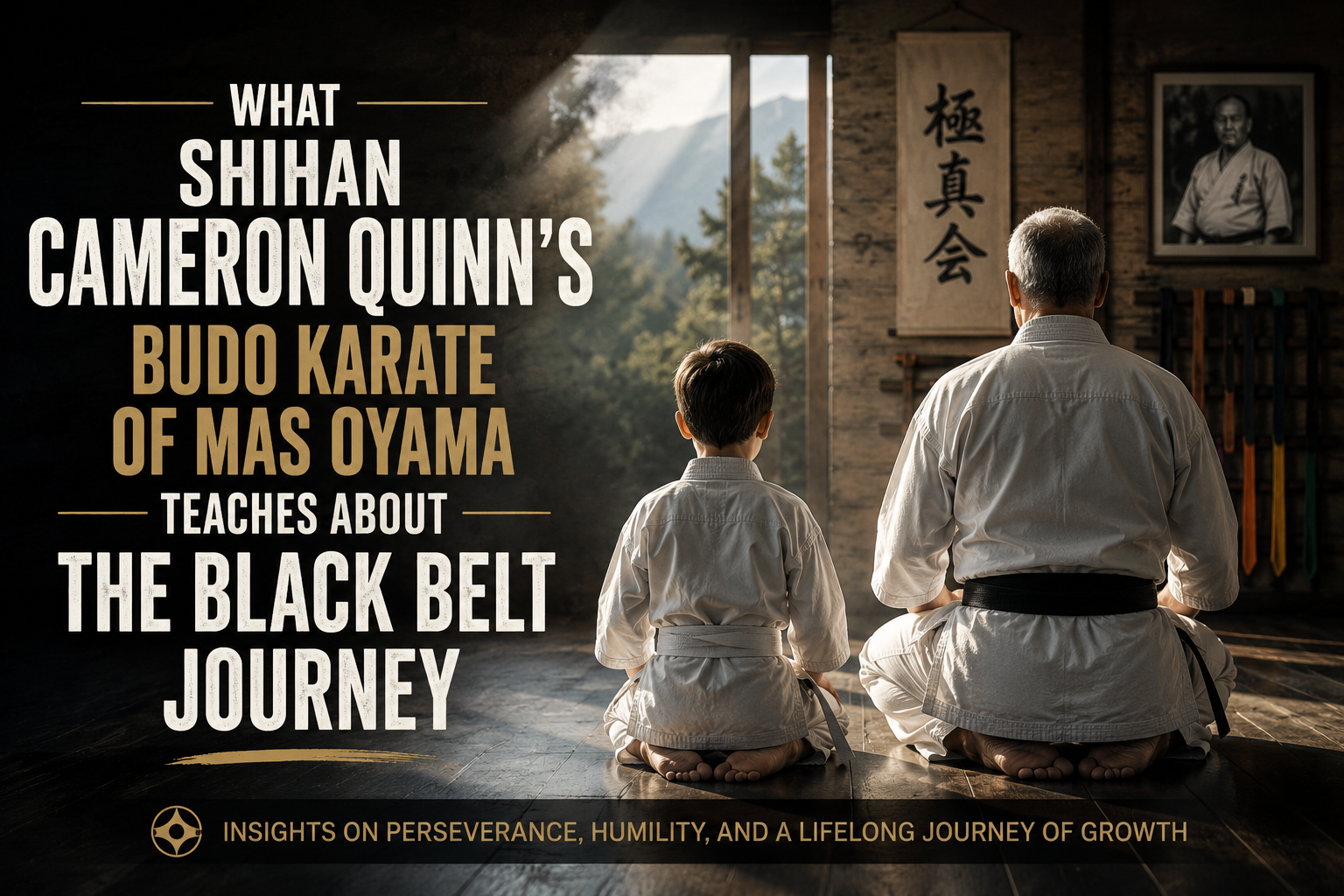

“A black belt is a white belt who never gave up.”
Most martial artists have probably seen that phrase somewhere — likely as part of a meme shared on social media. It’s an idea that feels universal, even though the original source has, at least as far as I’ve been able to determine, become lost over time. While re-reading the 2nd edition of Shihan Cameron Quinn’s book, The Budo Karate of Mas Oyama, I came across a great explanation of the phrase and the concepts behind it. I decided to share a few thoughts.
What Does It Really Mean?
Common sayings that may appear “simplistic” sometimes require a person to sit and contemplate their meaning before understanding the true depth of what is being said. Some might even compare it to a Zen koan. Most martial artists have heard the phrase “A black belt is a white belt who never gave up,” but few stop to reflect on what it truly means. Shihan Quinn’s analysis, which I share below, is spot on.
“As a black belt, remain aware of your shortcomings at all times. The shodan is not a master yet, but if he refuses to give up, one day his consistency will be rewarded. What is the difference between the beginner and the master? A black belt is a white belt who never gave up. The master is the beginner who never gave up in his efforts to improve. Continuous efforts bring surprising rewards. Have faith in your potential, but be honest with your self-assessment. Know where you are, where you are going, and how you’ll get there. Then work to close the gap.”
— Cameron Quinn, The Budo Karate of Mas Oyama (2nd Edition)
My Thoughts
This one paragraph sums up, in my opinion, the best advice anyone could give about earning a black belt. Too many see a black belt as the goal when it’s really only the beginning. On this journey, we need to remember the importance of being self-aware, making continuous effort, and having faith in our potential.
Shihan Quinn encourages us to be honest when it comes to examining ourselves. It almost goes without saying that an honest self-assessment comes with humility. If we do not look for our flaws, then how would we ever improve? Consistency, recognizing our imperfections, and always striving for improvement is the key to making progress. We should never get too comfortable or believe that we do not have room to get better.
Shihan Quinn reminds us that mastery is an ongoing process. The journey from white to black belt signifies progress and growth. “A black belt is a white belt who never gave up” is only part of this principle. We must remember that earning a black belt is not the final destination, but only another milestone along the way.
“The master is the beginner who never gave up in his efforts to improve,” reminds us that improvement is a lifetime journey. Both phrases are simple and seem obvious. But is it easy? Those of us who have been training for a while already know the answer.
Shihan Cameron Quinn
Cameron Quinn began training in Kyokushin in 1971 at the age of 12. By the time he wrote The Budo Karate of Mas Oyama, he had already spent extensive time living and training in Japan with Sosai Oyama and serving as one of his interpreters. His fluency in Japanese led to him traveling extensively alongside Sosai, and he received both his 3rd and 4th dan directly from the founder of Kyokushin.
His deep study of Japanese language, culture, and martial arts has given him a unique perspective on both Budo and karate training.
Today, Shihan Quinn is a 7th dan with more than 50 years of Kyokushin experience. In addition to Kyokushin, he also earned a black belt in Brazilian Jiu-Jitsu and continues teaching and conducting seminars around the world. In addition to writing several books, he also maintains a YouTube channel full of information, training ideas, and insights into both Kyokushin and martial arts in general.
The Budo Karate of Mas Oyama
After its publication in 1987, The Budo Karate of Mas Oyama went on to become one of the most acclaimed books ever written about Mas Oyama, his philosophy, and the history that led to the creation of Kyokushin. The book also shares many valuable insights into training and the martial arts journey itself.
The original edition featured two forewords — one written by Sosai Masutatsu Oyama and the other by Shihan Bobby Lowe. I can’t think of a much higher endorsement than that.
First editions are difficult to find, but fortunately the Second Edition of The Budo Karate of Mas Oyama was published in 2021. The revised and expanded edition also includes a new foreword by Sensei Dolph Lundgren.
I’ve been collecting Kyokushin books since 1980 and have read virtually every book related to the subject. This is a book that every serious martial artist should have in their library.
Conclusion
The truth behind the popularity of many memes is that there is sometimes a deep and relatable truth that speaks to people.
“A black belt is a white belt who never gave up” speaks to martial artists everywhere. It encapsulates the very essence of the martial arts journey. To walk the path of martial arts is a journey marked by continuous effort, self-awareness, and an unwavering commitment to improvement. What we in Kyokushin call Osu no Seishin (押忍の精神), “The Spirit of Osu.” A spirit that drives us to keep pushing and moving forward.
The journey from white belt to black belt to mastery is not simply a progression of rank, but a perpetual and lifelong evolution of the self. Osu!
“1–2 out of every 100 students reach Black Belt, and of those, only 1 out of every 1,000 achieves his 2nd Dan.”
— Mas Oyama
Connect with me:
Follow Kyokushin Karate Blog on Facebook, Instagram, and X.
Be sure to visit Kyokushinkai Karate, our Facebook group — one of the largest and most dedicated Kyokushin communities online.
Learn more about Bill Stewart and Texas Kyokushin Karate, where we continue the Kyokushin tradition in Texas.
