
Kyokushin karate is recognized around the world by its distinctive symbols, particularly the traditional Kyokushinkai kanji and Kanku. These symbols remain widely used throughout Kyokushin today, both by major organizations and independent dojos. As Kyokushin developed into different organizations, some retained the traditional symbols while others adopted variations or distinctive emblems of their own. This page looks at the traditional symbols of Kyokushin, along with those associated with the International Federation of Karate (IFK), World Karate Organization Shinkyokushinkai (WKO), and Kyokushin-kan.
Kyokushinkai Kanji (極真会)

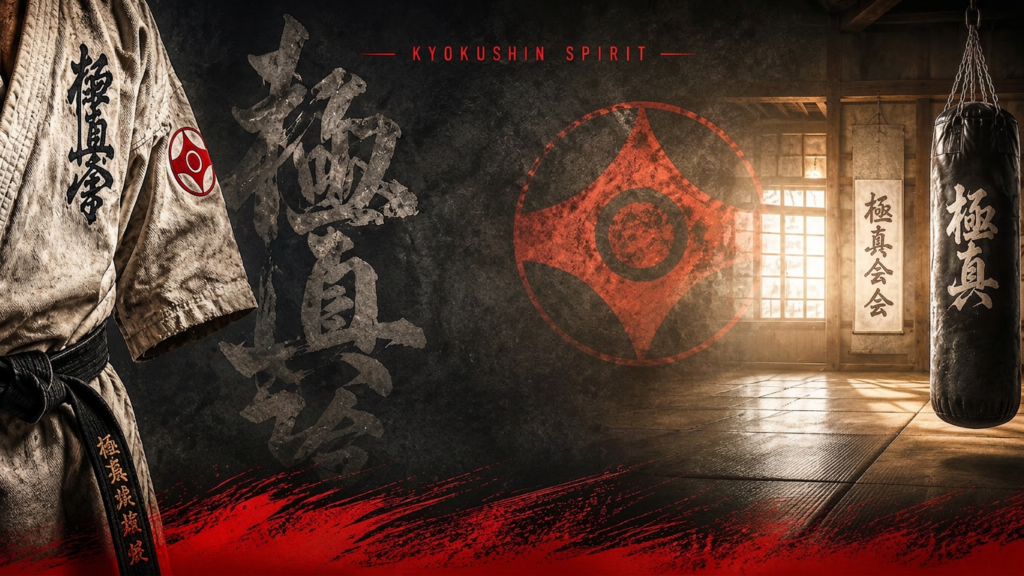
The kanji (漢字) worn on the left chest of the gi is a stylized brush calligraphy that reads “Kyokushinkai” (極真会), the name given by Sosai Mas Oyama to the karate style he founded. It is composed of three characters:
- 極 (Kyoku) – Ultimate
- 真 (Shin) – Truth
- 会 (Kai) – Association
Together, Kyokushinkai (極真会) means “The Association of the Ultimate Truth.” The kanji reflects the pursuit of personal truth through rigorous training and discipline.
Origins of the Kyokushin Calligraphy
The distinctive Kyokushin kanji calligraphy is generally attributed to “Sensei Haramotoki, calligraphy master and friend of Sosai Mas Oyama.” (1) This attribution is documented by Howard Collins in The Shodan. Collins spent considerable time living and training in Japan at the original Kyokushin Honbu during Sosai Oyama’s lifetime, giving his account particular historical significance.
(1) Howard Collins, The Shodan, p. 1.
Kanku Symbol (観空)

The Kanku is the emblem of Kyokushin and originates from the kata Kanku Dai (観空大), meaning “View the Sky.” In the kata, the hands are raised, and the fingers form a diamond-shaped window through which the sky is viewed.
- The points at the top and bottom of the symbol represent the fingertips — symbolizing peak focus.
- The thicker sides represent the wrists — symbolizing strength and power.
- The open center circle represents the view through the hands — symbolizing infinite depth.
- The outer circle enclosing the shape symbolizes continuity and circular motion.
- This symbol expresses the core values of Kyokushin: strength, clarity, and infinite potential, all encircled by the never-ending path of improvement.
IFK Emblem

The International Federation of Karate (IFK) crest, worn on the upper right sleeve of the gi, features a rising wave drawn from the kata Saiha (最破), meaning “maximum break” or “smashing through.” The wave represents:
- Persistence in the face of adversity
- Rising above challenges with patience and spirit
- The essence of Osu no Seishin (押忍の精神) — the Spirit of Osu
Shinkyokushinkai Kanji (新極真会)

The Shinkyokushinkai kanji (新極真会) is a variation of the traditional Kyokushinkai kanji used by the World Karate Organization Shinkyokushinkai (WKO). It retains 極真会 (Kyokushinkai) while adding 新 (Shin), meaning “new,” giving the name Shinkyokushinkai — “New Kyokushinkai.” The calligraphic design maintains a clear visual connection to the traditional Kyokushin kanji while distinguishing Shinkyokushinkai as a separate organization.
WKO Shinkyokushinkai Emblem (世界空手道連盟新極真会)

The World Karate Organization Shinkyokushinkai (WKO) emblem is a distinctive red circular symbol used to represent Shinkyokushinkai internationally. Its flowing circular design visually distinguishes the organization from the traditional Kyokushin Kanku while maintaining a recognizable connection to the Kyokushin tradition.
Kyokushin-kan Kanji (極真館)

The Kyokushin-kan kanji (極真館) is used by the Kyokushin-kan International Karate Organization, founded by Hatsuo Royama in 2002. It retains 極真 (Kyokushin) — “Ultimate Truth” — while replacing the traditional 会 (Kai), meaning “association,” with 館 (Kan), meaning “hall” or “training institution.” The calligraphy preserves a strong visual connection to traditional Kyokushin while identifying Kyokushin-kan as a distinct branch of the Kyokushin tradition.
Kyokushin-kan Kanku (極真館観空)

The Kyokushin-kan Kanku is a variation of the traditional Kyokushin Kanku adopted by Kyokushin-kan International Karate Organization. While retaining a visual connection to the traditional symbol, its design reflects Kyokushin-kan’s emphasis on traditional Budo and the unity of the martial artist.
The central space represents infinite eternity and the unity of Shin-Gi-Tai (心技体) — mind, technique, and body. The surrounding form represents inner calm and immutability, while the six-part design symbolizes the six continents of the world, expressing the international unity of Kyokushin practitioners.
Follow Kyokushin Karate Blog on Facebook, Instagram, and X.
Be sure to visit Kyokushinkai Karate, our Facebook group — one of the largest Kyokushin communities online today.
Learn more about Bill Stewart and Texas Kyokushin Karate, where we continue the Kyokushin tradition in Texas.
