

When I finished writing Position Before Technique, I thought I had followed the idea as far as I needed to. What began as a section on footwork had led me back to a lesson my teacher taught me more than forty years ago: position came first.
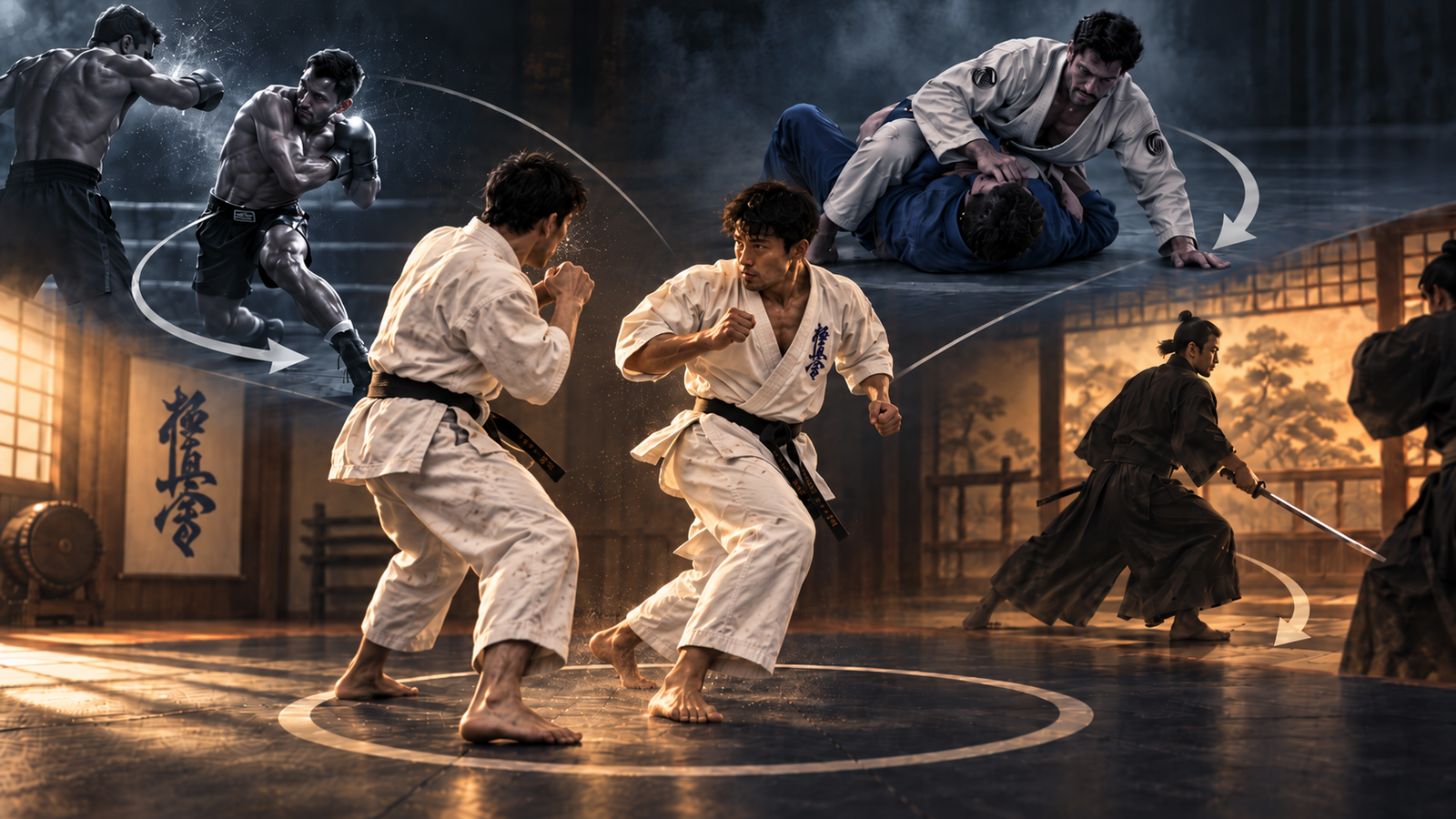
I had been looking at that lesson largely through the lens of Kyokushin: footwork, timing, distancing, tai sabaki, and the circle drill Shihan Swanson used to teach me how they all fit together. But the principle itself reaches much further than Kyokushin. Every serious fighting art seems to have arrived at the same conclusion, usually in its own words, and usually because it had to solve the same problem: how to deal with another person who is actively trying to stop you.
Brazilian jiu-jitsu may state it most directly. One of the first principles a new student hears on the mat is position before submission. Before you attempt to finish an opponent, you establish a position that controls them. A dominant position limits what your opponent can do to you while expanding what you can do to them. Some instructors take it further and teach position before everything: before the takedown, before the escape, before any attack at all. Grapplers even organize their entire art around a hierarchy of positions, and the standing instruction in any situation is simple: improve your position. The submission is treated as something that grows out of position rather than something you chase in spite of it.
I trained BJJ myself for about a year, off and on. I never got past white belt, though I earned a couple of stripes. I don’t remember the first time I heard the phrase position before submission, but the principle became obvious very quickly. If someone had better position, they controlled what happened next. If I improved my position, my options improved with it. It was the same basic lesson I had already learned years earlier in Kyokushin: position came first.
Boxing arrived at the same place from another direction. Boxers call it ring generalship, the ability to control where the fight happens and force an opponent to react to your movement rather than the other way around. Watch how a skilled boxer pivots to the outside after throwing a combination, taking an angle the opponent’s guard doesn’t cover. That is the exact habit I’ve spent years building into my students, having them pivot or change angles after nearly every renraku combination.
I developed that drill from my own experience and my own teacher’s lessons. Boxing coaches developed similar habits from theirs. There was no need for one to borrow it from the other. They were simply solving the same problem.
Boxing gives us a good example in Muhammad Ali. I mostly knew boxing through the major heavyweight fights, but Ali’s movement was impossible to miss. For a heavyweight, he moved remarkably well. He controlled distance, changed angles, and often wasn’t where his opponent expected him to be. A lot of what made him difficult to fight came down to movement and position. He wasn’t just throwing better punches. He was making his opponent fight from where he wanted the exchange to happen.
Then there is Musashi, writing about swordsmanship nearly four hundred years ago. In the Fire Scroll of The Book of Five Rings, which I’m reading in Alexander Bennett’s translation, The Complete Musashi, he repeatedly comes back to position, movement, timing, rhythm, and initiative. He begins by discussing how to use the place of combat to your advantage: putting yourself in a favorable position, restricting the opponent’s movement, forcing him toward bad footing or obstacles, and what he calls “winning the place.”
From there he moves directly into initiative. Musashi writes about attacking first, taking the initiative after the opponent begins to attack, and even taking it as the attack develops. Later he talks about “stopping the start,” disrupting the opponent’s rhythm, changing the line of attack when something isn’t working, and not allowing an opponent time to recover once you have gained the advantage. At one point he goes so far as to describe reaching a level where you can make the enemy move as you want him to move.
A lot of that is very close to something that I learned from Shihan Swanson and that I have stressed to my students over the years: action beats reaction. Get a step ahead, force your opponent to react to you, and keep him reacting. That does not always mean attacking first. It means taking control of the exchange instead of remaining one step behind, answering whatever the opponent decides to do. Shihan Swanson told us standing in front of someone and trading punches and kicks with them was not the smartest way to win a fight. Position and movement are a large part of how you take that control.
Musashi makes it clear that his understanding developed through years of training and fighting, but he also says that he went out and observed the methods of other schools. I can’t say where any particular idea came from, and I don’t think that is really the point. He was dealing with the same problem fighters are still dealing with today: how to put yourself in the better position, take the initiative, and make the other person fight on your terms.
My teacher read Musashi. The Book of Five Rings sat on his shelves, and it is quite possible the first time I ever opened it was in his home. When I left the Navy in 1986, I lived and trained with Shihan Swanson while preparing for my shodan grading and my second knockdown tournament. That was the same period as the circle drill. I can’t say whether Musashi had any influence on that drill, and I doubt Shihan Swanson ever thought of it in those terms when he put me inside the circle. The lesson came from fighting. But reading the Fire Scroll now, the connection is hard to miss.
The broader Japanese martial arts tradition points in the same direction. In arts such as judo, aikido, kendo, and karate, tai sabaki is more than simply getting out of the way. It is body movement used to change the relationship between you and your opponent, to leave you in a better position than the one you occupied before. That correction is the same one I made in the last article. Movement that only avoids an attack is incomplete. Movement should improve your position, while preferably weakening your opponent’s. In this way, movement itself becomes a weapon.
So here is the observation I keep coming back to. Whether these arts influenced one another isn’t really the point. They all had to solve the same problem: another human being actively trying to prevent them from succeeding.
When an art is tested against resisting opponents, position stops being a detail and reveals itself as the foundation. The vocabulary changes. The lesson doesn’t.
That is also why I have never accepted the idea that tai sabaki came into Kyokushin from outside, or belongs to any one system that specialized in it. It has always been my position that tai sabaki was an inherent part of Kyokushin. An art built on full-contact fighting could not have avoided discovering it, any more than boxing or jiu-jitsu could have.
“The heart of our karate is real fighting. There can be no proof without real fighting. Without proof there is no trust. Without trust there is no respect.” – Mas Oyama
My own training is one small piece of evidence that these ideas were already present within Kyokushin. The circle drill grew out of the Kyokushin my teacher had been taught going back to 1967. Nobody was following a trend. The fighting itself demanded it, and Shihan Swanson passed on what the fighting had taught.
I find something reassuring in that. It means the lesson doesn’t depend on any single lineage, organization, or teacher to survive. Wherever people train against real resistance, position will teach itself, and sooner or later some instructor will put a student inside a circle, take away the easy answers, and let them discover it the way I did.
Position came first. Everywhere.
Osu!
Follow Kyokushin Karate Blog on Facebook, Instagram, and X.
Be sure to visit Kyokushinkai Karate, our Facebook group — one of the largest Kyokushin communities online today.
Learn more about Bill Stewart and Texas Kyokushin Karate, where we continue the Kyokushin tradition in Texas.
