


Tucson, Arizona. June 6th, 2026. Three days of seminar under Shihan Mike Monaco had just ended in a formal grading examination, and four candidates had spent the morning being tested on technique, kata, fighting, and the kind of composure that doesn’t show up on a syllabus. When it was over, the grading committee was invited to say a few words to the newly promoted black belts. I chose to talk about two words that sound almost identical: Shoshin and Shodan. Both begin with the same Japanese character, Sho.
“In the beginner’s mind there are many possibilities, but in the expert’s there are few.” — Shunryu Suzuki
One of the people standing in front of me that day was my student, Claudio Rodriguez, who had just graded to Shodan alongside Logan Koster, while Logan’s father, Brandon, graded to Nidan. Claudio looked composed. More than composed. By the end of the afternoon, Shihan Monaco, Shihan Schrader, Shihan Weber, and Sensei Nawaz had each told me, in their own way, how prepared he looked. That didn’t happen by accident. We’d spent a long time on exactly the kind of preparation a grading like that demands, and watching him stand there, I felt like the work had done what it was supposed to do.
Watching him, it struck me again how easy it is to hear “black belt” and think the word means something it doesn’t.
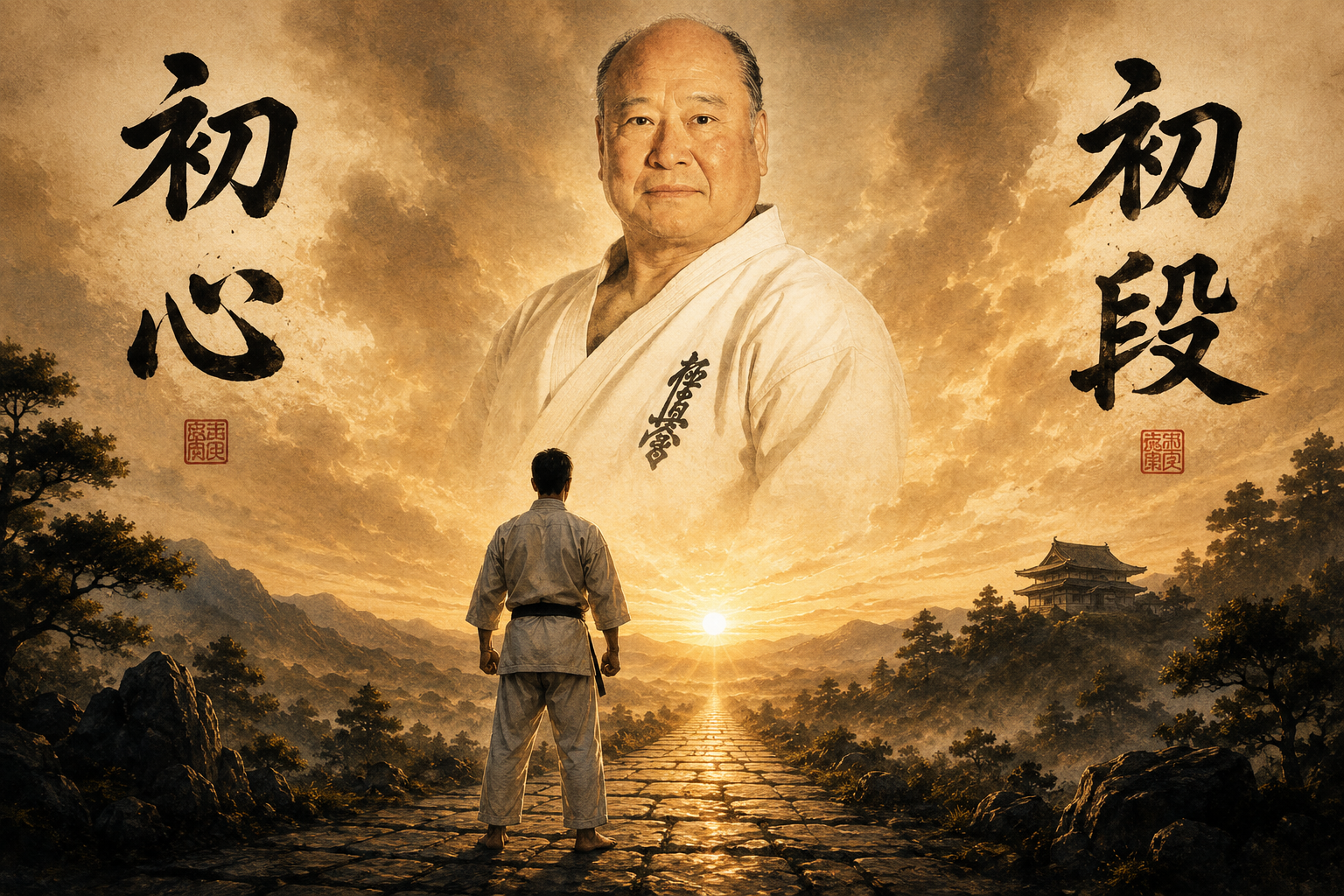
初心 (Shoshin) is often translated as beginner’s mind. It describes an attitude of openness, curiosity, and a willingness to keep learning no matter how much experience accumulates behind you.
初段 (Shodan) literally means first degree, or first step. It’s the first black belt, not the final one. Put them side by side and they’re telling you the same thing. The journey is just beginning.
People outside the martial arts tend to assume a black belt means someone has mastered karate. In my experience, it means something closer to the opposite. It means a student has mastered the fundamentals well enough to start studying what’s underneath them. For most people that takes three to five years of dedicated training, sometimes more, sometimes less. Claudio’s path ran a little over four years. Those fundamentals matter, but they’re a foundation, not a destination.
Once the basics stop requiring conscious thought, your attention shifts to timing, distancing, strategy, breathing, relaxation, and understanding why a technique works instead of just how to perform it. Teaching belongs on that list too. It’s a natural progression, not a separate track reserved for higher rank, because explaining a technique to someone else forces you to understand it more deeply than performing it ever will. I felt that again this year, working with Claudio toward Tucson.
Some people take to teaching pretty quickly because they can explain things clearly and put in the work to prepare. Others train for decades and never quite develop that particular skill. It’s its own discipline, separate from how well someone fights or how many kata they can perform.
The longer I train, the more I notice how much is still left to learn. I don’t think that feeling ever goes away, and I suspect most senior instructors would say the same. Every seminar hands me something new. Even after all these years, I still come across the occasional idea or perspective that makes me think about something a little differently.
Zen teacher Shunryu Suzuki wrote, “In the beginner’s mind there are many possibilities, but in the expert’s there are few.” I’ve always liked that thought, and over the years I’ve come to appreciate it even more.
It would be easy to look at someone with decades in the art and call them a master. I understand the instinct. But the people who’ve trained the longest are usually the quickest to tell you they’re still students. That’s what Shoshin has come to mean to me. It’s the understanding that no matter how much we learn, there is always more to learn. There is always another lesson waiting if we’re willing to keep looking.
Claudio has a black belt now. What it really recognizes is not that his journey is complete, but that the foundation has been built well enough for the real study of karate to begin. From here, he’ll spend years refining timing, distancing, strategy, teaching, and the countless details that only reveal themselves after the fundamentals become second nature.
Perhaps that’s why Shoshin and Shodan begin with the same Japanese character. Shodan reminds us where we are. Shoshin reminds us how we should approach the road ahead.
A black belt isn’t a finish line. It’s where the journey really begins.
Osu.
“One becomes a beginner after one thousand days of training and an expert after ten thousand days of practice.” — Mas Oyama
Enjoyed this article? Subscribe to Kyokushin Karate Blog and receive an email whenever a new article is published.
Follow Kyokushin Karate Blog on Facebook, Instagram, and X.
Be sure to visit Kyokushinkai Karate, our Facebook group — one of the largest Kyokushin communities online today.
Learn more about Bill Stewart and Texas Kyokushin Karate, where we continue the Kyokushin tradition in Texas.
