

Many people assume competition is all about winning. Of course we do our best to win, but that is not the real reason we are there.
Competition is about learning under pressure. It teaches us about ourselves and what actually works when someone is fighting back. That kind of pressure can be difficult to recreate in a normal training environment.
The objective is not medals or trophies. The objective is to see what we can actually do against someone who is trying to stop us.
You find out very quickly what works and what doesn’t.
In knockdown, things can go bad very quickly. One mistake can completely change a fight.
That’s a good reminder that fighting has consequences. If we ever find ourselves in a real-world situation where we feel we have to fight, the reason had better be worth it.
A person does not want the first time they experience real contact, real fear, or real resistance to be in an actual self-defense situation.
Part of preparation is learning how to function when another person is resisting and trying to hurt you. That is one reason I have always believed in pressure testing.
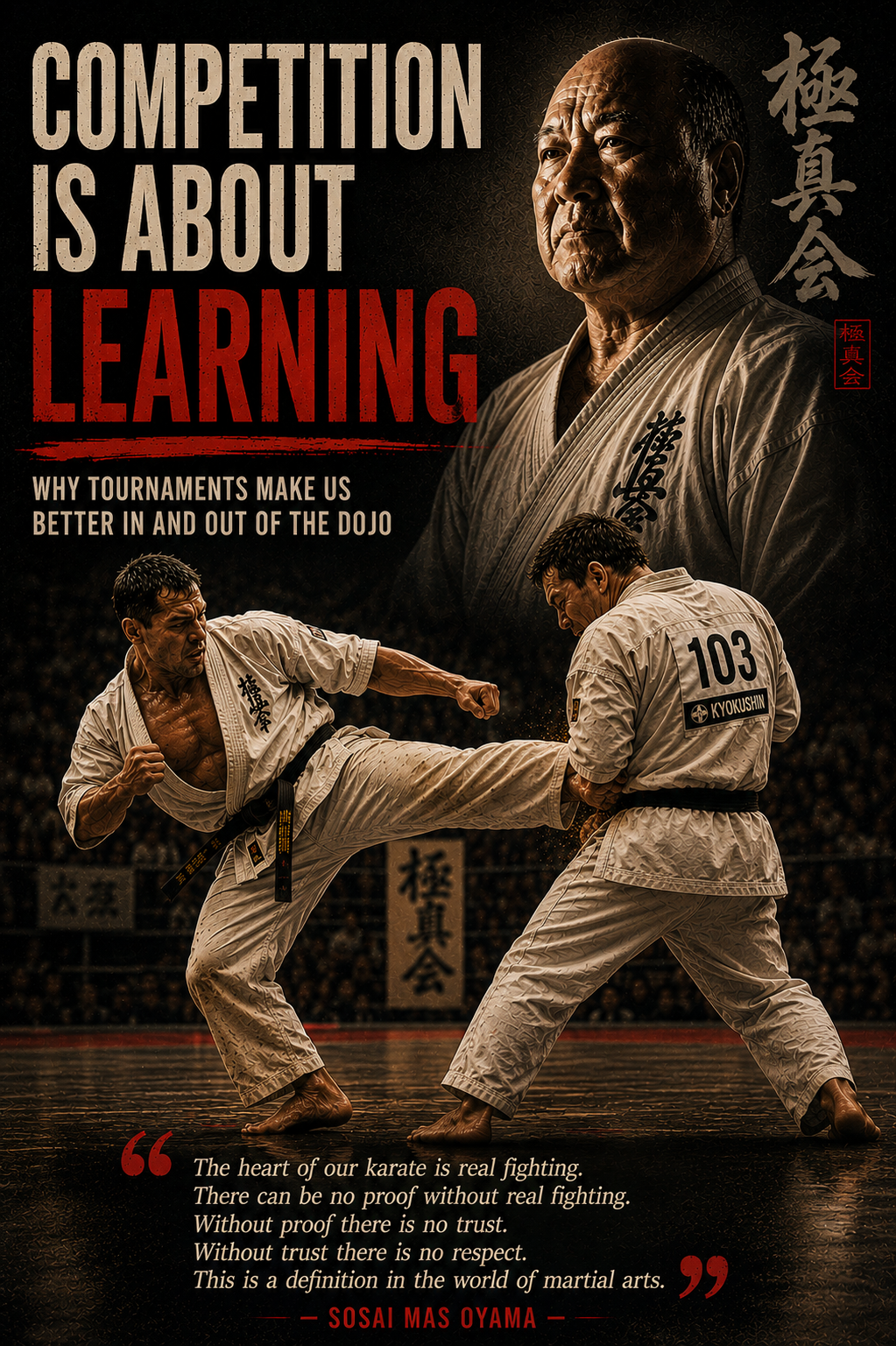
Sosai Mas Oyama himself emphasized the importance of real fighting:
“The heart of our karate is real fighting. There can be no proof without real fighting. Without proof there is no trust. Without trust there is no respect. This is a definition in the world of martial arts.”
Arguably, knockdown is about as close as most people will ever come to real fighting without actually being in one. Yes, there are limitations. No face punches, grabs, throws, or takedowns. But it is still bare-knuckle fighting against a resisting opponent under pressure, and that changes things.
Conditioning
Tournaments also reveal what kind of shape we are really in. There is no worse feeling than realizing you no longer have the conditioning to continue and the only thing left to do is absorb punishment.
The importance of conditioning was instilled in me by my teacher, and I have always made sure my fighters never step into a tournament unprepared physically.
But conditioning is not just about dominance. It is about survival.
In the real world, conditioning can be the difference between walking away and a trip to the hospital. Even in tournaments, I have seen fighters carried out on stretchers. Knockdown is real enough that serious consequences are always possible.
Preparation matters. The time to prepare is before things go wrong, not after.
A properly conditioned fighter should still be able to think, move, and defend themself late in a fight. One of my goals as a coach is to make sure fatigue does not become the deciding factor.
Every Fight Reveals Something
Different opponents reveal different things.
Sometimes the lesson is range against a taller opponent. Other times it is inside fighting, punching power, or footwork. Occasionally the lesson is simply learning how we react under pressure.
Every tournament teaches us something if we are willing to pay attention.
Afterward we look at what worked, what didn’t, and what needs to improve, then we go back to training.
Over time, all those experiences start adding up.
This is one reason I talk so much about pressure testing. Techniques often look good in compliant drills. Things change when another person is resisting, adapting, and trying to stop you from doing what you want to do.
Pressure has a way of exposing weaknesses quickly, but it also shows us what we do well.
Tournaments Are Training
I alluded to this earlier, but it bears repeating: tournaments are training. They are information.
You can lose and improve.
You can win and still have work to do.
Sometimes you perform well. Sometimes you find out very quickly what still needs work.
In knockdown, momentum can shift instantly. A single opening or lapse in concentration can completely change the outcome. That’s one reason tournaments are such valuable training.
Competition is valuable, but it is still only one part of training.
Knockdown famously does not allow punches to the face, grabs, or throws. That is one reason I make a distinction between Kyokushin, the style, and knockdown, the sport. Even some people who train in Kyokushin blur the line between the two.
Still, the lessons learned through competition carry over into other areas. We learn things about our techniques, our strategy, our tactics, and ourselves that translate directly into life outside the tournament.
And at the end of the day, real life is what we are preparing for.
Osu!
Connect with me:
Follow Kyokushin Karate Blog on Facebook, Instagram, and X.
Be sure to visit Kyokushinkai Karate, our Facebook group — one of the largest and most dedicated Kyokushin communities online.
Learn more about Bill Stewart and Texas Kyokushin Karate, where we continue the Kyokushin tradition in Texas. Follow Kyokushin Karate Blog on Facebook, Instagram, and X Learn more about Bill Stewart and Texas Kyokushin Karate, where we continue the Kyokushin tradition in Texas.
