

One of my earliest blog pieces was built on a response to a Facebook post about the first line of the Kyokushin Dojo Kun. Expanding on that idea, lets move on to the second line.
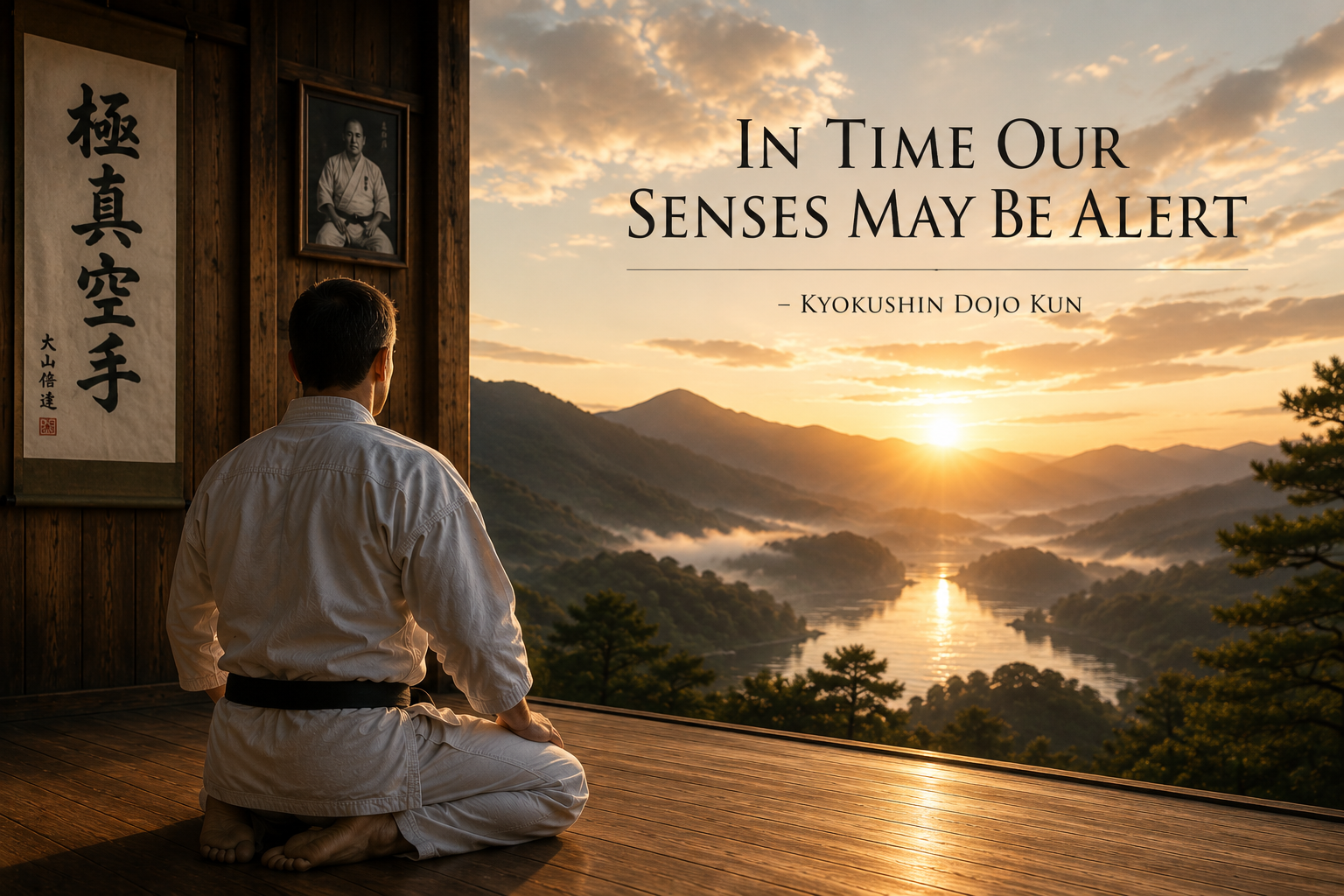
“We will pursue the true meaning of the Martial Way, so that in time our senses may be alert.”
The Dojo Kun
I’ve noticed that as I grow older, and continue to study, that my understanding of some things has evolved over time. When we’re young it often seems to be all about fighting and being stronger physically. As we grow older we start to see things that are much deeper than that.
This line from the Dojo Kun is one that reveals more depth the longer a person trains. Early on, many karateka interpret it primarily through the lens of fighting — sharper reflexes, faster reactions, better awareness in kumite. Certainly those things are part of it. Through years of training, a karateka learns to recognize distance, timing, rhythm, posture, and intent. Experienced fighters often react almost instinctively, sensing openings and danger before conscious thought has time to catch up.
Years of training can eventually produce moments where action occurs naturally, without conscious thought slowing the response. In Japanese martial arts this is often associated with the idea of mushin — a state in which the mind is no longer cluttered by hesitation, fear, anger, or overthinking.
But I believe this line points toward something much deeper than physical awareness alone.
The Martial Way
I think the phrase “Martial Way” is important. The Dojo Kun does not say we will pursue victory, trophies, or even fighting skill. It says we pursue the Way. In Japanese martial arts, ‘dō’ implies a lifelong path of self-development. Techniques are important, but they are ultimately a vehicle for something greater. My teacher described it as setting a goal of perfection, while understanding that we would never achieve it. That wasn’t the point. The journey was the point.
In Kyokushin, that pursuit takes place through difficult training — the repetition of kihon and kata, the pressure of kumite, exhausting conditioning, the frustration of failure, and the humility that comes from realizing how much we still have to learn.
Without the ability to recognize areas we need to improve, how would we ever get better?
Under pressure, it becomes harder to fool ourselves. We begin to see ourselves more honestly — our weaknesses, our ego, our fear, our impatience, and hopefully, our perseverance as well. Over time, this process sharpens not only the body, but the mind and spirit.
That sharpening is what I believe the Dojo Kun means when it speaks of our senses becoming “alert.”
An alert person notices things others miss.
Not only in fighting, but in life.
A karateka who has trained seriously for many years often develops an awareness that extends far beyond the dojo. You start recognizing tension before conflict escalates. You become more aware of your surroundings, your emotions, and your reactions. Experience teaches you when to act, and when restraint is the better choice.
This is closely tied to the idea of zanshin — remaining awareness. Not simply reacting to what is directly in front of us, but maintaining awareness of what is happening around us at all times. True alertness is not nervousness or aggression. It is the ability to remain aware and think clearly under pressure.
In Time
I also think one of the most important parts of this line is the phrase “in time.”
The Dojo Kun acknowledges that these things cannot be rushed.
Today, many people want quick progress and immediate recognition. But the qualities described here are developed slowly through years of consistent practice, setbacks, successes, and experience. In many ways, Kyokushin itself is a lesson in patience.
Learning to See
A beginner may initially think karate is about learning how to fight. Later, they begin to realize the greater challenge is learning how to control themselves.
And perhaps that is part of the true meaning of the Martial Way.
Not simply becoming stronger fighters, but becoming more aware human beings.
In the end, karate is not only teaching us how to strike, block, or endure hardship.
It is teaching us how to see, while taking us down a path toward a greater understanding of ourselves.
Connect with me:
Follow Kyokushin Karate Blog on Facebook, Instagram, and X.
Be sure to visit Kyokushinkai Karate, our Facebook group — one of the largest and most dedicated Kyokushin communities online.
Learn more about Bill Stewart and Texas Kyokushin Karate, where we continue the Kyokushin tradition in Texas. Follow Kyokushin Karate Blog on Facebook, Instagram, and X.
Be sure to visit Kyokushinkai Karate, our Facebook group — one of the largest and most dedicated Kyokushin communities online.
Learn more about Bill Stewart and Texas Kyokushin Karate, where we continue the Kyokushin tradition in Texas.
