
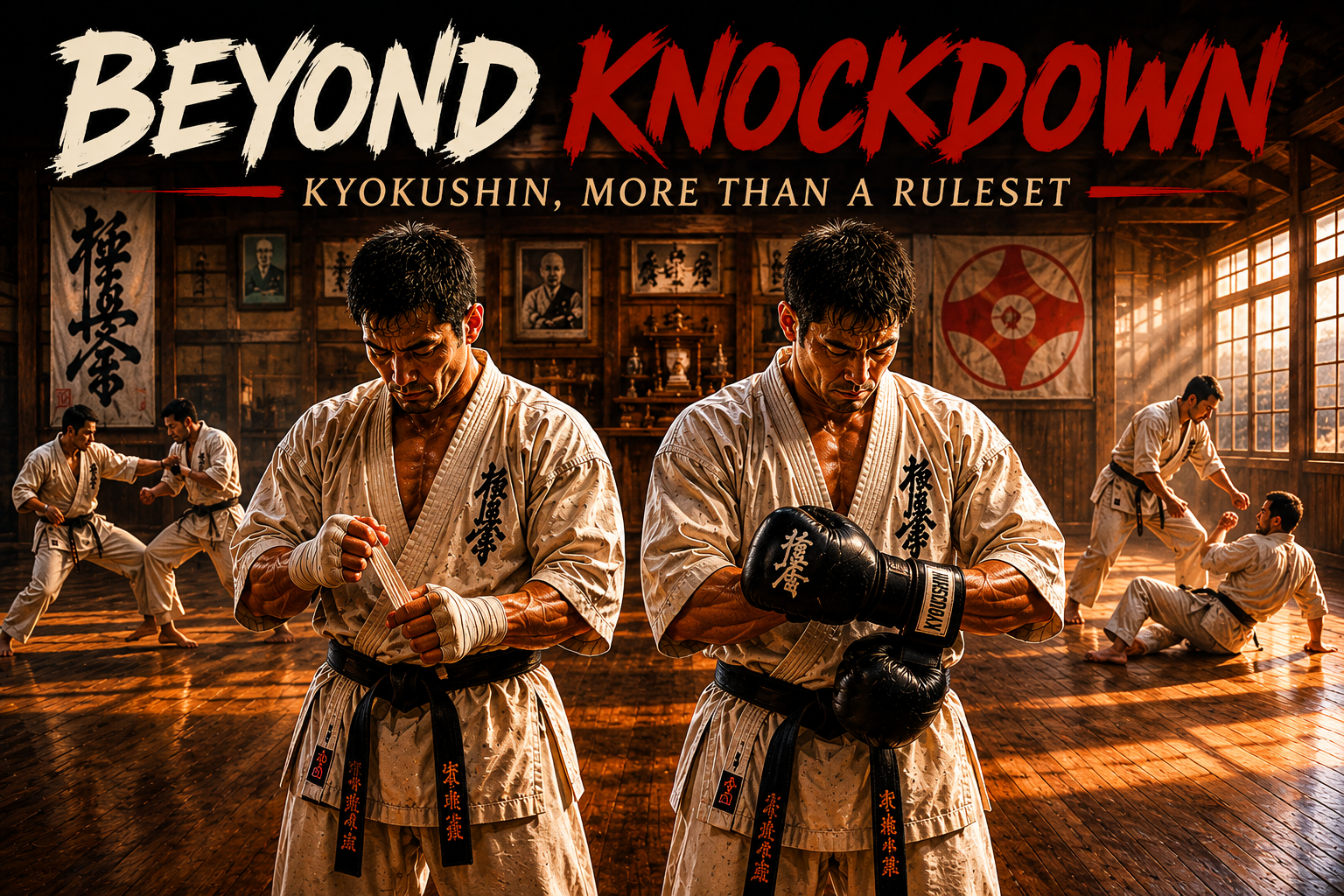

As many of you who are reading know, I’m quite active on social media. One subject that seems to come up repeatedly in Kyokushin discussions is the use of gloves in training.
At the same time, there often seems to be an assumption that wearing gloves in training somehow “isn’t Kyokushin”
I know some of you reading this are saying, “Of course,” while others are probably asking, “Where is that written?”
Kyokushin is known for its full-contact, bare-knuckle tournaments. It’s not the norm when it comes to combat sports, and because of that, we’ve always stood out. In the early All-Japan tournaments and later in the World Tournament, grabs and throws were also part of the rules. These were later removed, though the reasons why are probably worthy of a completely separate blog post.
The Origins of Knockdown
The 1st All-Japan Full Contact Open Karate Championships were held in 1969. Six years later, in 1975, the 1st World Full Contact Open Karate Championships took place in Tokyo. The increase in popularity and prestige of Knockdown tournaments resulted in more and more dojos beginning to focus more heavily on sport competition. As that focus spread, techniques commonly taught and practiced in the dojo that were not allowed in competition appear to have gradually fallen by the wayside in many schools, though certainly not all.
As Kyokushin evolved toward the mainstream, many dojos were already changing. In the early days of Kyokushin, when it was still known as “Oyama Dojo,” people came for the jissen kumite — full-contact fighting. It’s often been described as having an “anything goes” atmosphere, with very few rules beyond the obvious things like no eye gouging. What interested everyone was discovering what would actually work in a real fight. Because it was bare-knuckle, and because punches to the face could and did happen, blood was not uncommon. Some fighters would even wrap small towels around their hands for protection. This is historical fact and well documented.
For Kyokushin to grow and reach more of the public, Sosai seems to have recognized that sports competition could help popularize Karate in much the same way competition had done for Judo. At the time, many within the Japanese martial arts community viewed Kyokushin’s hard kumite as little more than brawling rather than “true” martial arts. This was something Sosai also wanted to change. If Kyokushin was going to establish itself in the public mind as “The Strongest Karate,” something more was needed.
Bare-knuckle fighting with punches to the face could become very bloody, and becoming a spectacle was not what Sosai wanted. It would only reinforce the negative stereotype he was trying to overcome. The answer was the development of the Knockdown tournament — a full-contact ruleset that removed punching to the face while still allowing hard contact.
Although many criticize Knockdown rules as not being “realistic,” I would argue that realism is not really the point of combat sports. Whether it’s Judo, kickboxing, wrestling, BJJ, Karate, Muay Thai, MMA, or some other combat sport, there are always rules designed to protect the competitors. Nothing calling itself a sport is ever going to be 100% realistic. Sport is more about testing yourself and your techniques against a resisting opponent. Winning a tournament recognizes who performed best under a specific ruleset on a particular day — not necessarily who would win in an actual fight.
Although Sosai ultimately decided that competition would remain bare-knuckle, he did consider the use of gloves. One only has to turn to page 169 of the revised edition of What is Karate? published in 1966. The idea appeared again in the revised edition of This is Karate, published in December 1973, and was still included in the Second Revised Edition published in April 1980.
My point is simple: if some argue that using gloves “is not Kyokushin,” how do they reconcile that with the fact that Sosai himself clearly discussed the idea in his books? If we are going to practice hand techniques to the face and head, are there really those suggesting we should return to the 1950s and 1960s, when padding often meant little more than wrapping your hands in a towel? This is historically factual and well-documented.
Gloves and “Realism”
I would argue that bare-knuckle competition and sparring are, in many ways, more realistic — even without face punches. Learning to strike properly with a bare fist, understanding what it feels like to land those strikes, and understanding what it feels like to be struck without protective padding all teach lessons that are difficult to fully replicate while wearing gloves and protective equipment. That doesn’t mean I’m advocating bare-knuckle punches to the face in the dojo, but I do believe there is value in understanding the realities and limitations of bare-knuckle striking.
At the same time, gloves are not “realistic” either. In an actual fight people are not walking around wearing boxing gloves. Ironically, I don’t see those who criticize Knockdown for not allowing punches to the face in competition, advocating for bare-knuckle face punching in training or competition. The reality is that gloves exist for a reason. They help protect the hands and allow people to train punches to the face and head with far greater intensity and frequency than would otherwise be possible. This is historically factual and well documented.
Gloves also change the nature of striking, affecting distancing, defensive habits, and even how combinations are thrown. They allow fighters to throw punches harder and with less concern about damaging the hands. None of that makes gloves “bad.” It simply means they are a training tool with both strengths and limitations, just like any other method of training.
I believe in traditional training methods, including the makiwara and its role in developing grip strength and conditioning the hands. We should learn to strike with bare knuckles and, yes, understand what it feels like to be struck as well. I also believe in the traditional methods of body conditioning. At the same time, we need to practice grappling, escapes, grabs, joint locks, sweeps, and other techniques that fall outside the typical Knockdown ruleset.
Training should have balance, and protective equipment absolutely has a place as a training tool. And yes, based on the responses to a previous post where I asked, “Kyokushin doesn’t punch to the face???” there are clearly some who disagree. We all know there are many things that can happen in a real fight, and getting punched in the face is certainly one of them. Wearing gloves and practicing punches to the face is an accepted training method in dojos all over the world, including — yes — some Kyokushin dojos.
Kyokushin Beyond Tournament Rules
Let me revisit what has become an ongoing theme in my blog: Kyokushin is much more than Knockdown fighting or simply striking. Kyokushin is a very complete martial art. We need only look at the “big three” books written by Masutatsu Oyama — What is Karate?, This is Karate, and Advanced Karate — to see that there is far more to Kyokushin than sport competition. These classic books clearly include techniques and concepts that are not allowed under tournament rules.
I’ve heard Shihan Cameron Quinn speak on his YouTube channel about carefully studying these books and examining the material in depth. His conclusion was that a full 70% of the material operated within standup grappling range.
Kyokushin was founded on the philosophy that Karate should be budo, and training realistically was always part of that vision. Whether people like it or not, realistic training sometimes means putting on gloves and practicing punches to the face. The search for what works in a real fight helped shape Kyokushin from the very beginning.
While some schools may remain heavily focused on the sport side of Knockdown competition, I believe more and more people are beginning to realize that Knockdown fighting is only the tip of the iceberg when it comes to Kyokushin. I’m seeing increasing interest in the Kyokushin community to returning to the broader roots of the style and its original focus on practical fighting ability.
Agree or disagree, for some that means gloves in training at times. We are also seeing more use of protective equipment that allows harder training while reducing unnecessary injuries. These are not new concepts, Sosai himself discussed the potential for this in his books. Meanwhile, many practitioners who grew up in Knockdown competition are now turning toward Judo and BJJ in order to expand their grappling skills.
In the long run, I think this will be good for Kyokushin. It won’t mean the end of Knockdown competition, Knockdown as a sport will continue, but it may help produce more well-rounded martial artists when it comes to self-defense.
But that’s just what I think. What do you think? Let me know in the comments.
Connect with me:
Follow Kyokushin Karate Blog on Facebook, Instagram, and X.
Be sure to visit Kyokushinkai Karate, our Facebook group — one of the largest and most dedicated Kyokushin communities online.
Learn more about Bill Stewart and Texas Kyokushin Karate, where we continue the Kyokushin tradition in Texas. Follow Kyokushin Karate Blog on Facebook, Instagram, and X.
Be sure to visit Kyokushinkai Karate, our Facebook group — one of the largest and most dedicated Kyokushin communities online.
Learn more about Bill Stewart and Texas Kyokushin Karate, where we continue the Kyokushin tradition in Texas.
