

I’ve been teaching kata for a long time, but this is the first time I’ve tried to put into words how I do it. When I wrote about footwork and position, I figured out partway through that what I was really doing was explaining how I teach fighting. This piece turned out much the same way. None of this will be new to many instructors, especially those who came up the way I did. This is simply how I do it.
Everything is a step. Each stage builds on the one before it, and a student doesn’t move on until they’re ready. If I had to put into words what ready looks like, I would say it’s flow. When I see the kata flowing at whatever stage they’re at, that’s when I know.
Two things develop alongside the sequence the whole way through, timing and rhythm. By timing, I mean when each technique happens: where the pauses fall, which movements are fast and which are slow, where the kiai goes, and which techniques land and stop rather than flowing into the next. By rhythm, I mean how the kata moves as a whole, the way techniques connect and group together from beginning to end. Neither one is a separate stage. The student starts developing both as they learn the kata, and each stage that follows refines them.
Learning the Sequence in Chunks
The first thing I teach is how the kata begins. I name the kata, the student repeats it back, and on the command “Yoi!” they move into the ready stance.
I teach the sequence of a kata by breaking it into chunks, and I’m normally doing the kata with them as I teach it. I call the count, then describe the movement while I demonstrate it. In Pinan Sono Ichi, for example, I say “Ichi!” and then “turn left 90 degrees into zenkutsu dachi, left gedan barai.” Next comes the step into right zenkutsu dachi with a right chudan seiken tsuki. Once they have that, I add the 180-degree turn into right zenkutsu dachi with gedan barai, followed by pulling the right foot back into nekoashi dachi and striking with a right tettsui komekami uchi.
I continue that way until we’ve gotten all the way through the kata. Only once they know the whole sequence and can perform it on their own do we drill the entire kata.
Mas Oyama made the same point about not rushing in What Is Karate? (1966). In Chapter 8, “Formal Exercises” (page 103), he describes the individual thrusts, blocks, and kicks as the alphabet of karate, and kata as the spelling that turns that alphabet into words and sentences. He cautions beginners not to rush when learning kata, and to learn the full meaning of each movement rather than only its outward appearance. Once a movement has been mastered, though, he says to build up as much speed in it as possible, because “remaining too long in any single posture gives your opponent a good attack opportunity.”
By the Count
Once the sequence is learned, we drill the whole kata by the count. I call a number, the student performs one technique and waits for the next number. When I count a kata, there is essentially a second for each count. Oyama used the same interval for basics in What Is Karate? (1966). In the chapter on thrusts (page 42), he says not to hurry and to allow about a second between thrusts, and in the chapter on kicks (page 53) he calls for a one-second interval between kicks. A student still needs time to think about stance, chamber, direction, and where the next movement goes, and counting one technique at a time gives them that time.
Counting one technique at a time is only a stage, though, and students don’t stay there. In kumite, a block and a counter aren’t two separate events with a pause between them. They happen together, or so close together that the difference hardly matters, and I think at some point kata should start reflecting that.
Grouping the Count
The next step is to group the count. Instead of one technique per number, I group techniques that belong together. Usually that means two techniques on one count. On the long lines of the Taikyoku and Pinan embusen, where the student moves straight down the line, I’ll put all three techniques on a single count. In Pinan Sono Ichi, which is counted in 20 steps, the first eight counts of the traditional count become 1-2, 3, 4-5, 6-7-8. Count 3 stays on its own because it already holds two movements, the gedan barai and the tettsui komekami uchi.
In a sense, grouping the count goes back to how I taught the kata in the beginning. Instead of the single count for each step that we use once the sequence is memorized, I use a single count for the same chunks I used when I was teaching the sequence, just for different reasons. The first time, the chunk helps the student remember what comes next. This time, it’s there so they move through it without stopping to reset.
What led me to this drill was that sometimes a student will go too fast, and their individual technique suffers. Concentrating on two movements at a time trains them to put multiple techniques together, as they would in fighting. It also effectively slows them down and makes them focus on what they’re doing in that moment.
When the techniques are grouped, the student moves to the next technique immediately and executes it without waiting for the count, and the kata starts to flow. A block followed by a strike becomes one action instead of two, and three steps down the embusen become one drive forward instead of three separate stops. The grouped count also forces the student to think. With no pause between techniques to reset, they have to stay a step ahead of where they are, knowing what comes next before they get there.
In that respect it’s like fighting, but it isn’t exactly like fighting. The student is still working the low stances I explained in If Kihon Is So Important, Why Don’t We Fight That Way?. The techniques and stances don’t change. What changes is how quickly one technique follows the next.
We work one technique on each count, then two techniques on a single count. Kata also has a rhythm to it, so grouping the count isn’t about rushing through it. The student builds the power in a single technique, then ties it to the next one.
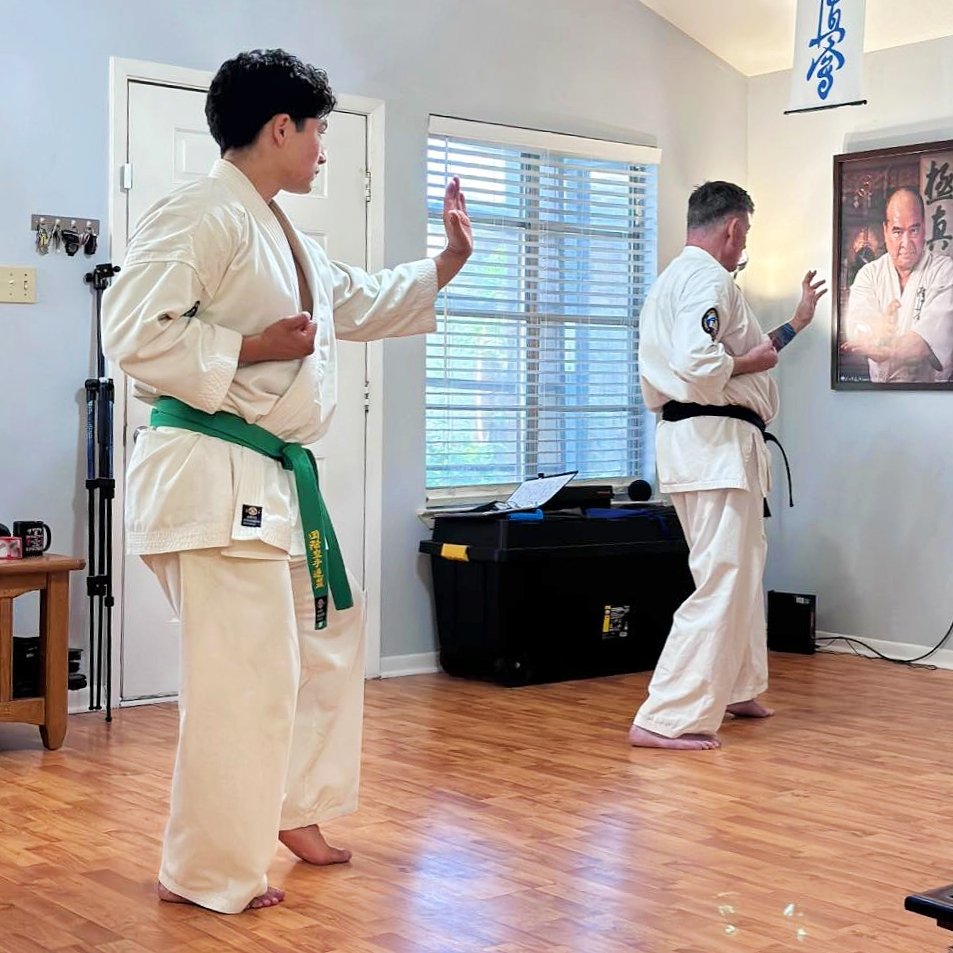
Claudio’s performance of Pinan Sono Ichi on my YouTube channel is a good example of where this leads. When I first changed the count for him, I told him to perform two steps on one count, and when we reached the long line of the embusen, three. Coming back the other way, I had him put the turn onto the embusen and all three steps down the line on a single count. We worked it until he could perform it smoothly to that count. The grouping isn’t fixed. I adjust it to the student and to what I’m seeing in their kata at the time.
Without a Count
Once the student knows the sequence and can perform the movements in combination, we can start working on the kata without a count. That is mugorei, without count or command, which I wrote about in Osu During Drills. With no count at all, students have to carry the rhythm themselves. Grouping the count is the step before this. I still set the pace, but the rhythm has already started to come from the techniques instead of from the numbers.
Flow and Visualization
Over time the kata doesn’t so much get faster as it appears to flow better, until someone watching can see the opponent falling as they’re struck.
Steve Arneil and Liam Keaveney’s Kyokushin Kata Book (3rd edition, 2014) gives a suggested performance time for each kata as a training guideline, to help students get a feel for whether they’re going too fast or too slow. Pinan Sono Ichi falls between 22 and 25 seconds, while Tensho, with its slow movements, runs between 2 minutes 19 seconds and 2 minutes 23 seconds. Kanku Dai, which is longer and more complex, falls between 1 minute 40 seconds and 1 minute 45 seconds, and it takes a certain level of conditioning just to get through it at that pace. These are guidelines, not rules. Nobody is standing there with a stopwatch at a tournament, but when a kata is performed with the right timing and rhythm, it naturally falls into that general range.
A lot of kata is about visualization, and that is what we’re working toward. It is also an important part of moving toward a deeper understanding of the kata. Actual applications often don’t look exactly like the kata, but that doesn’t mean visualization doesn’t help the performance.
In What is the Purpose of Kata? I wrote that kata can feel like choreography at first. I believe that if kata is functional training, then at some point it should be performed with the rhythm of a fight, not the rhythm of a count.
The kata doesn’t change from one stage to the next. What changes is how the student moves through it, from counting through a sequence to moving through it the way a fight moves.
How do you teach kata in your dojo? Share your thoughts in the comments.
Osu!
Follow- Kyokushin Karate Blog on Facebook, Instagram, and X. Be sure to visit Kyokushinkai Karate, on Facebook, one of the largest and most dedicated Kyokushin communities online. Learn more about Bill Stewart and Texas Kyokushin Karate, where we continue the Kyokushin tradition in Texas.
