

Over the past few weeks I’ve been organizing material for a new student handbook project. I expected one section to be fairly straightforward—a discussion of footwork. I wanted to expand on some of the stepping patterns we teach, such as Oi Ashi, Okuri Ashi, Ashi Fumikae, pivots, turns, and other ways of moving around an opponent. It seemed like a simple enough topic until I actually sat down and started writing.
The more I worked through my notes, the more I realized I couldn’t really explain footwork in isolation. I was starting to put something on paper I don’t think I’ve ever really tried to sort out before—part of my own approach to teaching someone how to fight.
Footwork is only one piece of that. Sparring, conditioning, pressure testing, timing, distancing, and learning to function under resistance all matter as well. While working through the footwork material, I noticed that many ideas connect through a single thread: position.
Like most instructors, I don’t think of myself as having invented a “system.” I teach what I learned from my teachers, refined by decades of training, competition, observation, and teaching. I’ve explained these ideas countless times in class. What I hadn’t really done was step back and try to organize them into a written explanation of why I teach them the way I do.
One memory, in particular, suddenly came back to me.
While preparing for my second knockdown tournament, my instructor, Shihan Jim Swanson, introduced a new drill. Looking back now, I think he had identified a weakness in my first knockdown performance and was giving me a way to address it.
That isn’t much different from what I do today when I review video of my student Claudio Rodriguez’s tournament fights. Claudio competes regularly in knockdown, and we look at what is working, where the problems are, and what needs improvement before the next tournament, then build drills around those areas.
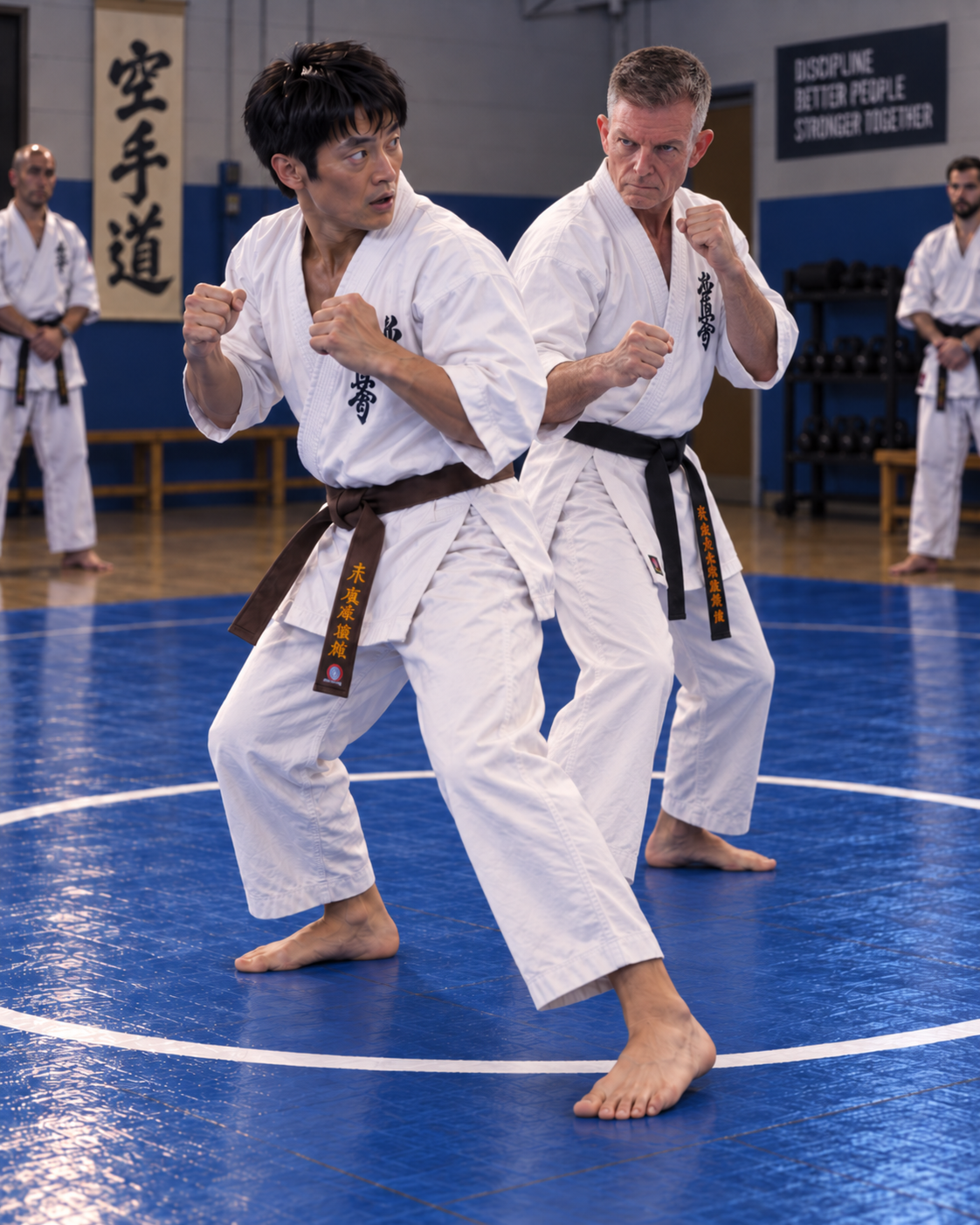
Our dojo trained in a gymnasium where we rolled out wrestling mats before each class. One evening Shihan Swanson placed me inside one of the smaller practice circles marked on the wrestling mat and told me two simple rules: I must not attack and I must not step outside the circle.
For the rest of the class, students took turns attacking me inside that space. Shihan Swanson didn’t tell them to take it easy. Quite the opposite-they were encouraged to hit me as hard as they were capable of. There were no pads. I could block, or I could move. If I failed to do either one, they struck me with full force.
There was enough room to move, but not enough room to simply keep backing away. After a step or so, I had to find another solution.
I don’t remember analyzing the drill at the time or thinking much about what it was supposed to teach me. That was also typical of the way many of us trained in those days, especially those of us with Japanese instructors, or instructors who had trained in Japan. We weren’t encouraged to stop and ask a lot of questions about why we were doing something. The expectation was that we would learn through doing. Shihan Swanson told us what to do, and we did it.
Looking back now, though, I can see what the restrictions forced me to learn. Because retreat was limited and the consequences of getting caught were immediate, I had to change angles, pivot, move around my opponent, and find ways to avoid remaining directly in front of them without leaving the circle. Today, I would describe much of that as tai sabaki—not simply footwork, but using movement to change my position in relation to an opponent.
That drill continued for several weeks. At the time, most of our brown and black belts were training separately at another location with one of my seniors, so they weren’t part of the regular class where I had been doing the circle drill.
Then one evening, Shihan Swanson brought them in to spar with me. This was the first time in weeks that I had been allowed to move freely. The first person I sparred with was one of the brown belts. He moved toward me, then suddenly stopped and began looking around, trying to figure out where I had gone. One of the black belts finally pointed behind him, and the black belts all got a good laugh out of the fact that he had completely lost track of me. To be fair, it was pretty funny.
What stands out to me now is that I hadn’t consciously decided to move behind him. I had simply moved. Somewhere during those weeks of repetition, moving for position had begun to happen without conscious thought. In martial arts, we often associate that kind of response with mushin—the point where you no longer have to think through what to do next.
At the time, I simply took it as a sign that my movement had improved. Sitting here writing this article forty years later, I see something else in it. Shihan Swanson wasn’t just teaching me how to pivot. He was teaching me to fight for position, and through repetition that movement had become instinctive. By taking away my ability to attack, he had taken offense out of the equation. Position came first.
That realization led me to another connection. Over the last several years, I have developed a habit of having students pivot or change angles after nearly every renraku combination. I never consciously connected that drill to those early lessons. The idea was to teach students not to simply finish a combination and remain standing directly in front of their opponent. Once the combination is finished, they should move, improve their position, and be ready for whatever comes next.
I wanted movement to become part of the combination itself. Attack, move, improve your position, and attack again. Over time, I began thinking of that as positional awareness—the habit of understanding where you are in relation to your opponent, what you can do from that position, and what your opponent can do from theirs. Every exchange should leave you in a better position than when it began.
Watching Claudio compete has reinforced that idea for me. More than once I’ve watched him disappear from an opponent’s line of attack, appearing unexpectedly at an angle—or even completely behind them—during an exchange. Those moments aren’t accidents. They are the product of training movement until positional awareness becomes instinctive rather than something that has to be consciously considered.
The methods were different, but the lesson was essentially the same one my instructor had taught me decades earlier.
As I continued working through my notes, I found myself thinking less about individual stepping patterns and more about what all of those movements were supposed to accomplish. Oi Ashi, Okuri Ashi, Ashi Fumikae, pivots, turns, and angle changes are useful tools, but they are only tools. The larger concept is tai sabaki.
Movement should change the relationship between you and your opponent. If I move to avoid your attack, I should also be improving my position for my own counterattack. Closing the distance should be done in a way that limits your opponents ability to attack effectively. Creating space shouldn’t simply mean retreating; that movement should create another opportunity.
Whenever possible, I want my opponent reacting to me rather than the other way around. If I move to your outside, you have to turn to face me. If I change the angle, you have to adjust before you can continue attacking effectively. That moment of adjustment may be very brief, but it creates opportunity.
In that sense, footwork isn’t simply defensive. Movement itself can become an offensive weapon.
The more I think about it, the more convinced I become that position is one of the most important aspects of fighting, yet one we rarely discuss in karate. It affects distancing, timing, angles, initiative, defense, offense, and the choices available to both fighters.
Perhaps that is why this article stopped being about footwork. Footwork describes how we move. Tai sabaki describes what we are trying to accomplish with that movement. And positional awareness is what allows us to understand whether the movement actually improved anything.
Of course, none of that exists by itself. Good movement means little if you cannot apply it against someone who is actually trying to hit you. Timing has to be developed through sparring. Technique has to survive pressure. Conditioning has to be sufficient to keep making good decisions when you’re tired. The ability to fight is built from all of those things working together.
Position is only one part of that larger picture, but it touches almost everything else we do.
Looking back, I realize many of the drills I use today grew naturally out of lessons I was taught decades ago. I didn’t consciously preserve them as part of some formal method. The specific drills evolved much later, shaped by my own experience and by the needs of the students I was teaching. Only now, in trying to write all of this down, am I seeing how closely some of them connect back to lessons I learned much earlier.
Maybe that is the real value of putting these things on paper. It forces you to look at what you teach, why you teach it, and where those ideas came from.
In this case, what began as a section on footwork brought me back to a lesson I was taught more than forty years ago.
Position came first.
Osu!
Follow Kyokushin Karate Blog on Facebook, Instagram, and X.
Be sure to visit Kyokushinkai Karate, our Facebook group — one of the largest Kyokushin communities online today.
Learn more about Bill Stewart and Texas Kyokushin Karate, where we continue the Kyokushin tradition in Texas.
