

Three fights in Bangkok, the men behind them, and a turning point in the development of Japanese kickboxing
In February 1964, three Japanese karateka entered the ring at Bangkok’s Lumpinee Stadium to face professional Muay Thai fighters. Two of them won, and one lost. Kyokushin has been telling the story of that 2–1 victory ever since.
Tadashi Nakamura and Akio Fujihira won their matches. Their instructor, Kenji Kurosaki, lost his. Most accounts give the results and move on, and a surprising number get the details wrong, starting with the date. Thai accounts have long said their side sent second-tier fighters. Yasuhiko Oyama, watching the film back in Japan, saw something different in the man Kurosaki faced. He also remembered Mas Oyama warning Kurosaki at the airport not to fight. I wanted to know who the Thai fighters really were and whether Kurosaki meant to fight when he left Japan. Along the way, I found that the best evidence for when the fights took place had been sitting in Nakamura’s own book all along.
We’re fortunate to have firsthand accounts from men who were there. Tadashi Nakamura described his experience in The Human Face of Karate, while Yasuhiko Oyama, one of the original fighters selected for the team, discussed the preparations in Chasing the American Dream. We also have statements from Kurosaki himself, including a recorded interview in which he watches footage of his fight and discusses what happened. [1][2][3]
Add the newspapers of the day, Thai sources, and the research of Japanese historian Masashi Hosoda, and we can follow the whole thing: the training, the postponements, the argument over the rules, and how Kurosaki came to fight. The story doesn’t end in Bangkok, either. What those men learned there fed into Japanese kickboxing and, through Kurosaki’s students, into gyms a long way from Japan. [4]
How the Challenge Began
By the early 1960s, Mas Oyama had established a reputation for teaching karate that emphasized powerful techniques, demanding physical conditioning, and fighting against genuine resistance. His students trained hard, and the opportunity to test their abilities against experienced fighters from another martial art was appealing. That opportunity came through Osamu Noguchi, a Japanese boxing promoter who became interested in arranging contests between Japanese karateka and Thailand’s professional Muay Thai fighters. Tomeo Sagoya, an influential patron of both Noguchi and Mas Oyama, helped bring the dojo into the project. Later, his home became the meeting place for negotiations over the rules. Noguchi told Hosoda that because Sagoya took Kurosaki’s side, he couldn’t simply brush Kurosaki’s demands aside. That didn’t mean Kurosaki got everything he asked for. The karateka gave up their uniforms and bare knuckles, but they kept throws and headbutts. [4]
Kurosaki later recalled that Noguchi and Mas Oyama had discussed Thai boxing during a social gathering. Mas Oyama expressed confidence in karate’s superiority, and Noguchi offered to arrange an actual competition. [3] According to Yasuhiko Oyama, Noguchi presented the proposed challenge to the young fighters partly as a matter of national pride. Japanese karate would have an opportunity to demonstrate its effectiveness against an established fighting tradition that was largely unfamiliar to them. [2]
Nakamura and Yasuhiko Oyama both heard that it started in Thailand. On Noguchi’s trips there to find boxers, the Thais laughed at the idea of karate against Muay Thai. In Yasuhiko Oyama’s version, a gym owner told Noguchi a karate fighter wouldn’t last a minute. Nakamura heard that Noguchi had grown tired of being told karate was ridiculous and told a Thai promoter he would arrange the challenge himself. Back in Japan, Nakamura wrote, Noguchi tried other karate styles first, and every one of them turned him down before he went to Mas Oyama. Neither man was there, and Yasuhiko Oyama was careful to say the story came from Noguchi. Whether it happened that way, or was Noguchi’s way of firing up the fighters and getting the matches made, we can’t know. Either way, it’s exactly the kind of story a promoter would tell. [1, pp. 57–58][2]
Promoting fights was Noguchi’s business. A contest between Japanese karateka and professional Thai boxers was the kind of match people would pay to see. In a January 2021 interview with BOUTREVIEW, historian Masashi Hosoda said that Noguchi had suffered a serious financial setback following legal difficulties involving foreign currency used to pay for a world boxing championship. He had lost his regular television boxing promotion work, which had provided a substantial source of income.
Hosoda suggested that those financial difficulties were an important reason Noguchi began looking for opportunities outside conventional boxing. He even questioned whether Noguchi would have become involved in developing kickboxing had his circumstances been different. [8] The fighters wanted to test their karate. Noguchi saw a business opportunity and offered to put the fights together.
Mas Oyama selected four of his most capable young karateka: Tadashi Nakamura, Akio Fujihira, Yasuhiko Oyama, and Hirofumi Okada. These were accomplished fighters who had already distinguished themselves through the demanding training at the Oyama dojo. Nakamura remembered arriving at the dojo to find the other three men already there, with Kurosaki sitting beside Mas Oyama. Mas Oyama told the four why he had chosen them and asked if they would go. They answered osu together. Yasuhiko Oyama remembered the group’s nickname, the Four Samurai. In both accounts, Kurosaki’s assignment was to prepare them. [1, pp. 57–58][2][5]
The accounts I’ve found refer to three bouts, though four men trained. Three makes sense to me. If the idea was to see whether Japanese karate or Muay Thai would come out on top, four bouts could have left them with two wins apiece. My guess is they wanted an alternate and planned to decide closer to departure which three would fight.
Preparing for an Unfamiliar Opponent
The Japanese knew relatively little about Muay Thai. They understood that Thai boxers used punches, kicks, knees, and elbows, but had limited knowledge of how professional fighters combined those techniques or approached competition. In his later interview, Kurosaki recalled trying to obtain films or other information about the Thai fighters. There wasn’t much available, and he had to prepare his students largely without knowing exactly what they would encounter. [3]
Despite those limitations, Kurosaki understood that fighting professional Thai boxers would require preparation beyond ordinary dojo training. These were men who earned their living through competition, and he wasn’t going to assume that his students’ karate experience alone would be sufficient. Yasuhiko Oyama told the story of the first glove session twice. In his 2011 newsletter, it was Mas Oyama who brought out the gloves. He told the black belts to put them on and box, punches only. For a couple of rounds their punches looked sharp. Then their arms tired and the punches turned into wild swings. [5] In his autobiography, Yasuhiko Oyama credited Kurosaki with bringing the 15-ounce gloves and telling the men to fight. [2] The two versions may not be as different as they look. The session took place in Mas Oyama’s dojo, but Kurosaki was in charge of the training, and both men were probably there. Remembering one of them handing out the gloves fifty years or more later is easy to understand. What matters to this story doesn’t change with whose hands the gloves came from: experienced karateka found gloved fighting harder than they expected.
Kurosaki also recognized that a few additional training sessions at the dojo wouldn’t be enough. He persuaded Mas Oyama that the team needed a dedicated training camp lasting at least a month, but there was a problem. None of the fighters had the money to pay for the necessary accommodations, food, and transportation. Kurosaki raised money for the camp and found the men a place to stay at Kinugawa in Tochigi Prefecture, which Nakamura identified as Kurosaki’s ancestral home. Nakamura remembered the five of them arriving in early August, renting two upstairs rooms in an old farmhouse and cooking for themselves. Nakamura’s book attaches later years to all of this, a problem I come back to when we get to the fights. I follow Hosoda in placing the camp in August 1963, with the fights in Bangkok the following February. [1, pp. 59–62][2][4]
The Kinugawa Training Camp
At Kinugawa the men had a month to work on the problems those first rounds in gloves had exposed. Yasuhiko Oyama recalled that Kurosaki supervised the four students’ sparring. Kurosaki himself stayed out of the rounds. [5] Nakamura remembered running, sprinting, skipping rope and shadowboxing in the mornings. In the afternoon they sparred in headgear and lifted weights. Kurosaki also took them down to the Kinu River. They practiced kicks standing hip-deep in the water, then swam against the current using a dog paddle. [1, p. 59]
What stayed with Nakamura was how close the four men grew over that month. Yasuhiko Oyama remembered a smaller adjustment that tells you something about their early rounds. None of them was used to a mouthpiece. When they got short of breath, they would spit it out. [1, p. 60][2] Oyama remembered being particularly determined to make the most of the opportunity. He trained so hard that Kurosaki told him to slow down, something he recalled with pride because his instructor rarely suggested that anyone was training too much.
By the end of the camp, the four young fighters were considerably more comfortable with the equipment and techniques they had initially found so unfamiliar. Yasuhiko Oyama described returning to Mas Oyama’s dojo and testing his new skills against a strong brown belt. During the exchange, he blocked a punch and followed with an elbow strike to the jaw, knocking his opponent unconscious. He recalled that even Mas Oyama was impressed by the technique. [2]
Back in Tokyo the team also had a chance to spar at Noguchi’s Meguro Gym. Yasuhiko Oyama remembered Kurosaki picking him to go first. Nakamura described going with Kurosaki and Okada and getting into the ring first himself. Both came away encouraged. Whether they were remembering the same visit is unclear. [1, pp. 60–61][2]
A Competition That Kept Being Postponed
The first postponement came after the training camp, and it was followed by others. Noguchi repeatedly announced changes to the schedule, often without providing explanations that satisfied the fighters. Yasuhiko Oyama recalled overhearing Mas Oyama warning Kurosaki to be cautious in his dealings with Noguchi. Mas Oyama was concerned about the promoter’s promises and advised Kurosaki not to depend too heavily on what he was being told. [2][4]
Yasuhiko Oyama remembered how excited the men were on the ride back from Noguchi’s gym. Then the fights were postponed again. By then he felt he could no longer count on Noguchi, and his enthusiasm for the trip began to fade. [5] According to a memorial published by Renseijuku, Okada’s father had died and he was supporting his family. Each change of date meant arranging more time away from work. Yasuhiko Oyama faced his own decision. Graduation was approaching, and he needed a job to support himself and his mother. He wrote that by the time he withdrew, Okada had already stopped training with the team to look for work. Nakamura nearly withdrew too. [2][5][20]
Why Did Kurosaki Fight?
Nakamura remembered a cold night at the dojo in December. The stove was glowing red in the corner as he explained his situation to Mas Oyama. His parents wanted him to stay home in Japan rather than go to Thailand with the team. Nakamura recalled telling Mas Oyama that the trip could jeopardize his graduation. Kurosaki joined them and said that, after so many postponements, Okada and Yasuhiko Oyama probably couldn’t go. Mas Oyama pointed out that if Nakamura stayed home too, only Kurosaki and Fujihira would be left. They might as well call it off. [1, pp. 61–62][4]
Seeing the expressions on his teachers’ faces, Nakamura thought about everything Kurosaki had put into training them. He told Mas Oyama he would go, even if he had to earn the money for another year of school. He later addressed the story that Kurosaki decided to fight in Thailand. “Rumor has it that it wasn’t until Kurosaki Sensei reached Thailand that he decided to enter the competition, but this was not so.” Nakamura also mentioned a second story, that Kurosaki considered entering when the team shrank. He wrote that preparing the team had left Kurosaki little time to train himself. He believed his instructor felt responsible for seeing the trip through. [1, p. 62]
Kurosaki put it in personal terms himself. In his 1979 autobiography, in a passage reproduced by Hosoda, he wrote that he had taken on the challenge in his personal capacity. In a recorded interview years later, he recalled having little desire to fight but feeling the Japanese could hardly go all the way to Thailand and come home without fighting. [3][4]
On January 14, 1964, Nikkan Sports named Kurosaki, Nakamura, and Fujihira as the three men who would represent the dojo. Kurosaki acknowledged the disadvantage of fighting under Thai rules and said he wanted to test karate’s strength through his own experience. Noguchi later told Hosoda why he’d had the article written and sent the three men to Bangkok while the rules were still unsettled. As long as they were in Tokyo, he thought they might pull out. [4][7]
Yasuhiko Oyama went to Haneda Airport to see the team off. In both his accounts, he recalled Mas Oyama warning Kurosaki that Noguchi would try to get him into the ring. Kurosaki had spent those months teaching the four men and had done little to prepare himself for a fight. The 2011 newsletter adds Kurosaki’s reply, “Osu! Osu!” Yasuhiko Oyama understood it as a promise to stay out of the ring. [2][5]
In the dojo, if your teacher gave you an instruction and you answered osu, it generally meant “Yes, I will do it.” It could also have meant simply “Yes, I hear you.” Nakamura was there in December when Mas Oyama counted Kurosaki alongside Fujihira. Neither man tells us what passed between Mas Oyama and Kurosaki between those two conversations. [1][5]
Four Weeks in Bangkok
The Japanese delegation departed Haneda Airport on January 15, 1964. Their arrival in Bangkok presented an immediate change from the winter weather they had left behind in Japan. Nakamura recalled struggling with the tropical heat, unfamiliar food, and basic accommodations. He described sleeping beneath a mosquito net and waking to find geckos on the ceiling and walls. When the team left Japan, the dates they had been given were January 22 and 31. [1, pp. 62–65][4]
Thai reporters came to see how the visiting karateka measured up. Nakamura and Fujihira sparred with men from the Burad Gym, starting without kicks. Nakamura remembered the sparring as one-sided in the visitors’ favor. What he noticed was the reporters’ reaction. They seemed uneasy to him, and they left early. [1, p. 65] Posters advertising the challenge appeared around Bangkok, including one Nakamura remembered for its provocative reference to a graveyard for the losers. He interpreted the publicity as evidence that the Thai side expected to defeat the Japanese.
As the scheduled bouts drew near, the team received word of another postponement, possibly of almost a month. Nakamura recalled worrying that his graduation exams would be over before he got home, which is exactly what he had told Mas Oyama he was prepared to risk. Kurosaki suggested going home. Nakamura understood the remark as concern for the students and what the delay might cost them, and once his instructor had said it out loud, he put the thought aside and concentrated on preparing for the fights. Leaving may not have been simple in any case. Tomeo Sagoya’s eldest son, Yoshihiro, later related a detail about those weeks. According to Hosoda, Kurosaki told Yoshihiro after returning to Japan that Noguchi had collected the fighters’ passports and locked them in a safe. [1, p. 65][4]
Although the uncertainty was frustrating, Nakamura later acknowledged that the additional time had been beneficial. They were able to observe Muay Thai matches, become familiar with the stadium, and continue their training in an environment much closer to the conditions they would encounter during the competition. Nakamura remembered Kurosaki having them train in a closed garage during the hottest hour of the afternoon to get used to the stifling heat of the stadium. He also recalled meeting Japanese flyweight champion Hiroyuki Ebihara, who was in town for his rematch with Pone Kingpetch. That fight took place in Bangkok on January 23, 1964, an independent check on the year of the trip. [1, p. 66][25]
Three days before the fights, Nakamura learned at a press conference that the opponents had changed. The replacements were there, and to his eye they looked tougher than the men the Japanese had expected to face. [1, p. 66] Given how that first sparring session went, I have to wonder whether someone took a second look at the matchups. The postponement gave them time to do it. Who made the change, and what prompted it, are still open questions.
Negotiating the Rules
Kurosaki recalled that the karateka originally expected to fight barehanded in their uniforms. Fujihira remembered objecting when they were told to wear gloves and give up throws. Hosoda places Kurosaki’s acceptance of gloves during talks in Japan. In Bangkok, Kurosaki was still pressing for permission to use throws and headbutts. [3][4] He wasn’t asking for anything exotic. Throwing and grabbing were part of everyday training in early Kyokushin. I’ve written before that knockdown is a ruleset, not Kyokushin itself, and this is a good example. The competition format most of us know today came later.
Even when the first All-Japan Kyokushin tournament was held in 1969, competitors were permitted to use techniques that would later be prohibited. Terutomo Yamazaki, the tournament’s first champion, recalled the original regulations in a 2019 interview with eFight. The early rules permitted a wider range of techniques, including brief grabbing that could lead directly into a throw. [9] In a separate interview published by Shinkyokushinkai, Shihan Isao Kobayashi similarly recalled that early All-Japan competition permitted grabbing, hooking, and throwing techniques, with the rules becoming more restrictive as the competition format developed. [10]
These weren’t unusual additions to Kyokushin at the time. They were part of the karate being practiced in the dojo, and Kurosaki wanted his students to retain the techniques they had trained to use. The negotiations produced a compromise. Under the agreed special rules, the fighters would use Thai boxing regulations, including three-minute rounds and two-minute rest periods, but throwing techniques and headbutts would also be permitted. [4]
The Fights at Lumpinee Stadium
Pinning down the date of the fights took more work than anything else in this article. Writing in Black Belt in December 1968, Lloyd Williamsen gave February 12, 1963, as the date arranged for the matches. [26] Hosoda, working from the Japanese press, gives February 12, 1964. Nakamura gives February 17, and the years in his chapter don’t line up with any other source, or always with each other. I don’t hold that against him. He was writing more than twenty years later, in Japanese, for a book that was then translated, and I know how easy it is to remember an event clearly and still get the date mixed up after that much time. His account gives us details only someone who made the trip could remember, from the conversation with Mas Oyama in the dojo to what he saw from Fujihira’s corner. He also kept the best evidence I’ve found for the date. [1, pp. 59–62, 66, 69][4]

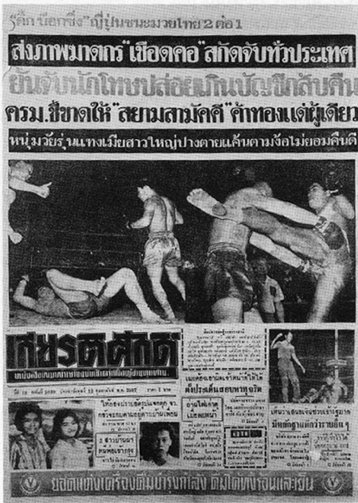
On page 70 of his book, Nakamura reproduces the front page of the Thai daily Kiattisak. The dateline reads Wednesday, February 12, B.E. 2507, which is 1964, and the line under the masthead identifies it as the early-morning edition. Across the top runs the headline “Kick Boxing: Japan beats Muay Thai 2 to 1,” beside a photograph Nakamura identified as the moment he knocked out his opponent. By the time Bangkok woke up on Wednesday, the result was already in print. That’s why I’m confident the fights took place on Tuesday night, February 11, 1964. [1, p. 70][24]
Tadashi Nakamura vs. Tang Sae-Leng
For the fights themselves I rely mainly on Nakamura, who described his own bout and watched the other two from ringside. I haven’t found film of Nakamura’s fight, so for the exchanges themselves I rely on his description. He entered the ring first, facing a fighter he called Tan Salen, known as the Green Tiger. Thai sources give his name as Tang Sae-Leng, and English-language accounts also spell it Tan Charan. He was an experienced fighter who had not competed for about three years and had become a trainer. [29] Nakamura planned to rely on his speed, kicks, and straight punches, but quickly discovered that his opponent’s movement and defensive skills made him difficult to hit cleanly. During an early exchange, Nakamura was knocked down by a kick to his supporting leg. He recovered and began adjusting his approach, landing a powerful body kick that sent Tang to the canvas. Nakamura recalled making a mistake after the knockdown by remaining too close to his opponent, interfering with the referee’s count and allowing him additional time to recover.
Back in his corner after the first round, Nakamura was already wondering how he could last the scheduled five. Noguchi urged him to take the fight to Tang. Early in the second round Nakamura scored his third knockdown. Tang got up once more, and Nakamura won with a straight punch to the jaw. [1, pp. 66–68]
Kenji Kurosaki vs. Rawee Dechachai
Kurosaki entered the ring next, facing Rawee Dechachai, whom Nakamura’s English edition identifies as “Fubii Katchakcha,” a former welterweight champion. [1, p. 68] Rawee, nicknamed the Air Force Rocket, was known for his elbow strikes. He was a champion at Rajadamnern Stadium and a boxing champion of the Royal Thai Air Force, and after he retired from fighting he worked as a maintenance technician in the Air Force’s Ordnance Department. [11][12][30] Over his career, Rawee shared the ring with the best fighters of his generation. Thai sportswriters still list him among the opponents of Apidej Sit-Hirun, who in 1964 held welterweight titles in both Muay Thai and international boxing. On a royal card, Rawee lost a decision to Sompong Charoenmuang, and the King presented Sompong with the trophy for best Muay Thai fighter for that win. [22][31][32] Nakamura described Rawee as a highly experienced fighter with effective movement and excellent timing. Kurosaki had also injured a toe during training in Thailand, which limited his kicking ability.
The contest exposed problems that Kurosaki would later discuss openly in his recorded interview. He had difficulty judging distance, defending against low kicks, and adapting his usual karate methods to the use of gloves. Watching footage of the fight years later, he explained that the Thai fighter’s attacks gradually affected him more than he had initially realized. He also acknowledged that once he lost control of the distance, he found himself attacking without the effectiveness he would have wanted. [3]
I’ve watched the film of the fight myself. Kurosaki threw Rawee to the canvas more than once, and it’s easy to see why he’d fought so hard to keep throws in the rules. What I never saw him land was anything that really hurt Rawee, and I didn’t see him use his low kick at all, which fits the injured toe Nakamura mentions. Rawee landed somewhere between eight and ten elbows to Kurosaki’s face. When Kurosaki wrapped him up and pinned him in the corner, Rawee got an arm free and brought a couple of elbows down on the back of Kurosaki’s head. [11]
Nakamura remembered Kurosaki still on his feet when the referee stopped the fight. Yasuhiko Oyama, who saw the film back in Japan, remembered him falling unconscious. [1, p. 68][2] In roughly the last 30 seconds of the fight shown on film, Rawee appears to land at least three elbows to Kurosaki’s face, two with his right and one with his left. The last strike shown is a right elbow. The film then cuts to Kurosaki on the canvas, struggling to get up as the referee counts. Rawee is declared the winner, and Kurosaki is carried from the ring on a stretcher. [3] Nakamura recalled that he and Fujihira carried their instructor back to the changing rooms. The score was one apiece, and Fujihira still had to go out and fight. [1, pp. 68–69]
Akio Fujihira vs. Haofai Lukkhlongtan
Nakamura’s English edition gives Fujihira’s opponent as Haufi Lukkontai. In Thai he was Haofai Lukkhlongtan, one of the better-known fighters from Bangkok’s Lukkhlongtan gym, where he was remembered as the “knee master.” Thai sources describe him as near the end of his career. [28][29] From the corner, what struck Nakamura was the difference in height. [1, p. 69] Nakamura described Fujihira attempting to close the distance and attack while his opponent countered effectively with knees and other techniques. As the contest continued, Fujihira appeared to be taking the worst of the exchanges.
In the second round Fujihira dropped his opponent with a headbutt. Haofai got up, but Nakamura could see how unsteady he was. Fujihira followed with punches and put him down again to win the deciding match. [1, p. 69] Fujihira’s headbutt would ordinarily raise questions for anyone familiar with Muay Thai rules. But as Hosoda documents, headbutts had been expressly permitted under the special rules negotiated for this competition. Fujihira was using a technique both sides had agreed to allow. [4]
The surviving film of this fight isn’t continuous. It’s a series of cuts, with Japanese captions added later. It opens with Fujihira throwing a low kick right after the start, and a caption quotes him: “Until then, I’d never even thrown a low kick.” He followed it with a left and kept coming with punches. When Haofai tried to tie him up in the clinch, Fujihira timed a throw and came down on him with his full weight. According to the captions, that was the plan from the start: throw him the moment he reached for the clinch. Haofai answered with knees from the clinch, sharp ones from the taller man, just as Nakamura saw from the corner, and he began coming forward with middle kicks. Fujihira’s second throw came the same way, as Haofai moved into his knees. Fujihira later summed up his approach simply: “I had no room to spare, so all I could do was go forward and attack.”
The film shows the finish a little differently from Nakamura. He remembered a headbutt dropping Haofai before Fujihira finished him with punches. On film, the knockdowns come from punches: a right straight that put Haofai down, then a left, a right, and a right hook that ended it at 1:40 of the second round. Since the film is edited, the headbutt may simply be in one of the missing pieces. The moment the fight was over, he turned to the packed stadium and yelled, “Don’t underestimate the Japanese!” With most of the fight missing, I wouldn’t read too much into what’s there. But Kurosaki had fought hard to keep throws in the rules, and the plan Fujihira took into the ring was built around them. [1, p. 69][34]
Was Kurosaki Set Up to Lose?
Yasuhiko Oyama believed he was. After the team returned, the men gathered at the dojo to watch the fight film. Yasuhiko Oyama wasn’t impressed by the opponents Nakamura and Fujihira had faced. Then he saw the man across the ring from his instructor, a fighter with “a great, powerful body.” As he watched Rawee fight, he remembered Mas Oyama’s warning at the airport. Yasuhiko Oyama wrote that he was angry because Kurosaki had been set up. [5]
In his autobiography, Yasuhiko Oyama named Noguchi and explained why he suspected him. Kurosaki had argued with Noguchi and called him out. Looking back, he believed the promoter wanted to get even by drawing Kurosaki into a fight he hadn’t trained for. He called it “his evil plot to pay him back.” That was his judgment about Noguchi’s motive. [2, “The Birth of Kickboxing,” Part 2]
Nakamura recalled that the Japanese learned at a press conference three days before the event that their opponents had changed. To him, the new men looked tougher than the ones originally announced. His account puts the whole team on the receiving end of that change. Yasuhiko Oyama was comparing the men who actually fought, and of those three he thought Kurosaki had drawn the hardest assignment. [1, p. 66][5]
A Japanese review of Hosoda’s biography identifies Rawee as the strongest of the three Thai opponents. Watching Rawee in Bangkok, Nakamura noticed his timing and how hard Kurosaki found it to close the distance. [1, pp. 68–69][13]
Thai accounts have long told the night differently. In their version, the organizers didn’t think much of the visitors and matched them with ordinary fighters, and the only real contest was Rawee’s win over the Japanese instructor. [27][29] The organizers may well have thought these three would be good enough to beat the visitors. What interests me is how much trouble Tang and Haofai gave the two Japanese fighters who won. Tang Sae-Leng had been in the game long enough to become a trainer, which tells me other fighters were learning from him. Haofai Lukkhlongtan’s own gym remembered him as the “knee master,” and Nakamura saw why from the corner as the taller man countered Fujihira with his knees. Neither of them was at his peak, but they were experienced professionals, good enough to put Nakamura on the canvas and to get the better of Fujihira until the headbutt. [1, pp. 66–69][28][29]
Thai sources also say Rawee had been away from the ring for about a year. [29] That doesn’t change the matchup that mattered. Kurosaki was 33, a month short of his 34th birthday. Rawee was in his early twenties at most. Anyone who has spent time around the fight game knows how big that gap is. A fighter in his thirties is near the end of his competitive life, and a fighter in his early twenties who has grown up in the ring is in his prime. Kurosaki had also spent months preparing the younger men instead of himself, and by Nakamura’s account he fought out of a sense of responsibility for the trip. He wasn’t helpless in that ring, but he wasn’t prepared the way the two men he trained were. Neither side’s version of that night is complete without the other. [1, p. 62][11][23][30]
Who picked Rawee for Kurosaki, and what did that person intend? None of the accounts identifies who made that match. But there’s another question I’d ask. What would a 3–0 victory for Kyokushin have meant for Noguchi?
For Mas Oyama, three karateka beating three professional Thai boxers in Bangkok would have been wonderful publicity. Noguchi had to think about whether people would buy a ticket to see karate face Muay Thai again. With two Japanese wins and a Thai victory over the man who trained both winners, fans on either side had a reason to come back. I think 2–1 gave a promoter more to work with than a clean sweep. Whether anyone chose the opponents with that in mind is a question the result alone can’t answer.
Writing in Black Belt in 1968, Lloyd Williamsen said Noguchi thought the Japanese had done well, though Thailand hadn’t put its strongest fighters in the ring. Noguchi also noticed how excited the crowd had been. From a promoter’s point of view, what better reason to put on another show? The Japanese had won two out of three, and Thai fans still had reason to think their best men could turn the result around. [26]
The Aftermath
The Japanese had won two of the three fights, but the trip did not end happily. The following day, Nakamura and Fujihira visited Kurosaki as he recovered from his injuries. Nakamura recalled thanking their instructor for everything he had done to prepare the team and help them through the difficulties surrounding the competition. Kurosaki wept. It was the first time either student had seen him cry. [1, p. 69]
Nakamura was aware that news of Kurosaki’s defeat had reached Japan before the team returned, and he anticipated that Mas Oyama would be unhappy. On the journey from the airport, he found himself sharing a taxi with Chiyako Oyama, Mas Oyama’s wife. He decided to explain everything Kurosaki had done for the team, hoping that hearing the account from Chiyako would influence her husband’s reaction.
Unfortunately, Nakamura’s efforts were unsuccessful. Nakamura recalled Mas Oyama saying he suspected Kurosaki had spent his time drinking instead of training. [1, pp. 70–71] Nakamura had watched Kurosaki spend those months preparing the younger men. Hearing Mas Oyama criticize him afterward, Nakamura wrote, “It was the first time that I had doubts about my teacher.” [1, p. 71]
From Karate to Kickboxing
Losing in Bangkok didn’t drive Kurosaki away from fighting. It sent him deeper into it. He became a central figure in Japanese kickboxing and founded Mejiro Gym in Tokyo. It’s the clearest example I know of the idea that we win or we learn. Two things caught my attention. Fujihira said he’d never thrown a low kick before that night, and Kurosaki recalled how much trouble Rawee’s low kicks gave him. By the time I started training in 1980, gedan mawashi geri, the low roundhouse kick, was a staple of our Kyokushin training. It makes me wonder how much those fights in Bangkok influenced the way we came to use it. [3][34] One of his most successful students was Toshio Fujiwara, who joined Kurosaki’s gym in 1969 and developed into an outstanding professional fighter. In 1978, Fujiwara became the first non-Thai to win a Rajadamnern Stadium championship, capturing the lightweight title on a sanctioned card held in Tokyo. [14]
Kurosaki’s influence also extended well beyond Japan. In 1975, three Dutch karateka, Jan Plas, Jan van Looyen, and Peter van der Hemel, traveled to Japan and trained under Kurosaki. Impressed by his methods, Plas returned to Amsterdam and established a kickboxing gym named Mejiro, after the Tokyo neighborhood where Kurosaki taught. Mejiro Gym Amsterdam became an important center for Dutch kickboxing, helping develop a fighting tradition that would later produce numerous international champions. [15]
The influence of the Thailand challenge extended beyond Kurosaki. Fujihira also became involved in kickboxing, competing professionally under the name Noboru Osawa, while Noguchi continued developing the new sport as a commercial promotion in Japan. [17] In his history of Noguchi, Hosoda described the Thailand challenge as an important early step toward Japanese kickboxing. According to Hosoda, Noguchi announced the name “Kick Boxing” at a reception in Bangkok before the fights. The Thai newspaper reproduced on page 70 of Nakamura’s book gives us a contemporary example of that name in print: Kiattisak used it when reporting the result. [4][24]
The commercial side matters to this story. Promoters were looking for contests that would attract audiences, while fighters and instructors were learning from encounters with unfamiliar techniques and methods. The Thailand challenge brought those interests together, sometimes uncomfortably, but helped influence the direction of Japanese full-contact fighting for years afterward.
Differing Accounts of Noguchi’s Role
The participants did not always agree about who deserved credit for the challenge or the development of Japanese kickboxing. In Chasing the American Dream, Yasuhiko Oyama discussed an interview Noguchi gave to Full Contact KARATE magazine in April 1996. In his account, Noguchi claimed that Mas Oyama had become concerned that the Thai fighters were too strong and that a defeat would damage Kyokushin’s reputation. Noguchi also claimed that he had been responsible for training the Japanese fighters who traveled to Thailand.
Yasuhiko Oyama rejected both claims. On the private conversations between Noguchi and Mas Oyama, he acknowledged that he hadn’t been there. On the training, he could speak for himself. He had spent a month at Kinugawa with the other three men, and Kurosaki had run the camp. [2][6] Nakamura gave Noguchi credit for explaining the Thai boxing world to the team, arranging sparring at his gym and advising him between rounds in Bangkok. He was equally clear about who planned the training and supervised the men day after day. That was Kurosaki. [1, pp. 58–61, 67]
The Men Who Took Part
The five men went different ways after Bangkok. Some stayed in karate and others moved into professional kickboxing, and between them they left a mark on full-contact fighting in Japan and well beyond it. I’ll start with Kurosaki, who trained them, took them to Thailand, and ended up fighting alongside them.
Kenji Kurosaki
Kenji Kurosaki was born on March 15, 1930, in Kuwamura, Tochigi Prefecture, the youngest of six children. He trained in kendo, karate, and judo from a young age, and he tested his limits in ways most of us wouldn’t attempt: a week of fasting without water, going without sleep, and 82 days of seclusion in the mountains. It isn’t hard to see where the nickname Oni no Kurosaki, Kurosaki the Demon, came from. At 28 he opened the Narimasu branch of the Oyama dojo, and he was 33 when he fought Rawee. [23]
After Bangkok he built the kickboxing career described earlier, and Mejiro Gym produced a string of champions. Two of them run through this story: Akio Fujihira, the student he took to Bangkok, and Toshio Fujiwara, who went on to win a Rajadamnern title. In October 1978 Kurosaki founded his own organization and created Shin Kakutōjutsu, a combat art meant to cover all of fighting rather than a single style. He also wrote about his approach to training, beginning with his 1979 autobiography, Hisshi no Chikara, Hisshi no Kokoro. [14][23][33]
Nearly thirty years after the fight, Kurosaki returned to Thailand while filming a documentary about his life for Japanese television. He went to see Rawee Dechachai, and the Thai commentator who reported the meeting said the two men greeted each other like close friends who had been apart a long time. [11] I don’t know of anywhere outside combat sports where a great rivalry so often turns into a great friendship. Two men can spend a night trying to knock each other out and then go have a beer together afterward. Anyone who has fought understands what it takes, and that usually leads to respect. As I’ve often said, it’s the fighter, not the style.
Kaicho Tadashi Nakamura, 9th Dan
Tadashi Nakamura traveled to the United States in 1966 to establish and develop Kyokushin Karate in New York. He became one of Mas Oyama’s most important representatives in North America and spent the next decade building the organization and teaching American students. In 1976, Nakamura left Kyokushin and founded the World Seido Karate Organization. Seido reflects his belief that karate training should develop character as well as physical ability, emphasizing respect, sincerity, and personal responsibility.
Nakamura holds the title Kaicho, 9th Dan, and is the founder of World Seido Karate. The organization has schools internationally, with its headquarters in New York City. His son, Nidaime Akira Nakamura, serves in the organization’s leadership. [16] His autobiography, The Human Face of Karate, provides a firsthand account of his early training under Mas Oyama, the Thailand challenge, his move to America, and the eventual establishment of Seido.
World Seido Karate: https://www.seido.com/
Books and publications: https://www.seido.com/seido-store/books
Akio Fujihira (Noboru Osawa)
Fujihira boxed professionally under the name Akio Osaki. For the surname he took one character from each teacher: 大 from Mas Oyama and 崎 from Kurosaki. He fought eleven professional boxing bouts before becoming known to kickboxing audiences as Noboru Osawa. [21] Despite his relatively small stature, Fujihira developed a reputation for exceptional determination and physical conditioning. Known as the Little Giant, he became an early Japanese bantamweight kickboxing champion and established himself as one of the sport’s respected competitors. [17]
His extraordinary dedication to training was something Yasuhiko Oyama remembered vividly. In a March 2024 interview for World Oyama Karate, Oyama described how Fujihira would remain at the dojo long after regular practice ended, sometimes training until midnight. His loud kiai and relentless workouts occasionally disturbed the neighbors, leading to complaints and even visits from the police. Yasuhiko Oyama also recalled that Fujihira’s training remained just as intense after the new Kyokushin headquarters opened. With his fellow students gone for the evening, he would continue practicing in the basement, sometimes disturbing Mas Oyama and his family, who lived upstairs. [18]
After retiring from professional competition, Fujihira opened Osawa Shokudo, a Tokyo restaurant that became famous for its exceptionally spicy curry. He operated the restaurant for approximately forty years before closing it in May 2013. [17] Even retirement didn’t entirely quiet his enthusiasm for training. Yasuhiko Oyama remembered that, after leaving the restaurant business around age seventy, Fujihira began running again. According to Oyama, Fujihira’s wife complained that he was exhausting himself so badly that he could barely move when he returned home. After being persuaded to stop running, Fujihira reportedly joined a nearby boxing or kickboxing gym. There, his intense bag work and unusually loud kiai attracted so much attention that the gym owner asked him not to return. Oyama related these stories with obvious affection and admiration. His point was that Fujihira had always trained with an intensity that was exceptional, even among the demanding practitioners of early Kyokushin. [18]
Soshi–Saiko Shihan Yasuhiko Oyama, 9th Dan
Yasuhiko Oyama continued developing his karate career after the Thailand preparations and became widely respected for his technical knowledge, fighting strategy, and ability to train successful full-contact competitors. In 1972, he moved to Birmingham, Alabama, where he helped expand Kyokushin Karate in the United States. He and his older brother, Shigeru Oyama, later separated from Kyokushin and established World Oyama Karate as an independent organization in the mid-1980s.
Yasuhiko Oyama holds the title Soshi–Saiko Shihan, 9th Dan, and is a founder of World Oyama Karate. Its international headquarters is located in Birmingham, Alabama, and the organization continues teaching the full-contact karate methods developed by the Oyama brothers. [19] His autobiography, Chasing the American Dream, offers a personal account of his early life, training under Mas Oyama, his career as an instructor, and his eventual move to the United States.
World Oyama Karate: https://worldoyama.com/
Books and publications: https://worldoyama.com/books/
Hirofumi Okada
Hirofumi Okada was one of the original four fighters selected for the Thailand challenge and participated in the preparations under Kurosaki at Kinugawa. Okada subsequently established Renseijuku, a karate organization dedicated to preserving the practical fighting methods of the early Oyama dojo. Its approach emphasizes striking, throwing, and the broader range of techniques practiced before Kyokushin’s competition rules became more restrictive. [20] Renseijuku identifies Okada as one of the leading practitioners of the original Oyama dojo, a reputation consistent with his selection for the Thailand challenge.
Okada passed away on April 9, 2025, at age 85. His organization announced his death on April 21, noting that his funeral had already been held privately in accordance with his wishes. [20] Although he did not ultimately compete in Bangkok, Okada remained an important figure in preserving the older fighting methods of the Oyama dojo, and his involvement in the original preparations deserves recognition.
Most people remember the Thailand challenge as a score. What came out of it was bigger than three fights. Kurosaki helped develop Japanese kickboxing and contributed to the foundations of the Dutch fighting tradition. Nakamura and Yasuhiko Oyama went on to establish international karate organizations. Fujihira became a professional boxer and kickboxing champion, while Okada devoted his later career to preserving the fighting methods of the early Oyama dojo.
The morning after the fights, Nakamura and Fujihira knelt beside Kurosaki’s bed to thank him. I doubt Kurosaki would have taken any credit for their wins. We can show our students the path, but they’re the ones who have to walk it. That doesn’t make students any less grateful to their teachers. If anything, it’s the opposite, and Nakamura and Fujihira knew exactly what he had done for them. Kurosaki lost in Bangkok. The two men he trained made sure he wasn’t alone in it. [1, p. 69]
Osu!
References
[1] Nakamura, Tadashi. The Human Face of Karate. Translated by Dennis Logan. Tokyo: Shufunotomo, 1989.
“My Trip to Thailand,” pp. 56–71. Page references follow the English edition (second printing, 1992). The original Japanese edition appeared in 1988.
[2] Oyama, Yasuhiko. Chasing the American Dream. World Oyama Publishing, 2021.
See “The Birth of Kickboxing,” Parts 1 and 2. A firsthand account of the original four fighters, Kurosaki’s training program, the Kinugawa camp, repeated postponements, and Oyama’s withdrawal.
[3] Kurosaki, Kenji. Recorded Japanese interview accompanying footage of his Thailand fight.
Video: 黒崎健時vsムエタイ3, published on YouTube by 株式会社アッパー. Includes Kurosaki’s discussion of the rules, his performance, and his reasons for accepting the challenge.
https://www.youtube.com/watch?v=qN5KnMG2yhw
[4] Hosoda, Masashi. Bunshun Online, November 18, 2020.
Two excerpts from Hosoda’s 沢村忠に真空を飛ばせた男 (Shinchosha, 2020). The first covers Nakamura’s December conversation and the negotiations in Japan. The second reproduces the January 14 newspaper report and gives Noguchi’s explanation for arranging the story and sending the team to Bangkok. Part one · Part two
[5] Oyama, Yasuhiko. “Muay Thai.” World Oyama Karate Honbu Newsletter, Issue 29, October 2011.
An earlier published account of the Thailand preparations, including the original four-man team and the Kinugawa training camp.
https://sfoyama.com/wp-content/uploads/2023/04/WOK_Newsletter29.pdf
[6] Noguchi, Osamu. Interview in Full Contact KARATE, April 1996, Issue No. 110.
Discussed and quoted by Yasuhiko Oyama in Chasing the American Dream, including Oyama’s objections to Noguchi’s account of the preparations and Mas Oyama’s involvement. The original interview has not been independently examined.
[7] Nikkan Sports, January 14, 1964.
Contemporary Japanese newspaper report identifying Kurosaki, Nakamura, and Fujihira as the three fighters scheduled to depart Japan on January 15. Reproduced in Hosoda’s historical account, reference [4].
[8] Hosoda, Masashi. Interview with Yoshinori Ihara, BOUTREVIEW, January 15, 2021.
Discusses Noguchi’s financial difficulties, the loss of his regular boxing promotion income, and their possible influence on his decision to develop kickboxing.
https://www.boutreview.com/3/interview/item_48067.html
[9] eFight. Interview with Terutomo Yamazaki, September 20, 2019.
The first All-Japan Kyokushin champion recalls the original 1969 tournament regulations, including momentary grabbing and throwing techniques.
https://efight.jp/news-20190920_355038
[10] Shinkyokushinkai. Interview with Shihan Isao Kobayashi, May 15, 2014.
Discusses the development of Kyokushin knockdown competition and the original allowance of grabbing, hooking, and throwing techniques.
https://www.shinkyokushinkai.co.jp/news/jfko1st/
[11] Thai Classic. “Rawee Dechachai (Thailand) VS Kenji Kurosaki (Japan).” YouTube, December 18, 2015. Film of the fight with Thai television commentary from around 1993, identifying Rawee as the “Air Force Rocket,” noted for his elbows, and giving his age that night as 22. https://www.youtube.com/watch?v=NGGpeRhs7ec
[12] Muay Thai Technical Knowledge Database. “Rawee Dechachai.”
Thai-language material describing Rawee’s fighting techniques and reputation.
https://kumta-muaythai.com/data-base/kherux-khay-mwythiy?catid=9&id=152:xngkh-khwam-ru-mitay-yxd-mwythiy&view=article
[13] Ichijo Book Review. Review of Masashi Hosoda’s biography of Osamu Noguchi, December 2020.
Discusses the three 1964 contests, the differing quality of the Thai opponents, and Kurosaki’s disadvantageous matchup.
https://ichijyo-bookreview.com/2020/12/post-1916.html
[14] Fight Record. “All Non-Thai Muay Thai Fighters to Win a Rajadamnern Stadium Title.”
Documents Toshio Fujiwara’s 1978 title and notes that the championship was won in Japan on a Rajadamnern-sanctioned card.
https://fightrecord.co.uk/all-non-thai-muay-thai-fighters-to-win-a-rajadamnern-stadium-title/
[15] Mejiro Gym Amsterdam. “The History of Mejiro Gym Amsterdam.”
The gym’s official account of Jan Plas’s 1975 visit to Japan, his meeting with Kurosaki, and the origins of Dutch Mejiro Gym.
https://mejirogym.nl/history.php
[16] World Seido Karate Organization.
Official organizational history, information about Kaicho Tadashi Nakamura, and bookstore.
https://www.seido.com/
[17] Takeyama Dojo. “Kickboxing Master: Noboru Osawa.” August 13, 2013.
An account from a former student identifying Fujihira as Noboru Osawa and documenting his kickboxing career, restaurant, and later coaching activities.
https://ameblo.jp/takeyamadojo/entry-11588732257.html
[18] World Oyama Karate Official Online Training. “Yasuhiko Oyama Karate Stories,” Episode 36, March 4, 2024.
A recorded interview in Japanese, with English subtitles, in which Yasuhiko Oyama recalls Fujihira’s extraordinary dedication to training and several incidents arising from his continued practice.
https://www.youtube.com/watch?v=7JoeQsOCoDM&t=4s
[19] World Oyama Karate Organization.
Official history and information about its founders.
https://worldoyama.com/style-and-history/
[20] Renseijuku. Official organizational history and April 21, 2025 death announcement for Hirofumi Okada.
Identifies Okada as its founder and a leading practitioner of the early Oyama dojo. The April 21 announcement confirms his death on April 9, 2025.
https://sougoukaratedou-renseizyuku.com/page1
https://sougoukaratedou-renseizyuku.com/blog-archive/day-202504 May 14 memorial on Okada’s withdrawal: https://sougoukaratedou-renseizyuku.com/page4/bid-567138
[21] Shotaro Funaki. “小さな巨人”藤平昭雄(大沢昇) [The Little Giant, Akio Fujihira (Noboru Osawa)], October 2022. Fujihira’s boxing name and bout-by-bout record credited to the Japan Boxing Commission. https://ameblo.jp/upper/entry-12770750797.html
[22] Daily News (เดลินิวส์). “กลุ่มคนรัก ‘อภิเดช ศิษย์หิรัญ’ ตั้งสมาคมรำลึก ‘จอมเตะบางนกแขวก’.” February 28, 2024. Lists Rawee Dechachai among Apidej Sit-Hirun’s notable opponents and records Apidej’s 1964 welterweight titles in Muay Thai and international boxing. https://www.dailynews.co.th/news/3214140/
[23] Kurosaki, Kenji, and Makoto Tokuhashi. サムライへの伝言 [Message to the Samurai]. Bungeisha, 2004. The publisher’s author profile gives Kurosaki’s birth as March 15, 1930, in Kuwamura, Tochigi Prefecture, and lists Noboru Osawa (Fujihira) and Toshio Fujiwara among the champions he trained. https://www.bungeisha.co.jp/bookinfo/detail/4-8355-7396-X.jsp
[24] Kiattisak (เกียรติศักดิ์). Front page of the early-morning edition dated Wednesday, February 12, B.E. 2507 (1964). The headline uses “Kick Boxing” in Thai script and reports Japan’s 2–1 victory. Reproduced in Nakamura [1], p. 70. I don’t read Thai. I read the front page with translation tools and then asked a Thai speaker on Reddit’s r/translator to check it. They confirmed the date line as Wednesday, February 12, B.E. 2507, and read the line under the masthead, หนังสือพิมพ์รายวันฉบับเช้าตรู่เพื่อผู้อ่านทุกท่าน, as identifying an early-morning daily.
[25] BoxRec. “Hiroyuki Ebihara vs. Pone Kingpetch (2nd meeting).” Bangkok, January 23, 1964. https://boxrec.com/wiki/index.php/Hiroyuki_Ebihara_vs._Pone_Kingpetch_%282nd_meeting%29
[26] Williamsen, Lloyd. “Kick Boxing: The Mixture of Mayhem.” Black Belt, December 1968. The earliest English-language account found. Gives February 12, 1963, as the date arranged for the matches and reports Noguchi’s view of the result. Its fight order, round details and year differ from the participants’ accounts.
[27] Main Stand. “โยชิฮิโระ ซาโตะ: นักชกคนเดียวในโลกที่ทำ ‘บัวขาว’ น็อกแบบหลับกลางอากาศ.” Thai sports article stating that the Thai side underrated the Japanese and sent three second-tier fighters, and that only Rawee won. https://mainstand.co.th/th/muaythai/muaythai/article/10
[28] LKT Muay Thai (Lukkhlongtan gym). “History” (ประวัติ). Lists Haofai Lukkhlongtan, “the knee master,” among the gym’s well-known fighters. https://lktmuaythai.com/th/history/
[29] Sanook. “มวยไทยเตะเก่ง: แต่ทำไมถึงไม่ค่อยมีแชมป์โลกคิกบอกซิ่งชาวไทย?” Thai sports article describing Haofai as near retirement, Tang Sae-Leng as having become a trainer, and Rawee as returning after nearly a year away. https://www.sanook.com/sport/959007/
[30] Institute for the Conservation of Thai Boxing Art, Department of Physical Education, Ministry of Tourism and Sports. ศิลปะมวยไทย [The Art of Muay Thai]. Undated (after 2012), p. 76. Profile of Rawee Dechachai giving his birth date (September 3, 1942), his Rajadamnern and Royal Thai Air Force championships, and his later work in the Air Force Ordnance Department. The text closely matches the Thai Wikipedia article on Rawee. https://www.dpe.go.th/th/doc-knowledge-sports/019e49df-0545-7a66-8d69-a9da2aa3c0a4
[31] Khaosod (ข่าวสด). “คลิปทรงคุณค่า การฟิตซ้อมของ ‘จอมเตะบางนกแขวก’ อภิเดช ศิษย์หิรัญ ยอดมวยไทยตลอดกาล.” Names “Air Force Rocket” Rawee Dechachai among the leading fighters who faced Apidej Sit-Hirun. Republished on LINE Today. https://today.line.me/th/v3/article/v30PGl
[32] Matichon Weekly (มติชนสุดสัปดาห์). “เด็กเก็บบอล: พระมหากรุณาธิคุณของในหลวง รัชกาลที่ 9 ต่อวงการมวยประเทศไทย.” Reports Sompong Charoenmuang’s decision win over Rawee Dechachai on a royal card and the King’s trophy for best Muay Thai fighter awarded to Sompong for it. https://matichonweekly.com/column/article_63104
[33] National Diet Library (Japan). Authority record for 黒崎健時 (Kurosaki Kenji), 1930–. Gives his birth year from the colophon of his autobiography, 必死の力・必死の心 [Hisshi no Chikara, Hisshi no Kokoro] (Sports Life, 1979). http://id.ndl.go.jp/auth/entity/00103067
[34] FiGhT. “Kyokushin vs Muay Thai in 1964.” YouTube, July 4, 2006. Edited film of Fujihira’s fight with Haofai, introduced by a Japanese title card reading “Muay Thai vs. Oyama Karate, mixed-style match (3 min × 5 rounds), February 1964.” The uploader’s description calls it the second of the three fights; Nakamura, who was there, places it third. https://www.youtube.com/watch?v=9zpMAVcvH5Q
Follow- Kyokushin Karate Blog on Facebook, Instagram, and X. Be sure to visit Kyokushinkai Karate, on Facebook, one of the largest and most dedicated Kyokushin communities online. Learn more about Bill Stewart and Texas Kyokushin Karate, where we continue the Kyokushin tradition in Texas.
