

Mas Oyama’s tenth motto reads, “The true essence of the Martial Way can only be realized through experience. Knowing this, learn never to fear its demands.” In The Value of Experience I wrote about what that means for competition, and why my teacher wanted every student to step into a tournament at least once. The older I get, though, the more I think the motto also describes something else: how karate gets passed from one generation to the next.
As instructors, we spend a great deal of time explaining things to students. We demonstrate techniques, answer questions, and share stories from our own training. We do our best to shorten the learning curve and help students avoid the mistakes we made ourselves. Some of what matters most can’t be explained, though. A student can read about perseverance, fear, or being responsible for others, but none of it means much until they’ve lived it, whether that’s continuing through a grading when every part of the body is saying stop, or standing across from an opponent before a tournament match. We can share what we’ve learned, but students still have to live it themselves before it becomes part of them.
Learning It the Hard Way
Some of the lessons we carry with us throughout our karate lives come from our teachers, while others come from experiences that reinforce what our teachers have already taught us. Many years ago, while serving on sea duty, I was president of our ship’s martial arts club and one of its assistant instructors, even though I was still a brown belt. Because practitioners from a variety of styles trained together, the club had agreed on a specific set of sparring rules, and one of them was simple: no leg kicks.
I was used to sparring with leg kicks, but most other styles at the time didn’t allow them, so the club voted to ban them, and I was fine with that. My teacher used to tell us that being Kyokushin meant being able to fight anyone under any ruleset. Tell me the rules and I’ll adjust, as long as we both follow them. The problem was one member who wore a black belt. In rank, I was technically the junior, but he kept throwing low kicks anyway. I expected a black belt to have control of both his power and where his techniques landed. More than once I reminded him of the rules and told him that if he wanted to fight with low kicks, I was fine with it, but we needed to agree on it first.
When sparring, I usually let my partner set the pace. If someone sparred light, I sparred light. If someone wanted to go hard, I was happy to oblige. My teacher’s son, Jimmy, once said that if someone hit me too hard during light sparring, it was like someone flipped a switch, and I went straight to knockdown mode. As the senior in rank, this black belt was setting the pace, and one day he threw one low kick too many and the switch flipped. I answered with three low kicks to the same leg, and he hopped off the mat on the other one. I’ll admit I may have kicked harder than I needed to, but it wasn’t personal. I was making a point. Afterward, he followed the rules. Some people don’t listen, and when they don’t, we can either keep taking it or show them why it’s better to follow the rules.
Not every lesson that only experience can teach comes with a low kick. A student can be told that years of sweat and effort toward a black belt will eventually pay off, but nothing compares to the moment they find out they’ve passed their black belt grading and realize that all those years have finally brought them there.
Becoming an instructor taught me something I never expected. Until then, I had no idea that watching a student do well in a tournament could be even more satisfying than competing myself. Teaching, I discovered, can be far more challenging, and far more rewarding, than it looks from the student side of the dojo floor.
Seeing My Teacher in My Own Karate

I remember sparring with my teacher, Shihan Jim Swanson, many years ago. During one exchange, we both attacked at exactly the same moment with the same technique, and then both answered with exactly the same counter. What happened next probably annoyed him just a little. I started laughing, not because either of us had done anything funny, but because I suddenly realized what had happened. After years of training together, we had arrived at the same solution to the same problem at exactly the same moment. For a brief instant, I could see just how much of my teacher’s influence had become part of my own karate. No one could have explained that to me beforehand. It had to be experienced.
Seeing Myself in My Student
Today I occasionally find myself on the other side of that. Several months ago, I was watching Claudio, one of my students, work with a beginner and found myself recognizing familiar explanations, familiar corrections, and even familiar mannerisms. For a moment, it felt like watching a younger version of myself.
It reminded me of something I once told him. After sharing a story about my own teacher, I remarked that forty years from now, long after I’m gone, he’ll probably tell that same story to one of his students, and if I’m fortunate, maybe he’ll have a story or two about the old man who first taught him Kyokushin. At the time it was simply a passing comment. The more I think about it, the more I believe this is how martial arts have always been passed from one generation to the next, not only through techniques, but through shared experiences.
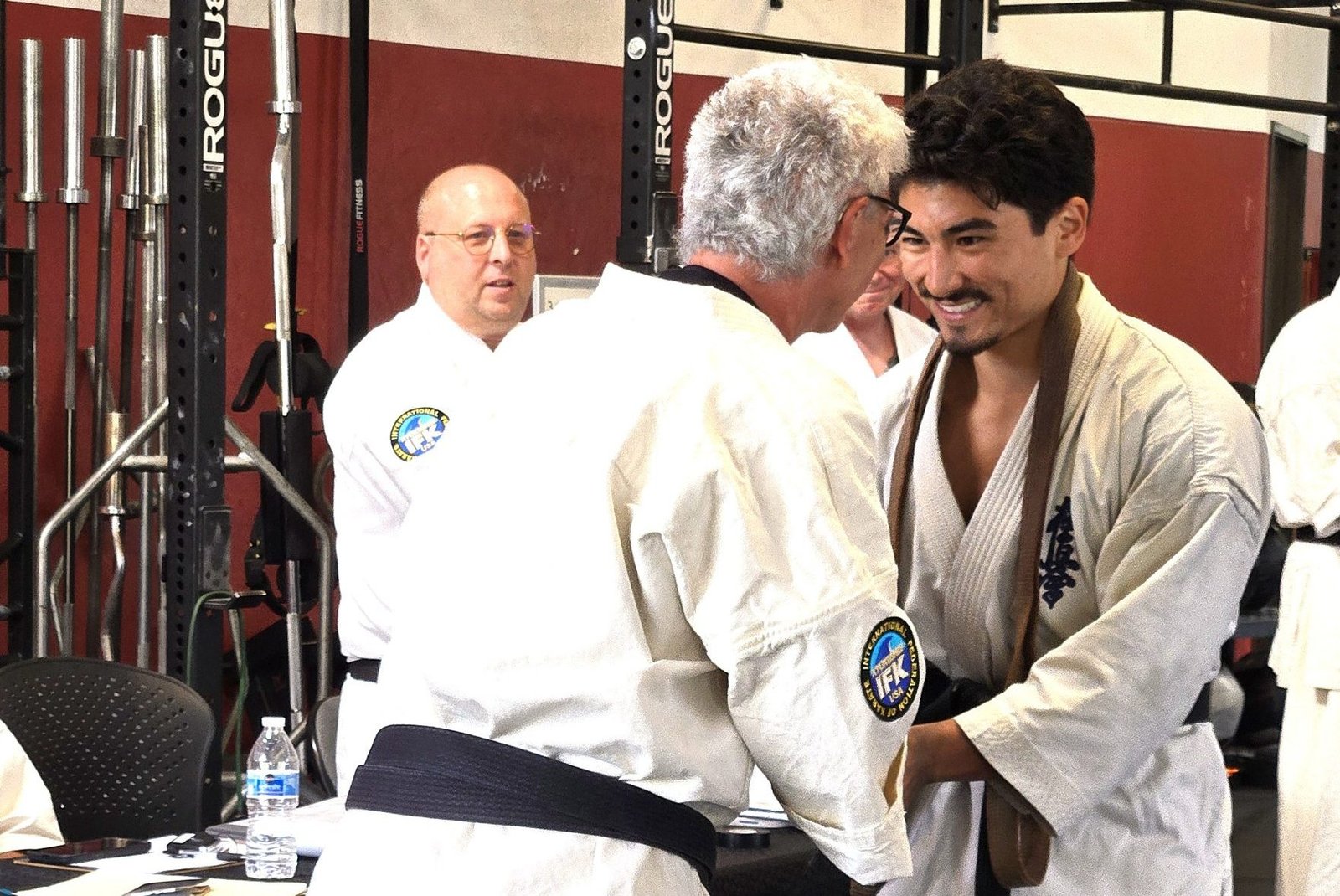
In June 2026, Claudio graded for shodan. When I tied his black belt around his waist, the memories of my own teacher came rushing back. I never made him an explicit promise, but I’ve always felt an obligation to pass on what he taught me, and in that moment it felt as though I had kept a promise to the most important person in my adult life, a man who has been gone for more than twenty years. It was an emotional moment. In some ways, I think a black belt can mean even more to the teacher than to the student.
What Experience Passes On
The most important things in karate can’t be found in a book, a video, or even an article like this one. Those things can point us in the right direction, but sooner or later we have to walk the path ourselves, and what our teachers gave us comes along in how we walk it. Some lessons can be explained, but the most important ones have to be lived.
Osu!
Follow- Kyokushin Karate Blog on Facebook, Instagram, and X. Be sure to visit Kyokushinkai Karate, on Facebook, one of the largest and most dedicated Kyokushin communities online. Learn more about Bill Stewart and Texas Kyokushin Karate, where we continue the Kyokushin tradition in Texas.
