

“I have not permitted myself to be ignorant of any martial art that exists. Why? Such ignorance is a disgrace to someone who follows the path of the martial arts.”- Mas. Oyama

Sometimes people ask me what martial arts go well with Kyokushin. It’s a fair question — especially given how training emphasis can vary from dojo to dojo. Some assume Kyokushin is “incomplete” because we don’t punch to the face, but that criticism usually comes from confusing tournament rules with the art itself.
Kyokushin was founded on the concept of what would work in a real fight. Shihan Cameron Quinn has often pointed out on his YouTube channel that if you look at Sosai Masutatsu Oyama’s three major works — What is Karate, This is Karate, and Advanced Karate — you’ll find that a large percentage of what he taught takes place within stand-up grappling range.
Kyokushin is often criticized because it supposedly “doesn’t teach punching to the face.” Anyone familiar with traditional Kyokushin training should realize that’s not true. For example, where do you think seiken ago uchi, uraken gammen uchi, and seiken jodan tsuki are aimed?
The issue is not the style of Kyokushin, but that in some schools, hand strikes to the face and head simply aren’t practiced in sparring to the degree they once were.
People should not confuse the style of Kyokushin with the ruleset used in knockdown competition. One is a martial art. The other is a sport.
That does bring up an important point that bears mentioning. I remember my sensei saying to us more than once, “Anytime you take a martial art and turn it into a sport, you weaken it.”
I started training in 1980, and in the dojo I came up in, we absolutely punched to the face while sparring, wearing lightweight gloves, and were allowed to grab, throw, and take down. If we were preparing for a competition, then we trained to that specific ruleset.
Years later, a student of mine who had previously trained in judo asked to do randori with me after class. He seemed genuinely surprised when I took him down and caught him in an armbar. As I said earlier, not all Kyokushin schools are alike.
As knockdown competition became more prominent, some dojo naturally began emphasizing the sport aspect more heavily than the broader curriculum. There are exceptions, of course, but over time it became more common for certain elements — face punching, clinching, throws, and groundwork — to receive less attention in regular training.
I should mention that I’m not suggesting everyone start cross-training in other martial arts simply for the sake of it. Kyokushin absolutely is a valid system of self-defense, and like other martial arts, it can also be trained for physical fitness, focus, discipline, and sport.
It’s safe to say that most Kyokushin dojo conduct sparring primarily under knockdown rules. Yes, it’s a sport ruleset, but it’s also an effective way to develop conditioning, toughness, timing, distancing, and the ability to function under pressure. Combined with kihon, renraku, kata, and body conditioning, it can absolutely prepare someone for self-defense.
At the same time, if a dojo rarely practices face punching, clinching, takedowns, or groundwork, then students who want to become more well-rounded fighters may benefit from exploring those areas further. That doesn’t mean abandoning Kyokushin. In my opinion, it means building upon the foundation Kyokushin already provides.
My advice is simple: talk to your sensei first.
There’s real value in building a solid foundation before branching out. Your instructor may even recommend specific teachers or systems that would complement your training. That was my own experience. When I was a young shodan and became interested in learning weapons more in-depth, my teacher recommended someone who taught both kobudō and taijutsu and encouraged me to train there.
Different combat arts emphasize different aspects of fighting. There’s nothing wrong with training with a specialist in an area you wish to develop more fully.
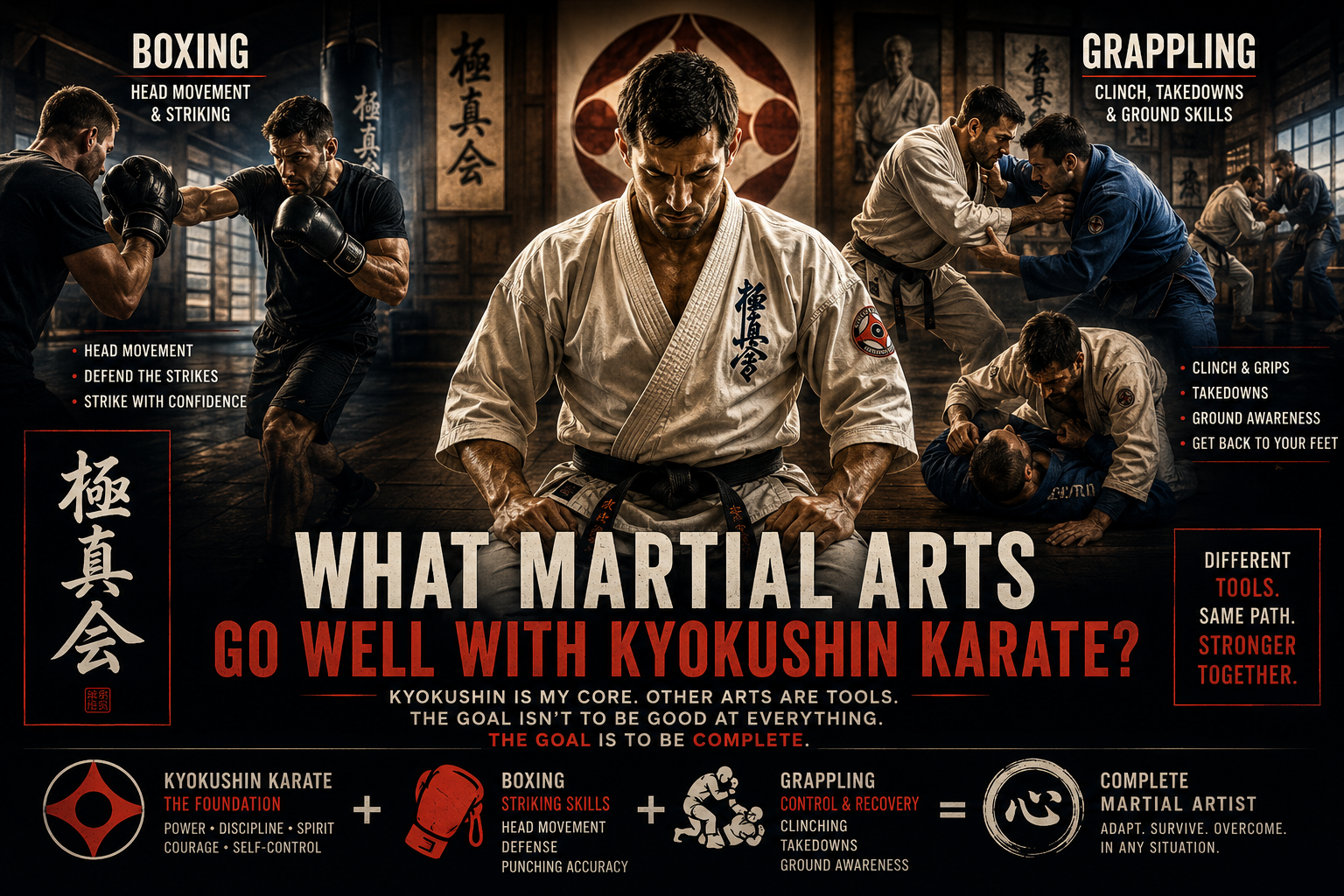
Having said all that, if it were me making the recommendation, I would suggest the best arts to complement Kyokushin training would be:
Boxing — for footwork, body movement, and hand skills.
Judo, BJJ, or Wrestling — for grappling, clinch control, and ground fighting.
Each of these can strengthen skills already present within Kyokushin and help develop a more complete martial artist.
Done with the right mindset, this doesn’t replace Kyokushin; it strengthens your understanding of it. Sosai Oyama’s vision was never about limitation — it was about exploration and truth through experience.
Good luck! Osu!
Final Thoughts
I’m trying to write a little more these days, and I have several new articles in the pipeline. I look forward to reading your thoughts and comments on this and other topics. OSU!
Connect with me:
Follow Kyokushin Karate Blog on Facebook, Instagram, and X.
Be sure to visit Kyokushinkai Karate, our Facebook group — one of the largest and most dedicated Kyokushin communities online.
Learn more about Bill Stewart and Texas Kyokushin Karate, where we continue the Kyokushin tradition in Texas.
