

Today, Kyokushin is widely recognized as a striking-based karate style centered around knockdown competition and hard conditioning. But early Kyokushin — and Mas Oyama’s own approach to fighting — included a much broader range of techniques than many people realize.
I was recently involved in an online discussion about how Mas Oyama might have performed under modern MMA rules. As I thought about the subject afterward, I found myself going back through some of Oyama’s older books — books I had not looked through carefully in years.
What struck me immediately was how much grappling-related material they contained.
Kyokushin is famous for its striking and conditioning. Unfortunately, it has also become known as the style “that doesn’t punch to the face.” That has always seemed a bit strange to me because in the dojo I came up in, we definitely did strike to the face.
There are valuable things to be gained from tournament fighting. The problems begin when everyday dojo training becomes more focused on winning a sporting contest and less focused on budo. When that happens, there is less time spent developing the broader range of skills someone might actually need in a real confrontation.
Over time, much of modern Kyokushin shifted heavily toward knockdown competition and striking specialization. As a result, many dojo gradually moved away from the grappling and self-defense elements that were once a much larger part of the system.
Fighting at Every Range
Shihan Cameron Quinn has spoken many times about the importance of being able to fight from different ranges. On one of his YouTube videos, he explained that Kyokushin was originally designed to function at kicking range, punching range, clinching range, and even on the ground.
That idea is not difficult to find in Mas Oyama’s own writings.
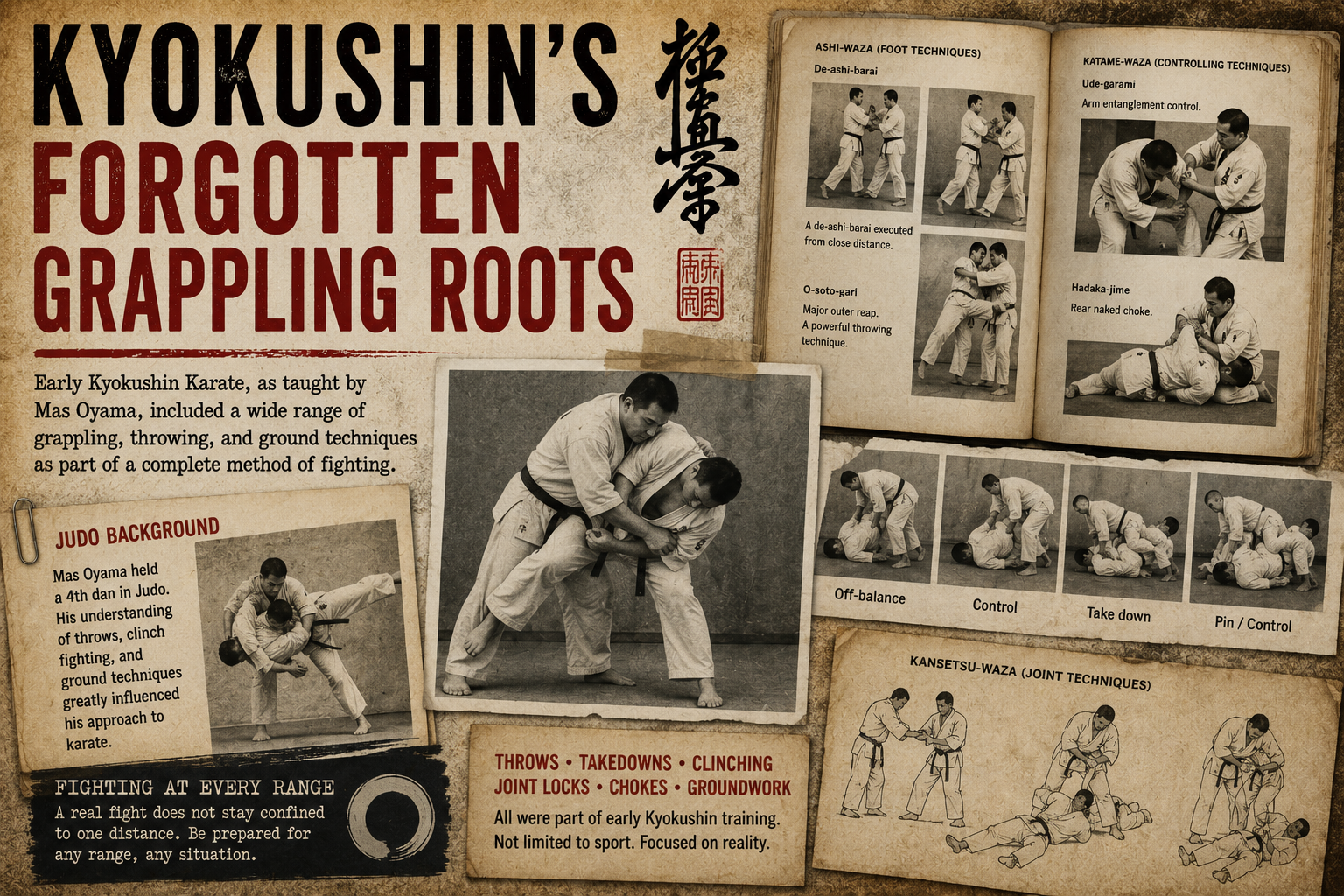
In books such as What is Karate? and Advanced Karate, Oyama included material covering:
- throws
- sweeps
- standing controls
- joint locks
- chokes
- ground work
- escapes and reversals
None of this means Kyokushin was historically a grappling art in the same sense as Judo, wrestling, or modern Brazilian Jiu-jitsu. Striking remained central. But it does clearly demonstrate that throws, clinch work, sweeps, standing controls, and even ground escapes were considered legitimate parts of karate training.
In books such as What is Karate? and Advanced Karate, Oyama included throws, sweeps, standing controls, escapes, and other grappling-oriented material alongside striking techniques and kata applications. Many younger practitioners may simply be unaware of this material because much of Oyama’s original published work has been out of print for decades.
Kosen Judo and the Roots of BJJ
Mas Oyama came from a Judo tradition that included far more groundwork than what is typically seen in modern sport Judo.
Originally, Judo competition allowed extensive ground fighting. Over time, however, Kodokan rules evolved. In 1925, the rules were changed to place greater emphasis on throwing techniques and to restrict the amount of time competitors could spend on the ground.
The reasoning was simple: prolonged groundwork was considered less exciting for spectators.
Some university teams, however, continued competing under Kosen rules. Those rules preserved a more balanced approach between standing techniques and ne-waza (ground fighting).
This matters because many of the techniques people now associate with Brazilian Jiu-jitsu already existed within early Judo.
Judo and Brazilian Jiu-jitsu
Mitsuyo Maeda, who later taught Carlos Gracie in Brazil, was a student of Tsunejiro Tomita, one of Jigoro Kano’s earliest students at the Kodokan. This placed Maeda only one generation removed from Kano himself and exposed him to an older form of Judo that placed far greater emphasis on groundwork than modern sport Judo typically does today.
Carlos Gracie later taught his younger brother Helio Gracie. From those teachings, Gracie Jiu-jitsu — and eventually Brazilian Jiu-jitsu — developed.
I reference BJJ here largely because it is the grappling art most commonly associated with modern MMA.
Historically, however, BJJ evolved from older forms of Judo that placed greater emphasis on groundwork than modern sport Judo typically does today.
Over time, the arts specialized in different directions.
Modern sport Judo evolved toward:
- throws
- stand-up exchanges
- shorter groundwork sequences
BJJ evolved toward:
- submissions
- positional control
- extended ground fighting
In many ways, Kosen Judo represents a more balanced midpoint between the two.
Karate Before Specialization
In the early days of Kyokushin, Mas Oyama’s emphasis was not on creating a sport. His focus was realism.
A real fight does not stay neatly confined to punching and kicking range. People clinch. They throw. They grab. Eventually, someone often ends up on the ground.
Oyama understood that reality. His goal was not to build a narrowly specialized sport system, but a method of fighting that addressed multiple ranges and situations.
Much of this material was not designed around consensual dueling at fighting distance. It addressed grabs, clinches, tackles, pins, weapon attacks, and chaotic close-range situations more commonly associated with self-defense.
When viewed through this lens, many traditional kata movements begin to make more sense as methods of controlling limbs, breaking posture, escaping grabs, off-balancing an opponent, or setting up throws — not merely as isolated blocks and punches against imaginary attackers.
Earlier generations of karateka often encountered Oyama’s books regularly in dojo libraries and personal collections, where throws, sweeps, self-defense applications, groundwork, and grappling exchanges were openly presented as part of karate training.
To be fair, much of modern Kyokushin’s emphasis on striking and knockdown competition is understandable. Time in the dojo is limited, organizational curriculum requirements are extensive, and tournament preparation naturally shapes training priorities. Even instructors who are aware of Oyama’s broader material may not spend much time teaching it regularly.
No curriculum can emphasize every aspect of martial arts equally. Over time, instructors naturally prioritize the material most relevant to their students, organizational requirements, and training goals.
I know I’ve been guilty of that myself at times.
Much of my own teaching over the years has focused primarily on strong fundamentals, hard conditioning, kata, and realistic knockdown training. I have spent far less time teaching some of the more traditional self-defense material I used to cover years ago, including weapons such as bo and tonfa.
That does not mean the training was ineffective. Far from it. Kyokushin’s emphasis on pressure testing, conditioning, timing, distance, and fighting spirit still produces highly capable karateka.
At the same time, revisiting Oyama’s older books makes it clear that some aspects of early Kyokushin simply received greater emphasis in earlier generations of training than they often do today.
That does not mean the older material disappeared.
It simply means priorities changed over time.
Would Mas Oyama Have Succeeded in MMA?
So how would Mas Oyama have performed under modern MMA rules?
Quite well, I believe.
People often imagine Oyama only as a striker because that is how modern Kyokushin is commonly perceived. The historical record, however, paints a much broader picture.
His striking ability alone would have made him dangerous. When combined with his grappling knowledge, throwing ability, conditioning, and understanding of fighting psychology, he would have been a formidable opponent in virtually any era.
Mas Oyama was not pursuing specialization for the sake of sport.
He was pursuing effectiveness.
That pursuit of effectiveness is one of the things that originally made Kyokushin so respected.
“One must try every day to expand one’s limits.” — Mas Oyama
Connect with me:
Follow Kyokushin Karate Blog on Facebook, Instagram, X, and YouTube.
Join the Facebook group — Kyokushinkai Karate — the largest Kyokushin community online.
Learn more about me and Texas Kyokushin Karate, where I continue the Kyokushin tradition in Texas.
